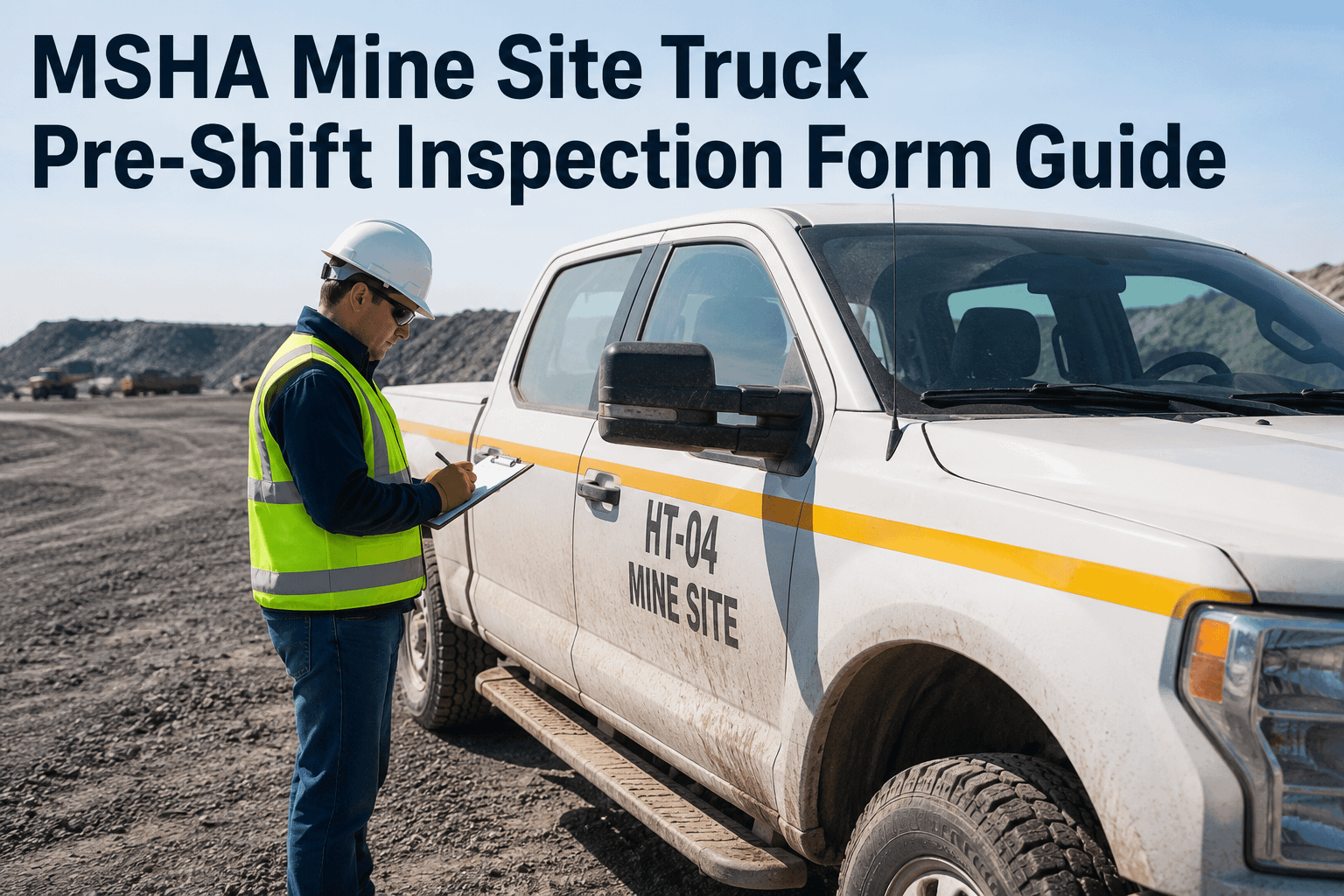
MSHA pre-shift truck inspections operate under a different regulatory framework than FMCSA DVIRs — same vehicles, different rules, separate penalty systems. Mining operations need a pre-shift template that satisfies 30 CFR §56.14100 (surface metal/non-metal), §57.14100 (underground metal/non-metal), §77.1606 (surface coal), or §75.1914 (underground coal) depending on mine type. The template must cover mining-specific items (backup alarms, ROPS/FOPS, fire extinguishers, mining strobes, communications) that standard DOT DVIRs miss, while remaining usable in field conditions with operators wearing gloves, in dust, at altitude, and in extreme weather. Start your free trial of our truck inspection and maintenance software to deploy MSHA-compliant pre-shift workflow — live in 10 minutes, free for up to 3 trucks.
MSHA Mine Site Truck Pre-Shift Inspection Form Guide
Why MSHA Pre-Shift Differs From DOT DVIR
Same vehicles, different rules. Mining operations subject to both MSHA and DOT face inspection requirements that overlap in some areas and diverge in others. Understanding the differences prevents the assumption that DOT DVIR compliance automatically satisfies MSHA pre-shift requirements.
Different Regulatory Authority
Mining-Specific Equipment Items
Powered Haulage Safety Focus
Operator-Conducted Requirement
Per-Shift vs Per-Day
Separate Penalty System
The 14-Section MSHA Pre-Shift Inspection Template
Every MSHA-compliant pre-shift inspection covers these 14 sections. The depth varies by vehicle type and mine application, but the categories don't. Contact our sales team for help deploying MSHA-compliant inspection templates.
01 Fluid Levels
02 Brake Systems
03 Steering
04 Tires & Wheels
05 Lights & Signals
06 Mirrors & Visibility
07 Operator Restraints
08 Backup Alarms
09 Fire Suppression
10 Emergency Equipment
11 Horn & Audible Warnings
12 ROPS/FOPS Structures
13 Communications
14 Specialized Equipment
Common MSHA Citations Related to Pre-Shift Inspection
Five citation categories appear most frequently in MSHA enforcement related to pre-shift inspection failures. Understanding these helps focus inspection discipline on the highest-risk items.
| Citation | Standard | Description | Severity Risk |
|---|---|---|---|
| §56.14100(a) | Pre-shift inspection | Failure to conduct required pre-shift inspection by operator | S&S possible |
| §56.14100(b) | Defect reporting | Failure to report safety/health defects identified during inspection | S&S likely |
| §56.14100(c) | Operating with defects | Operating equipment with known safety defects affecting safety | S&S, possible 104(d) |
| §56.14132 | Backup alarms | Failure to maintain functional automatic warning device | S&S possible |
| §56.14101 | Brake systems | Inadequate brakes on mobile equipment | S&S likely |
| §56.14130 | Seat belts | Failure to wear/maintain functional restraints | S&S possible |
| §56.4200 | Fire extinguishers | Inadequate fire suppression on mobile equipment | Standard citation |
| §56.14107 | Moving parts | Inadequate guards on moving machine parts | S&S possible |
"S&S" indicates a Significant and Substantial finding under MSHA Section 104(d), carrying enhanced penalty exposure and contributing to pattern of violations screening. Section 104(d) findings of unwarrantable failure carry the highest penalty tier. Repeat S&S violations within a 24-month period contribute to POV (Pattern of Violations) screening that can result in heightened MSHA enforcement actions including expanded inspections and increased penalty multipliers. The defense pattern: structured pre-shift inspection with documented findings, immediate defect reporting and correction workflow, and photographic evidence of inspection completion. Operations with disciplined inspection workflow rarely face citations in these categories; operations with paper-based or skipped inspections accumulate citations that compound over time.
PDF Templates vs Digital Workflow
Many mining operations search for MSHA pre-shift inspection PDFs because PDFs feel like the obvious format for compliance documentation. PDFs work — but produce predictable operational friction in actual mine site conditions. Compare the formats honestly:
| Attribute | PDF Template | Digital Workflow |
|---|---|---|
| Cost | Free (download once) | $15-65/vehicle/month typically |
| Mine site usability | Difficult — paper destroyed by dust, weather | Mobile-first, offline capable, durable |
| Glove compatibility | Pen/paper requires bare hands | Large tap targets work with gloves |
| Defect documentation | Text descriptions, no photos | Photo capture with GPS auto-tag |
| Records retrieval | File cabinet search | Search by date/vehicle/operator in seconds |
| MSHA audit response | Days to weeks to assemble | Minutes to export audit packet |
| Defect-to-repair workflow | Manual handoff, often broken | Automatic routing to maintenance |
| Citation defense | Limited — paper records often lost | Photo + GPS + timestamp evidence |
| Compliance baseline | Meets minimum requirements | Exceeds requirements with documentation |
PDF templates satisfy the basic MSHA documentation requirement but produce predictable failure modes in mining conditions: paper destroyed by dust and weather, inspections rushed or skipped because completion is operationally burdensome, defects identified but not documented with sufficient detail for repair workflow, records gaps discovered during MSHA inspections that should have been continuous. Digital workflow costs $15-65 per vehicle monthly but eliminates these failure modes while providing audit defense capability that PDF systems cannot match. The economic calculation: single avoided MSHA S&S citation pays for years of digital platform across the entire fleet. The choice isn't really PDF vs digital — it's whether to absorb the operational friction of PDF or upgrade to workflow that fits actual mining conditions.
2026 MSHA Enforcement Focus Areas
Five MSHA enforcement priorities affect pre-shift inspection compliance in 2026. Operations that align inspection workflow with these focus areas reduce citation exposure substantially.
Powered Haulage Safety
Surface Mine Fatalities Reduction
Pattern of Violations (POV) Screening
Increased Penalty Amounts
Inspector Training Modernization
Frequently Asked Questions
What's the difference between MSHA pre-shift and DOT DVIR?
The differences are substantial despite covering the same vehicles. DOT/FMCSA DVIR requirements under 49 CFR §396.11 apply to commercial motor vehicles operating on public roads — pre-trip inspection per day with chain of custody between drivers if multiple drivers operate the vehicle. MSHA pre-shift inspection under 30 CFR §56.14100 (or §57.14100, §75.1914, §77.1606 depending on mine type) applies to mine site mobile equipment — required inspection by each operator before each shift. Key practical differences: timing (per-day DOT vs per-shift MSHA), inspector (any qualified DOT vs equipment operator MSHA), items covered (DOT focuses on highway safety, MSHA includes mining-specific items like backup alarms, ROPS/FOPS, mining strobes, communications), penalty system (separate enforcement and penalty structures), records (3-month minimum DOT vs MSHA per-shift documentation), and audit triggers (DOT compliance reviews vs MSHA quarterly inspections and complaint-based investigations). Operations crossing between public roads and mine sites must satisfy both frameworks for those operations. The practical implication: a DOT-compliant DVIR doesn't automatically satisfy MSHA pre-shift requirements — different items, different timing, different documentation. Start your free trial for MSHA-specific workflow.
Can I just use a PDF template for MSHA pre-shift inspections?
Yes, PDF templates technically satisfy MSHA documentation requirements, but they produce predictable operational problems in actual mine site conditions. The compliance baseline: MSHA requires pre-shift inspection by the equipment operator, defect reporting, and records maintained — none of which specifically requires digital workflow. PDF templates printed and completed daily by operators meet these basic requirements. The practical problems with PDF templates: paper documents are destroyed by dust, weather, and rough handling common in mining environments; operators cannot complete paper forms efficiently while wearing PPE (gloves, eye protection); defect documentation is limited to text descriptions without photographic evidence; records retrieval during MSHA inspections requires manual file searching that often reveals gaps; defect-to-repair workflow handoff is manual and frequently broken; citation defense relies on paper records that may be incomplete or illegible. Digital workflow ($15-65/vehicle/month typical) eliminates these problems while providing additional capabilities: photo defect capture with GPS auto-tag, offline operation in dead zones, automatic routing of defects to maintenance, instant audit packet export, and structured retention discipline. The economic comparison: single avoided MSHA S&S citation typically pays for years of digital platform. PDF works for very small operations or initial compliance entry; serious mining operations benefit from digital workflow. Contact our sales team for digital workflow comparison.
What happens during an MSHA inspection?
MSHA inspections follow predictable patterns based on inspection type. Regular inspections: MSHA mandates four complete inspections per surface mine annually and six complete inspections per underground mine annually. Inspectors arrive unannounced, walk the operation, observe equipment in use, interview workers, and review records. Spot inspections: triggered by incidents, complaints, or focus area enforcement. May target specific equipment categories or operational practices. Equipment inspection process: MSHA inspector requests pre-shift inspection records for selected vehicles and dates, observes equipment for compliance with standards, may operate equipment to verify functions (brakes, alarms, lights), interviews equipment operators about inspection practices, identifies defects through inspector observation that may not have been caught in pre-shift inspection. Citation issuance: violations identified during inspection result in citations under appropriate 30 CFR sections; significant and substantial findings under Section 104(d) carry enhanced penalty exposure; unwarrantable failure findings indicate aggravated conduct beyond ordinary negligence; individual citations under Section 110(c) can hold specific persons responsible. Defense approach: structured digital pre-shift inspection records produce instant documentation of compliance; photo evidence of completed inspections defends against "failure to inspect" citations; defect-to-repair workflow documentation shows safety culture and immediate correction patterns. Operations with disciplined pre-shift inspection workflow consistently produce better MSHA inspection outcomes than those operating on paper or skipped processes. Sign up free for MSHA-ready inspection workflow.
How long should MSHA pre-shift inspections take?
MSHA doesn't specify minimum inspection time, but realistic and effective pre-shift inspections take 8-15 minutes per vehicle depending on complexity. The 14-section template completed properly requires meaningful operator attention to each item rather than checking boxes quickly. Realistic time allocations: fluid checks 1-2 minutes (visual inspection of multiple reservoirs); brake function test 1-2 minutes (service and parking brake); steering and tires 1-2 minutes (walk-around visual); lights and signals 1-2 minutes (operator activation test); mirrors, restraints, and safety equipment 2-3 minutes (visual + function); specialized equipment varies by vehicle type 2-5 minutes (water trucks vs simple light vehicles). Total: 10-15 minutes typical for service trucks (water, fuel, lube), 8-10 minutes for light vehicles, 15-25 minutes for complex specialized equipment. The discipline problem: operations under route schedule pressure produce inspections completed in 2-3 minutes that miss most actual safety issues. MSHA inspectors recognize rushed pre-shift inspections and may interview operators about specific items not realistically inspected in the time logged. Digital workflow with photo capture and GPS timestamps documents actual inspection time, defending against allegations of rushed or skipped inspections. Operational consideration: building pre-shift inspection time into shift schedules rather than expecting operators to "find time" produces both better safety outcomes and stronger MSHA compliance posture. Contact our sales team for shift-integrated inspection workflow.
Are mine site trucks subject to both DOT and MSHA?
Yes — vehicles operating both on public roads and on mine sites fall under both regulatory authorities, each applicable to operations in their respective domain. DOT/FMCSA applies to: operation on public roads, interstate commerce, vehicles above 10,001 lbs GVWR in commercial use, CDL operations. MSHA applies to: operation on mine site property, mine-site mobile equipment regardless of weight, all operators on mine property regardless of CDL status. Common scenarios: a fuel truck driving from a fuel depot to a mine site falls under DOT during highway travel and under MSHA during mine site operations; a water truck operating exclusively within mine boundaries falls under MSHA only; a mining service contractor operating across multiple mine sites falls under DOT during transit and MSHA at each mine site. Compliance implications: operators must satisfy both pre-shift requirements (DOT DVIR for highway operations + MSHA pre-shift for mine operations); records must be maintained under both frameworks (DOT 3-month minimum, MSHA per-shift documentation); inspectors from both agencies may conduct enforcement based on their jurisdictional authority. Practical recommendation: software platforms supporting mining operations should handle both DOT DVIR and MSHA pre-shift workflows on integrated platforms, avoiding the data fragmentation that occurs when separate systems handle each requirement. The 2026 eDVIR Final Rule (March 23, 2026) authorizes electronic DVIRs for DOT compliance — MSHA records can also be maintained digitally, though MSHA doesn't have an equivalent explicit Final Rule.
What are the penalties for MSHA pre-shift inspection violations?
MSHA penalties vary by violation type and severity finding. Standard 104(a) citations: civil penalties calculated using formula considering operator size, negligence, gravity, and other factors. Range typically several hundred to several thousand dollars per citation depending on circumstances. Significant and Substantial (S&S) findings under Section 104(d): enhanced penalty exposure for violations reasonably likely to contribute to safety/health hazards; commonly produce penalties of $2,000-$10,000+ per citation. Unwarrantable failure findings: indicate aggravated conduct beyond ordinary negligence; trigger 104(d) sequence with increased penalty exposure and potential closure orders. Pattern of Violations (POV) designation: triggered by repeated S&S violations within 24-month window; results in expanded inspections, increased penalty multipliers, and heightened MSHA scrutiny for years. Individual citations under Section 110(c): can hold specific persons responsible for violations; personal penalty exposure for managers and supervisors. Closure orders under Section 107(a): for imminent danger situations; halt operations until conditions corrected. The 2026 penalty environment: MSHA civil penalty amounts increase annually based on inflation adjustments; 2026 penalty maximums substantially exceed historical levels. Beyond civil penalties: criminal referrals possible for willful violations causing death; civil litigation exposure following fatalities or serious injuries; insurance premium increases following enforcement history; loss of contracts when mining operations require safety performance metrics. Single serious MSHA citation can produce costs exceeding $50,000-$500,000 when accounting for penalties, remediation, legal costs, and operational consequences. Structured pre-shift inspection workflow is the single most effective defense against these consequences.