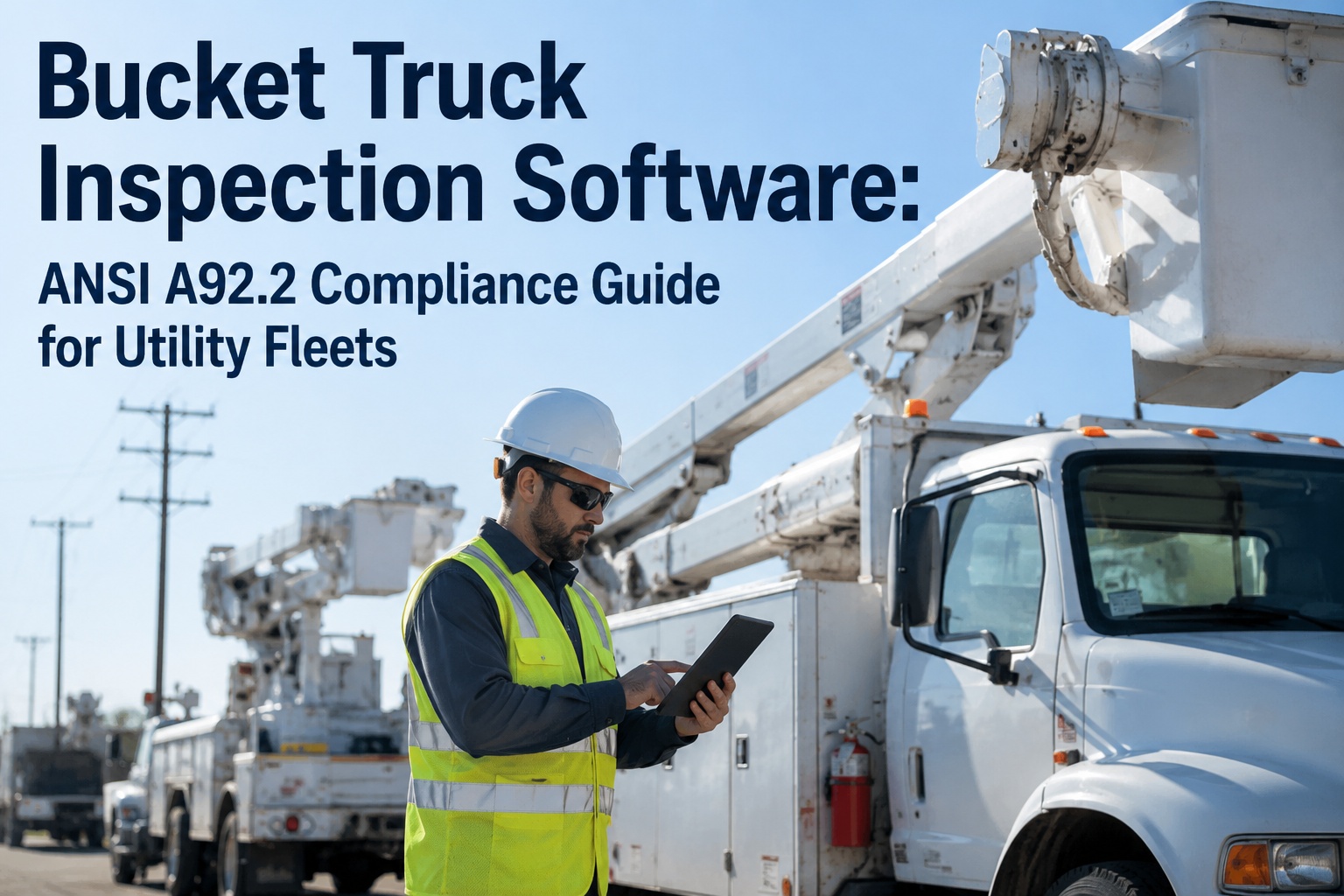
A bucket truck is the rare vehicle where a missed inspection can kill someone two ways — a boom failure that drops a worker, or a dielectric breakdown that puts thousands of volts through the operator. That's why ANSI A92.2 doesn't ask for one annual check; it requires a layered cadence of five inspections, plus annual dielectric testing on every insulated component, all of it the owner's legal responsibility. And because A92.2 is incorporated by reference into OSHA, those requirements aren't "voluntary" — they're enforceable by a compliance officer, with the consensus standard serving as the civil-liability standard of care. Running that on paper across a utility fleet is how dates slip and units stay in service past their interval. This guide breaks down the A92.2 inspection cadence, dielectric testing rules, and what the best bucket truck inspection software must do to keep your aerial fleet compliant and audit-ready. Run compliant aerial inspections free.
Bucket Truck Inspection Software: ANSI A92.2 Compliance Guide for Utility Fleets
Streamline boom inspections, dielectric testing, daily DVIRs, maintenance tracking, and audit-ready reporting — so every insulated aerial device meets ANSI A92.2 and OSHA, every time.
Why Bucket Trucks Demand More Than a DVIR
A standard truck fails mechanically. An insulated aerial device can fail mechanically and electrically — and either failure is potentially fatal. That doubles the inspection burden and raises the stakes on every missed interval. Three risks define why A92.2 is so demanding.
Boom, outriggers, and hydraulics hold a worker dozens of feet up. A cracked weld or failed cylinder is a fall hazard, not a breakdown.
Insulated booms protect operators working near energized lines. If the FRP insulation degrades, thousands of volts can reach the operator.
A92.2 is incorporated into OSHA and is the civil-liability standard of care — so a lapse is both an enforceable violation and courtroom exposure.
The Five A92.2 Inspections
A92.2 (2021) defines five distinct inspections, each at its own interval and rigor. The owner is responsible for four of the five — only the initial factory inspection isn't. Miss any interval and the unit must come out of service until it's done.
Never Miss an Interval Across the Fleet
Truck Inspection & Maintenance tracks daily, 150-hour, annual, and 15-year intervals per unit, fires advance alerts, and locks out any aerial device that's overdue — before it leaves the yard.
Dielectric Testing: The Test That Saves Lives
For insulated bucket trucks, the dielectric (hi-pot) test is the one that prevents electrocution. It verifies the insulating strength of the fiberglass components that stand between the operator and an energized line — and it must be done annually, by a qualified person, with results documented.
FRP upper and lower booms, the bucket, liners, FRP extensions on digger derricks, tool circuits, and the upper control system.
Annually within 12 months — and again after any repair or replacement of insulating components like hoses or leveling rods.
Comparing leakage current year over year reveals insulation slowly degrading — a rising trend flags trouble before failure.
Insulating liners must be tested annually; a gouge or cut that thins the material can fail the test and void protection.
What the Best Inspection Software Must Do
Generic fleet apps track mileage and oil changes — they don't understand a 150-hour periodic or a dielectric expiry. Use this as your evaluation core; these are the capabilities a utility aerial fleet actually needs.
Pre-built daily, periodic, and annual checklists matching the standard — so nothing on the aerial device gets skipped.
Daily, 3-month/150-hour, 13-month, and 15-year clocks per unit — with engine-hour triggers, not just calendar dates.
Store results, due dates, and year-over-year leakage trends, with alerts well before the 12-month window closes.
Operators run the pre-use inspection from a phone, with photo evidence and defect attribution — one per shift, logged.
A failed item flags the unit out of service and links to the repair, so it can't return until the malfunction is fixed.
Every inspection, test, and repair timestamped and exportable — for OSHA, insurers, and the standard of care.
Building an Audit-Proof Record
Because A92.2 is the standard of care, your documentation is your defense — in an audit and in court. Close these four and a compliance review or an incident investigation finds a complete, defensible trail.
Daily, periodic, annual, and structural inspections on record per unit, with dates proving each was on time.
Annual test results retained with leakage trends and post-repair re-tests — proof the unit stayed insulating.
Evidence that periodic, annual, and dielectric work was done by qualified personnel, as the standard requires.
For every finding, the documented repair before return to service — the record that closes the liability loop.
Frequently Asked Questions
A92.2 requires a layered cadence: a daily (frequent) pre-use inspection before first use each shift, a periodic inspection every 3 months or 150 operating hours whichever comes first, an annual inspection no later than 13 months from the last, and a major structural inspection once a unit reaches 15 years in service. A post-incident inspection is also required after any overload, tip-over, or electrical contact. The owner is responsible for all of these except the initial factory inspection. Start a free trial to track every interval.
While ANSI standards are technically "voluntary recommended practices," A92.2 is incorporated by reference into the OSHA standard, which makes the incorporated portions enforceable by OSHA compliance officers. It also serves as the civil-liability standard of care, meaning a court will measure your practices against it after an incident. In practical terms, A92.2 compliance is mandatory — and documentation is what proves it.
Dielectric (or hi-pot) testing verifies the electrical insulating strength of an aerial device's fiberglass components — the upper and lower booms, bucket, liners, FRP extensions, tool circuits, and upper controls. It's required annually within 12 months, and again after any repair or replacement of insulating components. If no test occurs within a 12-month period, the equipment can no longer be considered insulating. Tracking leakage current year over year also reveals gradual insulation degradation before it fails.
Daily pre-use inspections are done by trained operators. Periodic, annual, and dielectric inspections must be performed by a qualified person — someone who, through technical degree, certificate, professional standing, or demonstrated knowledge, training, and experience, can deal with the specific aerial device and its problems. Dielectric testing in particular must follow ANSI A92.2 and manufacturer procedures. Owners must retain proof of inspector qualifications. Contact our team about qualification records.
It replaces the calendar-and-binder system that lets intervals slip. Truck Inspection & Maintenance provides A92.2 inspection templates, tracks daily, 150-hour, annual, and 15-year intervals per unit with advance alerts, stores dielectric results and leakage trends, runs mobile pre-use DVIRs with photo evidence, locks out units with open defects, and keeps every record timestamped and exportable for audits — turning a high-stakes manual process into a system that can't quietly fall out of compliance.
Keep Every Aerial Device Compliant and Audit-Ready
Truck Inspection & Maintenance runs A92.2 daily, periodic, annual, and structural inspections, tracks dielectric testing with leakage trends and expiry alerts, locks out overdue or defective units, and keeps a complete, exportable record — so your utility fleet protects its operators and clears every OSHA audit.