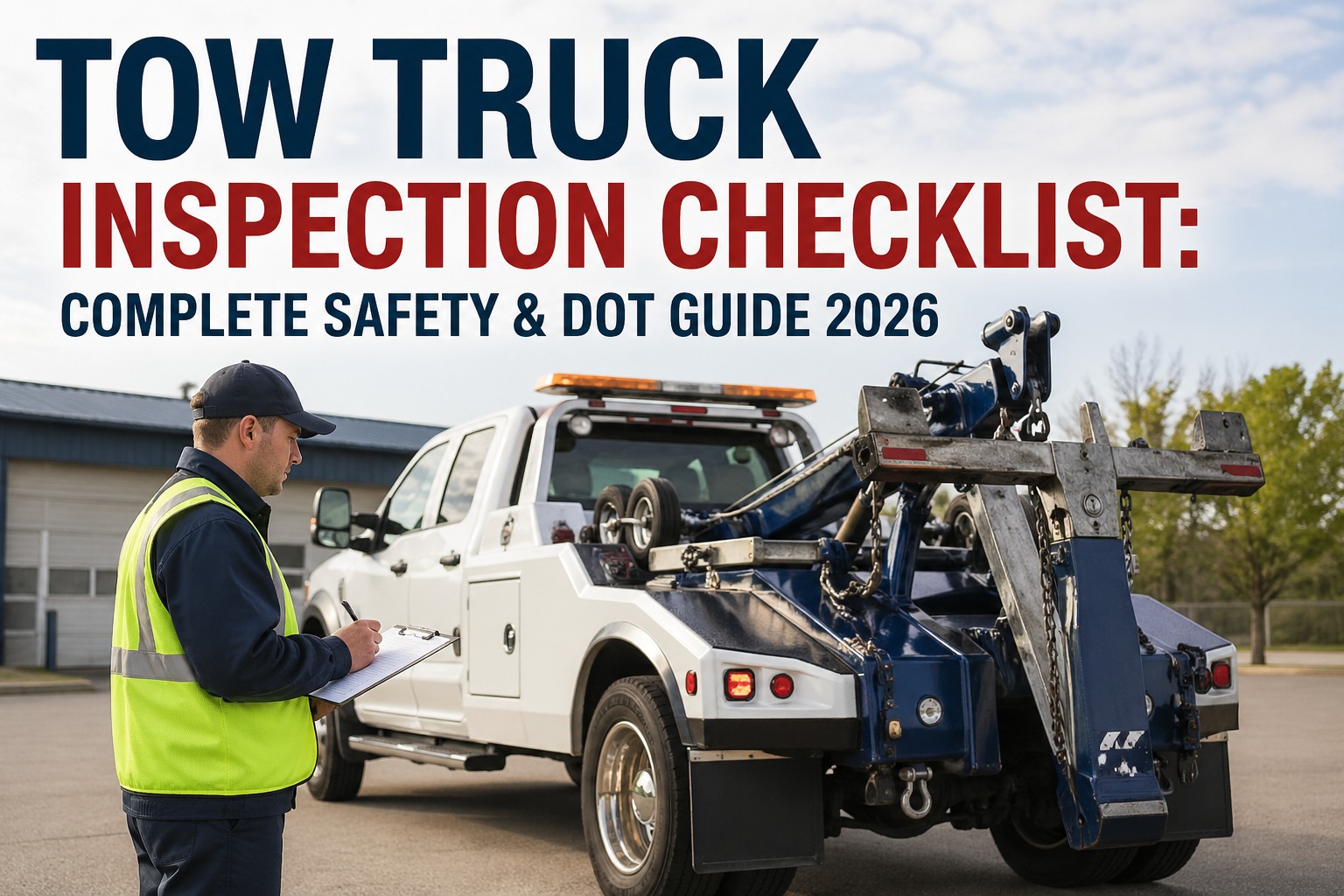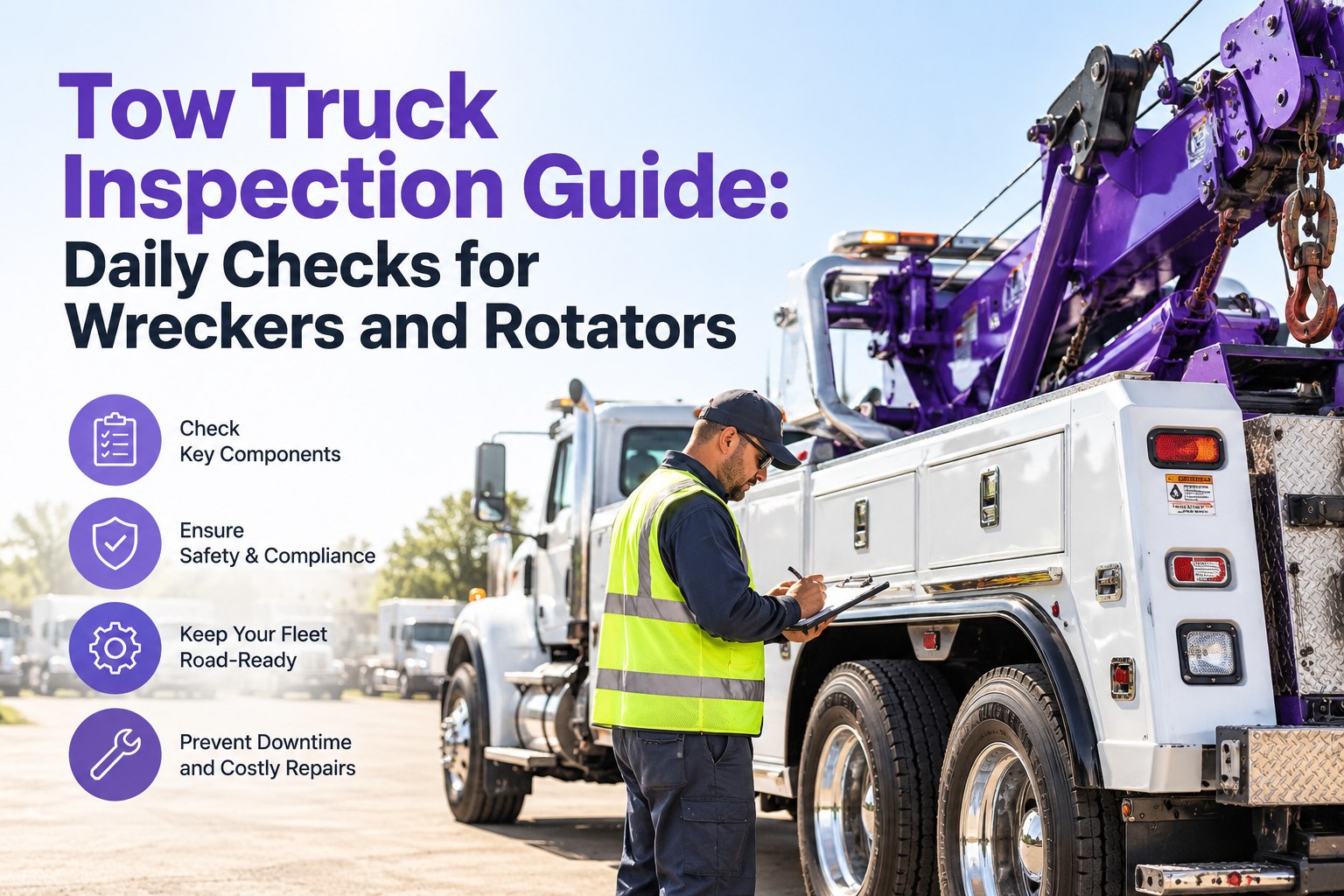
"Tow truck" isn't one machine — it's three rigs, each with a failure point the others don't have. A wrecker lives on its boom, winch, and wheel-lift; a rotator adds a slewing crane, outriggers, and rigging that can drop a bus if a pin lets go; a flatbed carrier rides on the tilt-and-slide hydraulics holding a car above the shoulder. This guide splits the daily inspection by rig type, so an operator checks what matters on the truck they're driving — plus the safety base every tow vehicle shares. And since a completed daily check is a DVIR, Truck Inspection & Maintenance Management Software (TIM) turns each one into a dated, photo-backed, routed record. Start free and run your tow inspection on any phone.
Three Tow Rigs, Three Failure Points. Inspect the One You're Actually Driving.
You want a pre-shift built around your rig — the boom on a wrecker, the outriggers on a rotator, the bed hydraulics on a carrier — not a one-size checklist that misses the part that matters. This guide splits the daily by equipment class and flags the shared safety line every tow truck crosses. TIM makes it stick: run it on a phone, photograph a frayed cable or a drifting bed, and it opens a work order. Every defect gets a first response within 4 hours — acknowledged, graded, and assigned.
Start With the Shared Base — Every Tow Truck, Every Shift
Before the rig-specific gear, every tow vehicle is still a commercial truck working the most dangerous environment in trucking — active shoulders and accident scenes. This base layer applies to all three, and it's where a DVIR starts.
Oil, coolant, hydraulic, DEF; belts, hoses, and leaks at the PTO.
Tread and pressure all positions; air build-up, parking brake holds; steering play in spec.
Amber beacons/strobes firing; head, tail, brake, marker; towed-vehicle light kit.
Reflective attire, cones/triangles, fire extinguisher, wheel chocks.
Wrecker — Boom, Winch & Wheel-Lift
The light-to-medium wrecker earns its keep on the boom and winch. The quiet catches here are the ones that fail under recovery load: a rust-streaked pivot pin, a fishhook in the cable, a wheel-lift lock that won't seat.
Sections, welds, and pivot pins — rust streaking at a pin means it may be seized and could break under load.
Run the full length through gloved hands: more than 3 broken strands in one lay length = replace now.
L-arm locks and slides operate freely; tie-down straps/chains at correct WLL; no bent inner tubes.
Cycle every function full range — smooth, no odd noise; rams, hoses, valves, and sheaves leak-free.
Rotator — Crane, Outriggers & Rigging
The heavy rotator is a mobile crane, and its inspection is the most demanding of the three. Slewing gear, outrigger stability, and multi-line rigging carry loads that can kill if a component lets go — walk them with a crane operator's discipline.
Extending boom sections, welds, and the slewing/rotation gear — no cracks, play, or grease starvation.
Beams, cylinders, and float pads — full deploy, no drift under load, no hydraulic weep at the rams.
Wire ropes, snatch blocks, sheaves, shackles, and hooks; safety latches intact, no distortion.
Load chart present and legible; controls labeled; overload/two-block protection functional.
Flatbed Carrier — Bed, Slide & Tilt Hydraulics
The rollback carrier's whole job is holding a vehicle above the road on hydraulics. When cylinder seals wear, the bed creeps — and a car sliding off on a shoulder is catastrophic. The bed-drift test is non-negotiable.
Tilt to working angle and hold 30 seconds — any downward movement means seal failure. Do not operate until repaired.
Cylinder ends and hinge pins for rust streaking; smooth slide/tilt with no jerk or noise.
Bed safety lock engages; carrier deck and frame for cracks and rust streaks; slide pads intact.
Wheel straps, chains, and the loading winch cable sound and rated; no fraying or burnt synthetics.
The Rust-Streak Rule — the Catch That Applies to All Three
One habit separates a careful tow operator from a checklist-ticker across every rig type: investigating streaks instead of wiping them. On a tow truck, the quiet signals are where the failures start.
A shiny halo or rust weep around a mounting or body bolt signals a loose bolt working itself out.
Streaking at a pivot or hinge pin often means a seized pin that can break under recovery or transport load.
A hydraulic hose or air line left unsecured will tear off on a load — secure it before it becomes a leak.
Broken strands slice gloves; order a replacement at the first fray, not after it snaps on a call.
One Checklist Per Rig Type — Not a Binder That Fits None of Them
TIM assigns the right inspection to each unit — wrecker, rotator, or carrier — so the operator sees only what applies to the truck they're driving, on any phone. A frayed cable, a drifting bed, or a rust-streaked pin gets photographed on the spot, opens a work order, and holds the unit out of dispatch until it's certified. The whole record lands in a searchable archive an auditor can pull in seconds.
Frequently Asked Questions
Inspect the Rig You're Driving — and Prove You Did
A shared base, a rig-specific layer for each of the three tow types, and the rust-streak habit that catches failures early. Run the daily on a phone, photograph the defect, block dispatch until it's fixed, and keep a record that stands up at an audit or a claim.