Most drivers check the coupling the same way they learned it years ago — glance at the gap, do a tug test, hook up the lines, go. The sequence matters more than the speed: checking the glad hands before confirming the jaws are actually locked means a driver could be pressurizing air lines on a coupling that isn't secure yet. The order a qualified inspector follows isn't arbitrary — it's built so each step confirms the one before it. Start free and guide every driver through the coupling sequence in the right order.
Fifth Wheel · Kingpin · Safety Latch · Glad Hands
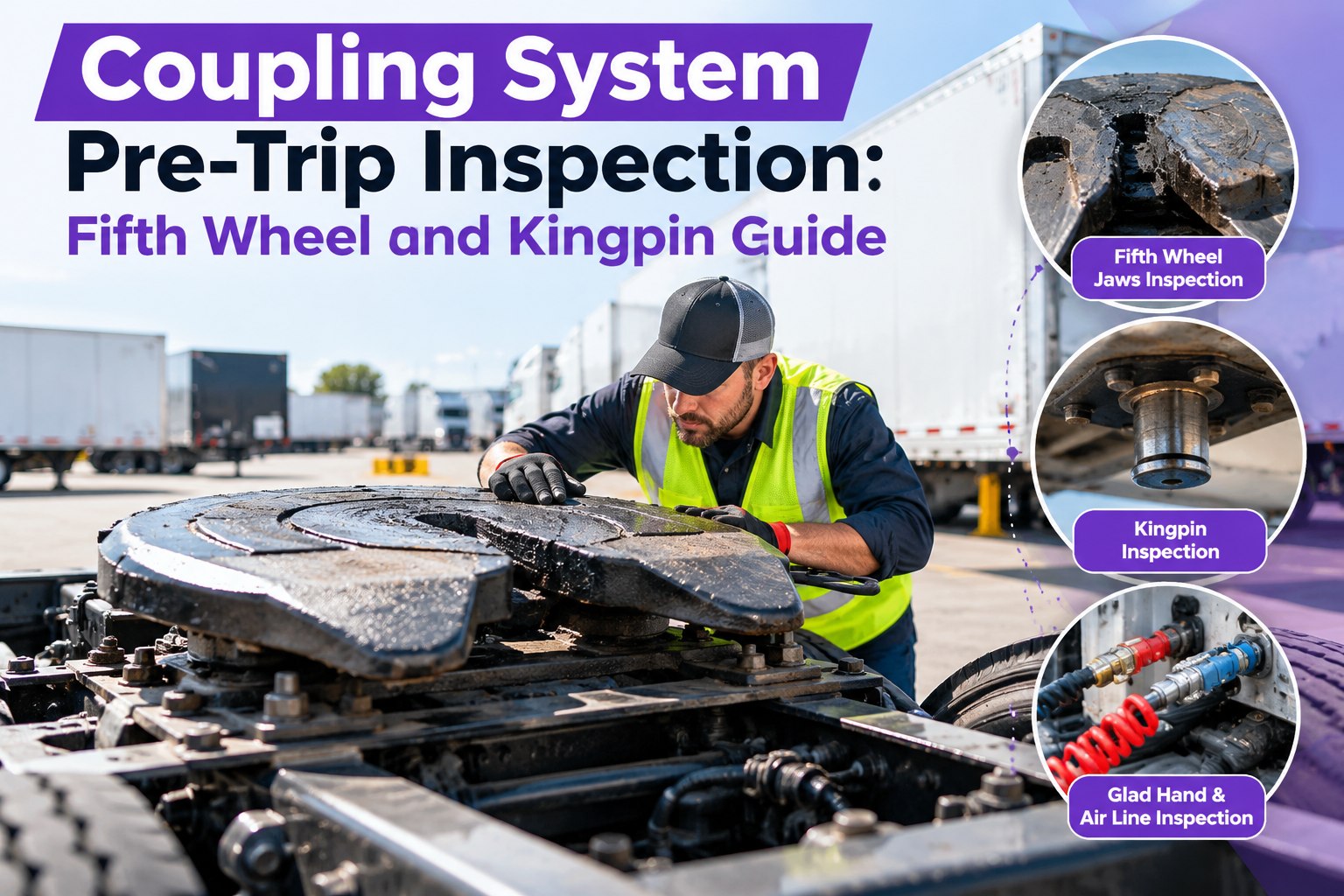
Coupling System Pre-Trip Inspection: Fifth Wheel and Kingpin Guide
A tug test done before the safety latch is confirmed, or air lines connected before the jaws are checked, can give a driver false confidence in a coupling that isn't actually secure. Truck Inspection & Maintenance Management Software walks drivers through the coupling sequence in the correct order on their phone, and guarantees any defect it catches is acknowledged, graded, and assigned to a technician within 4 hours.
8 Stepsin the order a qualified inspector follows
Guidedon the driver's phone, step can't be skipped
4-Hrguaranteed defect acknowledgment & assignment
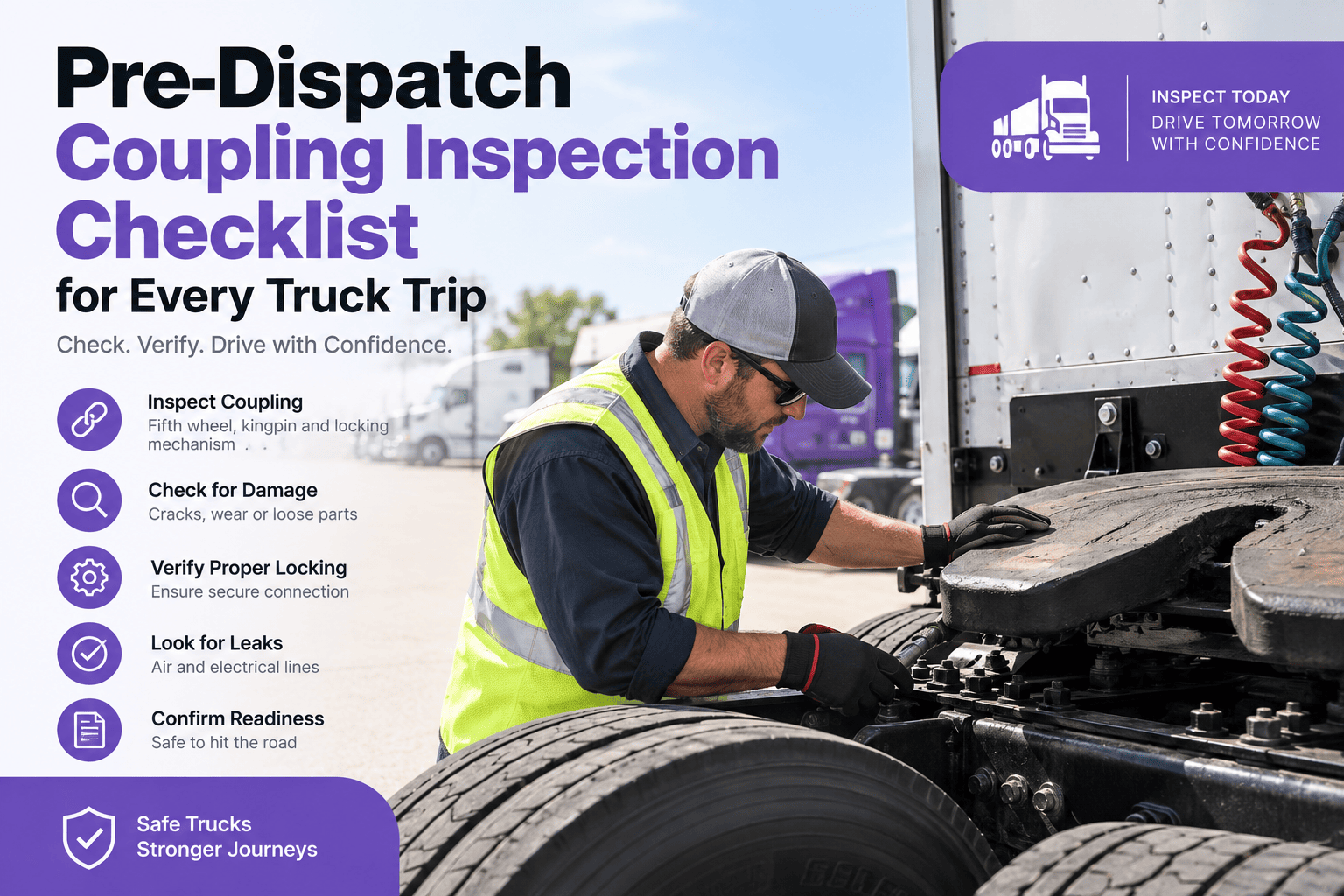
The Coupling Sequence, Step by Step
1
Back under & feel the biteBack the fifth wheel under the trailer slowly, feeling for the jaws engaging — don't pull forward yet.
2
Check the release handleConfirm it's fully in the locked position with no play — a handle that moves freely hasn't engaged.
3
Inspect jaw closure visuallyGet down and look — the locking jaws should be fully closed around the kingpin with no visible gap.
4
Confirm the safety latchThe secondary lock must be engaged over the release arm — this is the backup if the primary lock is ever disturbed.
5
Check kingpin-to-apron contactNo visible air gap between the trailer's kingpin apron and the fifth wheel plate — a gap here means the coupling isn't fully seated.
6
Connect & inspect glad handsSeated fully, no visible wear on the seals, and checked for leaks once air is applied — only after the mechanical lock is confirmed.
7
Route & secure the electrical line7-way plug fully seated, cable routed with enough slack for turns but not dragging on the ground or fifth wheel.
8
Pull forward — the tug test, lastOnly now does the tug test serve its purpose: confirming a coupling you've already visually verified, not substituting for that verification.
Why the Order Changes What the Check Actually Proves
The mistake that defeats the whole check Doing the tug test first and treating it as the entire inspection skips every visual confirmation that tells you why the coupling held. A kingpin seated on worn jaws, or a fifth wheel that was already closed before backing under, can both pass a tug test and still be a defect waiting to show up later in the trip. The visual steps exist precisely because a tug test alone can't catch them.
Mistakes That Show Up Most Often at Roadside
Skipping the Apron CheckAn air gap at the kingpin apron is easy to miss from a standing position — it requires actually getting down to look
Connecting Air Before the LatchPressurizing glad hands before confirming the safety latch risks masking a coupling problem with a pressurized system
Treating the Tug Test as SufficientA passed tug test confirms the jaws held at that moment — it doesn't confirm the kingpin or latch are actually in spec
Rushed Visual ConfirmationA quick glance from standing height misses a partially-closed jaw that's obvious from a kneeling position
The Right Sequence, Every Time, On Every Phone
Our Truck Inspection & Maintenance Management Software guides drivers through all 8 coupling steps in order, won't let a driver skip ahead to the tug test, and guarantees any logged defect is acknowledged, graded, and assigned to a technician within 4 hours.
Frequently Asked Questions
Should the tug test be done before or after the visual coupling checks?
After. The tug test is a confirmation step, not a substitute for the visual checks — it verifies that a coupling already inspected for jaw closure, latch engagement, and apron contact is actually holding under load. Done first and treated as the whole check, it can give false confidence in a coupling with an underlying defect.
Start free and enforce the correct step order automatically.
Why does the air gap at the kingpin apron matter so much?
A visible gap between the trailer's apron and the fifth wheel plate means the coupling isn't fully seated, even if the jaws appear closed — it's one of the clearest visual signs that something in the coupling process didn't complete correctly, and it's easy to miss without deliberately looking for it.
Is the safety latch really necessary if the primary lock already engaged?
Yes — the safety latch is a backup specifically for the scenario where the primary lock is somehow disturbed after coupling, whether from vibration, wear, or a partial release. Skipping its confirmation removes the one safeguard designed for exactly that failure mode.
Should glad hands be checked before or after confirming the mechanical coupling?
8 Steps · Correct Order · Every Coupling, Every Time
Stop Letting a Tug Test Carry the Whole Inspection
Our Truck Inspection & Maintenance Management Software guides every driver through the fifth-wheel and kingpin coupling check in the order that actually proves it's secure, and guarantees any defect it finds is acknowledged, graded, and assigned within 4 hours.
No credit card required. Free for up to 3 trucks.