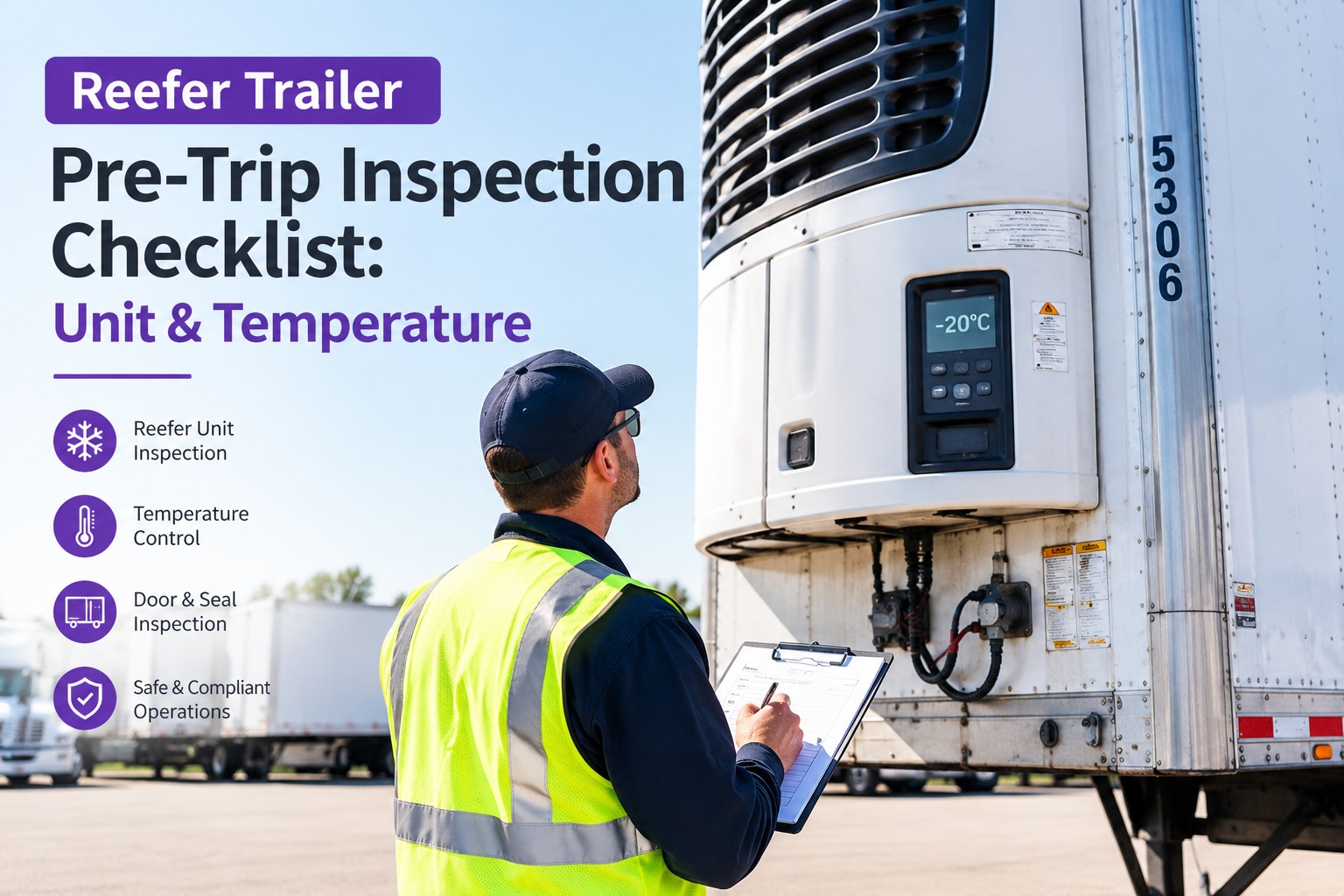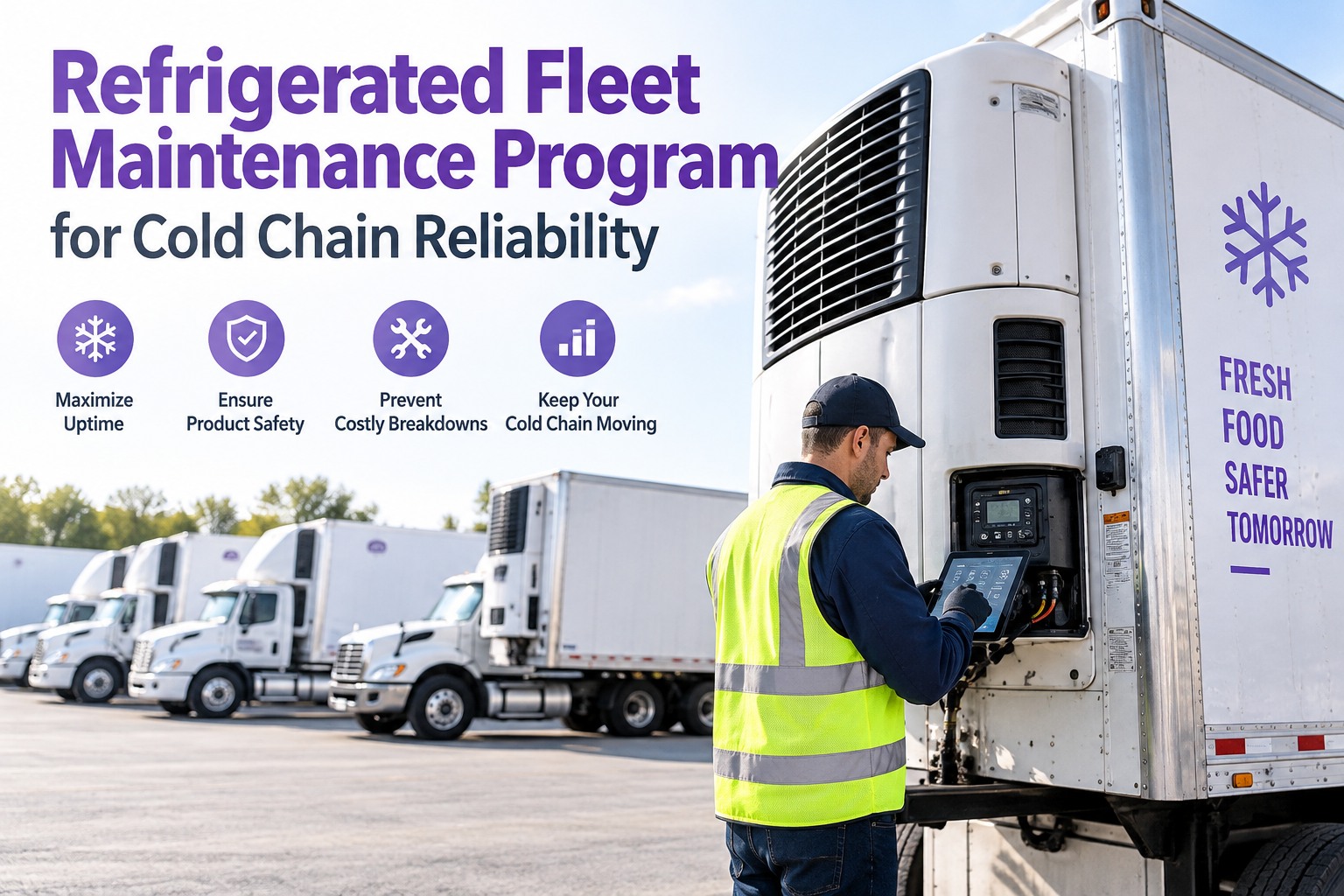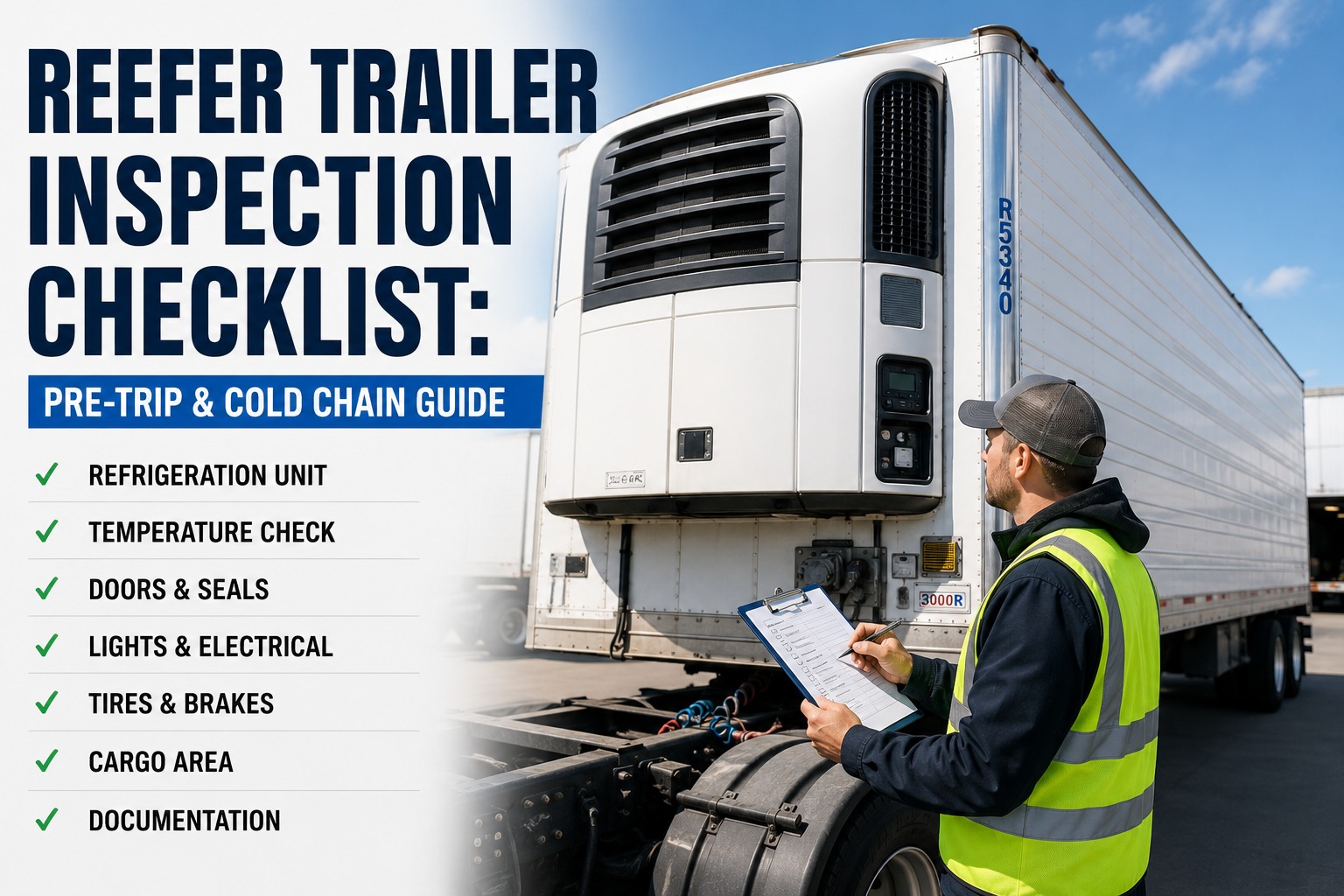
A reefer trailer inspection is not a standard trailer inspection with a temperature check tacked on the end — it is a fundamentally different discipline. A dry-van driver who misses a defect creates a maintenance issue; a reefer driver who misses a defect can lose a $75,000 load of pharmaceuticals or trigger an FDA FSMA violation. The refrigeration unit itself is a diesel engine running 1,800+ hours a year at the loading dock and on the road, wearing at the pace of a car driven 100,000 miles annually — but with its own fuel tank, its own belts, its own coolant, its own alarms, and its own maintenance schedule completely separate from the tractor. Layered on top of that are the trailer body itself (insulation, seals, drains, chutes, floor), the temperature monitoring system (return air probe, discharge air probe, data logger, alarms), the cargo (pulp temperature verified with a calibrated thermometer before loading), and the documentation trail that FDA FSMA 21 CFR 1.908 requires for every food-grade load. The cost of skipping the reefer-specific checks is enormous. A load rejection for temperature abuse can exceed $100,000. An FSMA violation attaches to the carrier, not just the driver, with EPA refrigerant handling penalties reaching $44,539 per day per violation. Meanwhile, most temperature excursions trace back to the same handful of causes: door seal gaps, blocked air chutes, weak reefer batteries in Cycle-Sentry mode, uncalibrated probes, or a trailer that was never properly pre-cooled before loading. This guide walks through the complete pre-trip inspection sequence in five stages, provides the definitive checklists for each stage, explains Continuous Run vs Cycle-Sentry mode selection, references temperature setpoints by cargo type, covers the top failure modes to catch during inspection, and shows how Truck Inspection & Maintenance generates FSMA-ready electronic inspection records automatically from the driver's phone — free forever for up to 3 vehicles.
Reefer Trailer Inspection Checklist: Complete Pre-Trip & Cold-Chain Guide
Five-stage inspection sequence, temperature setpoints by cargo, and the FSMA-ready electronic checklist that protects every load.
Why Reefer Inspections Are Different
Three fundamentals separate a reefer inspection from a standard trailer inspection. Understanding them shapes every checkbox on the pre-trip:
Two Engines to Inspect
The tractor has an engine. The reefer trailer has its own diesel engine (Thermo King, Carrier Transicold, or similar). That reefer engine has its own fuel tank, its own oil, its own coolant, its own belts, its own air filter, and its own maintenance schedule tracked in operating hours — not miles. A reefer engine can run 18+ hours a day at a stationary loading dock and accumulate wear like a car being driven 100,000 miles a year.
FSMA Regulatory Weight
The FDA Food Safety Modernization Act Sanitary Transportation rule (21 CFR 1.908) requires documented pre-trip inspection, verifiable sanitary conditions, calibrated temperature monitoring, and 12 months of record retention. A load rejection for "temperature abuse" is almost impossible to defend without a clean, time-stamped inspection record proving the unit was verified functional before departure.
Cargo Value Multiplier
A single pharmaceutical reefer load can carry $500,000+ in temperature-controlled product. Even a routine produce load runs $50,000–$75,000. Missing a bad door seal or a weak reefer battery isn't a maintenance oversight — it's a claim-triggering event. The inspection is loss prevention.
The 5-Stage Pre-Trip Inspection Sequence
Every reefer pre-trip follows the same five stages, in this exact order. Skipping a stage or performing them out of sequence creates gaps that cost loads:
Reefer Unit Startup & Diagnostic
Start the reefer unit cold, listen for abnormal noises, and run the automated pre-trip diagnostic sequence built into every Thermo King and Carrier controller. The unit tests itself — sensors, alarms, defrost cycle, compressor, and heat/cool changeover — in about 20 minutes. Any alarm code stops the trip.
Structural & Sanitation Walk-Around
Walk the trailer exterior and interior looking for anything that compromises the box — cracked panels, punctured skin, damaged door seals, blocked drains, torn air chutes, sanitation issues. Under FSMA, clean floors and clear drains are required, not optional. A washout ticket may be required by the shipper.
Setpoint Configuration & Pre-Cool
Set the controller to the shipper's specified temperature setpoint and operating mode (Continuous Run vs Cycle-Sentry). Pre-cool the empty trailer to that setpoint before loading begins. Verify return air and discharge air probes both read within 2°F of setpoint before opening doors to load.
Cargo Load Verification
Verify pulp temperature of representative pallets with a calibrated probe thermometer before loading. Reject cargo already outside spec — do not load it and hope the reefer can pull it down. Activate the temperature data logger inside the cargo before doors close. Document all temperatures on the BOL.
Departure & Documentation
Complete the tractor pre-trip DVIR. Verify reefer fuel level for planned trip duration. Confirm no active reefer alarms. Save the electronic inspection record with time-stamp, GPS location, driver signature, and photos of setpoint display. This is your FSMA defense document.
Stage 1: Reefer Unit Startup Checklist
Complete before any physical walk-around. If the reefer won't start or fails self-diagnostic, the trip is over before it begins:
Stage 2: Structural & Sanitation Checklist
The walk-around checks the physical integrity of the box and its ability to hold temperature. FSMA sanitation requirements apply here:
Trailer Body & Panels
- Sidewall panels intact — no cuts, punctures, or delamination
- Front bulkhead free of damage; no gaps at reefer unit mounting
- Roof visually inspected for cuts or moisture staining
- Reefer condenser coil clean; no bugs, leaves, or debris
- Reefer condenser fan clean; blade unbroken
- All lights functional (marker, tail, brake, clearance)
Door Seals & Hardware
- Rear door gasket intact around entire perimeter — no tears, no gaps
- Door seal flexibility test — no stiffness or cracking
- Hinges lubricated; no play in the door swing
- Latches, cams, and rods operating smoothly
- Side door (if equipped) sealed and locked
- Dollar bill seal test if any doubt about gasket seal
Box Interior & Sanitation
- Floor clean — no residue from previous load
- Floor drains clear and open — no blockages
- Interior walls clean; no allergen residue
- Air chute intact end-to-end; no tears or crushed sections
- E-track and load bars free of damage
- Washout ticket from prior load available if shipper requires
- No odors from previous cargo
Stage 3: Setpoint & Pre-Cool Checklist
Setpoint configuration and pre-cool verification is where most temperature-abuse claims originate. This stage must be documented photographically:
Continuous Run vs Cycle-Sentry Mode
Every Thermo King and Carrier Transicold unit offers two operating modes. Picking wrong per load is one of the most impactful — and most under-trained — decisions in reefer operations:
How it works: Reefer diesel engine runs continuously; compressor cycles on demand. Tightest temperature control available; battery load minimal since alternator runs constantly.
Required For
- Frozen loads (ice cream, seafood, meat)
- Pharmaceutical cold chain
- Any load with tight tolerances (±2°F)
- Extended door-open activity expected
How it works: Engine cycles on and off automatically to hold setpoint. Saves 20–40% fuel on suitable loads. Depends heavily on reefer battery health — a weak battery causes stall + failed restart overnight, silently drifting box out of temperature.
Suitable For
- Fresh produce with wider tolerance
- Dry-frozen loads with buffer capacity
- Shipper-approved cargo only
- Trips with healthy reefer battery verified
The Weak-Battery Cycle-Sentry Trap
The most common silent cold-chain failure: reefer running Cycle-Sentry mode overnight, battery too weak to restart after a shutdown cycle, engine stalls, box slowly drifts out of temperature for 6–8 hours until the driver notices at dawn. Load rejected. Always verify reefer battery voltage before selecting Cycle-Sentry — and default to Continuous Run when in doubt.
Setpoint Reference by Cargo Type
Setpoint always follows the shipper's instructions on the BOL — never the driver's judgment. This table is a general reference for cross-checking BOL setpoint against typical industry norms:
Digital reefer pre-trip with automatic FSMA record generation
Truck Inspection & Maintenance generates FSMA-ready electronic inspection records automatically — every checkbox time-stamped, GPS-tagged, photo-verified, and stored for the required 12 months. Setpoint photos, probe readings, and cargo pulp temperatures all captured from the driver's phone. Fleet dashboards surface uncompleted stages before departure, weak reefer batteries before Cycle-Sentry failures, and probe calibration expirations before audits. Sign up free for up to 3 vehicles.
Top 6 Reefer Failure Modes to Catch During Inspection
The same handful of failures cause the majority of cold-chain claims. Every one is catchable during a proper pre-trip:
Torn or Damaged Door Seal
Cracked, torn, or compressed gasket at rear door lets warm air in continuously. Reefer engine runs harder trying to hold setpoint; on hot days it can't. Dollar-bill test any suspect seal — if the bill pulls out without resistance, the gasket has failed.
Blocked or Torn Air Chute
Ceiling air chute distributes cold air the length of the trailer. Torn, crushed, or blocked by cargo, the rear of the trailer never sees adequate cold airflow — rear cargo drifts out of temperature while front stays perfect. Invisible until temperature data shows the excursion.
Weak Reefer Battery (Cycle-Sentry)
Battery below 12.4V may crank fine when engine is warm but fails to restart after a Cycle-Sentry shutdown cycle overnight. Engine stalls, unit shuts down, box drifts warm for hours. Silent, deadly, and completely preventable with a pre-trip voltage check.
Blocked Condenser Coil
Front-mounted condenser coil clogged with bugs, dust, or road debris can't reject heat efficiently. Unit runs full-throttle continuously and still can't hold setpoint on hot days. Clean the coil at every pre-trip; blast it with compressed air weekly.
Uncalibrated Return/Discharge Probes
Probe drift over time means the controller thinks setpoint is being held when actual box temperature is 4–6°F off. FSMA and pharmaceutical GDP require NIST-traceable annual calibration. Uncalibrated probe data is not defensible in a claim or audit.
No Pre-Cool Before Loading
Loading warm cargo into a warm trailer means the reefer spends the first hours of the trip trying to pull down instead of maintaining setpoint. FSMA requires proof of pre-cool. Every load must have 30+ minutes of empty pre-cool documented before doors open to load.
FSMA Compliance Documentation
The Food Safety Modernization Act Sanitary Transportation rule (21 CFR 1.908) is not optional for food-grade reefer carriers. Non-compliance risks FDA enforcement, loss of shipper contracts, and personal liability for fleet managers:
Documented Pre-Trip Inspection
Every reefer trip requires a time-stamped, driver-signed pre-trip inspection record. Paper checklists satisfy the letter of the rule; electronic records with photos are the practical standard.
Sanitary Condition Verification
Clean floors, clear drains, intact air chutes, no allergen residue, no chemical contamination. Washout ticket may be required. Photo evidence of interior condition strongly recommended.
Temperature Control Documentation
Setpoint verified, pre-cool completed, calibrated data logger activated, pulp temperature of cargo verified at loading. All captured on the BOL and in electronic record.
12-Month Record Retention
All temperature control records — pre-trip inspections, data logger downloads, probe calibration certificates — retained minimum 12 months. Audit-ready format required.
Frequently Asked Questions
What are the five stages of a reefer trailer inspection?
The complete pre-trip sequence is: (1) Reefer unit startup and automated diagnostic — verify fuel, oil, coolant, belts, run controller self-test; (2) Structural and sanitation walk-around — inspect trailer body, door seals, interior cleanliness, air chute, drains; (3) Setpoint configuration and pre-cool — set correct temperature, select operating mode, pre-cool empty box 30+ minutes; (4) Cargo load verification — check pulp temperature with calibrated probe, reject out-of-spec cargo, activate data logger; (5) Departure and documentation — verify no alarms, save electronic record with time-stamp, GPS, and photos for FSMA compliance.
What is the difference between Continuous Run and Cycle-Sentry?
Continuous Run keeps the reefer diesel engine running 24/7 with the compressor cycling on demand — tightest temperature control, higher fuel burn (1.0–1.2 gph). Required for frozen loads, pharmaceuticals, and any cargo with tight tolerances. Cycle-Sentry automatically starts and stops the engine to hold setpoint — saves 20–40% fuel (0.4–0.7 gph average) but depends heavily on reefer battery health for reliable restarts. Weak battery in Cycle-Sentry mode is the #1 cause of silent overnight cold-chain failures. When in doubt, use Continuous Run — the fuel savings aren't worth a rejected load.
Why check the reefer fuel tank separately from the tractor?
The reefer trailer has its own diesel engine with its own dedicated fuel tank — physically separate from the tractor. A tractor with a full tank tells you nothing about reefer fuel. Running out of reefer fuel mid-trip shuts down refrigeration and drops the load out of temperature within an hour. Always verify reefer fuel level for the planned trip duration plus 20% reserve during pre-trip. Some fleets tie reefer fuel level to telematics dashboards for real-time monitoring.
What does FSMA require for reefer inspections?
The FDA Food Safety Modernization Act Sanitary Transportation rule (21 CFR 1.908) requires documented pre-trip inspection, verifiable sanitary conditions (clean floors, clear drains), documented temperature control (setpoint verified, pre-cool completed, calibrated monitoring), and 12-month record retention. Uncertified refrigerant work carries EPA civil penalties up to $44,539 per day per violation — attached to the carrier, not just the technician. A clean, time-stamped inspection record is often the primary defense against a temperature-abuse claim.
How often should reefer temperature probes be calibrated?
For pharmaceutical cold chain, Good Distribution Practice guidelines specify NIST-traceable calibration at a maximum 12-month interval. For food cold chain, FDA FSMA does not specify a calibration interval but requires monitoring equipment to be accurate and reliable — industry best practice is annual calibration. Return air probe and discharge air probe are tested separately against a calibrated reference thermometer. Calibration certificates must be retained and available for audit. Uncalibrated probe data cannot be defended in a claims dispute or regulatory enforcement action. Talk to our team about probe calibration tracking.
How does Truck Inspection & Maintenance help with reefer inspections?
Truck Inspection & Maintenance generates FSMA-ready electronic reefer inspection records automatically from the driver's phone — every stage time-stamped, GPS-tagged, and photo-verified with 12-month retention built in. Setpoint display photos, return/discharge probe readings, cargo pulp temperatures, and washout tickets all captured in one record. Fleet dashboards surface incomplete inspections before departure, weak reefer batteries before Cycle-Sentry failures, and probe calibration expirations before audits. Free forever for up to 3 vehicles with no hardware. Sign up in 10 minutes.
Reefer pre-trip inspections that hold up in every claim, every audit, every load.
Every reefer trip is a claims-triggering event waiting to happen. The pre-trip inspection is the primary defense. Truck Inspection & Maintenance turns every driver's phone into a FSMA-compliant reefer inspection tool — 5-stage sequence, setpoint photos, probe readings, cargo pulp temperatures, and 12-month record retention automatic. Fleet dashboards catch weak reefer batteries, missing pre-cools, and probe calibration expirations before they become rejected loads. Free forever for up to 3 vehicles with no hardware and no contracts. Set it up in 10 minutes.