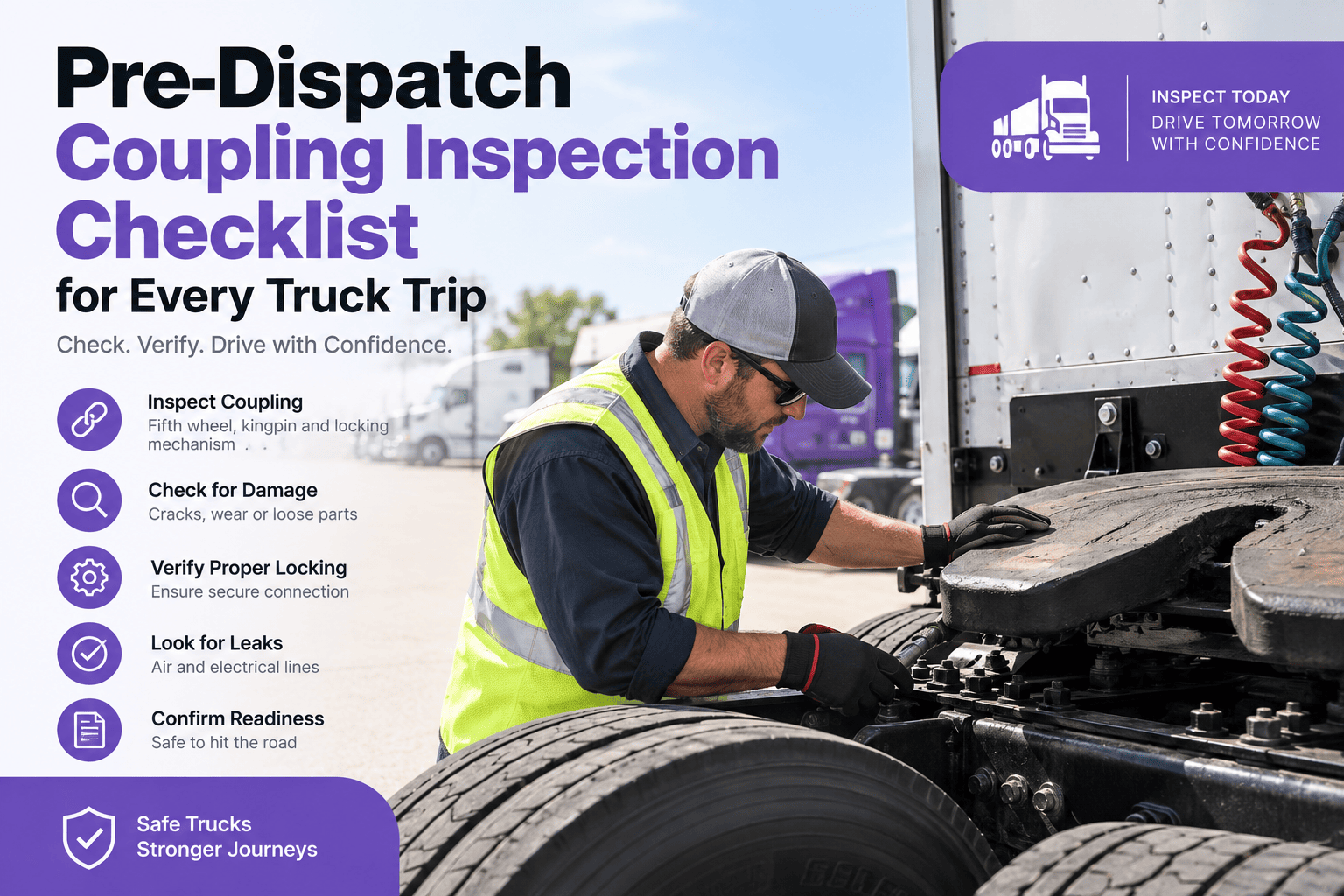
The fifth wheel is the single connection holding a 40-ton trailer to the tractor — and when it fails, the trailer comes loose at highway speed. A rushed tug test can pass on a coupling that isn't actually locked, and CVSA will find it at the scale with an immediate out-of-service. Truck Inspection & Maintenance Management Software runs the pre-dispatch coupling check as a sequenced workflow on the driver's phone — every zone photographed, every step signed, the truck locked out of dispatch until the record is clean. Start free and lock unsafe couplings out of dispatch automatically.
One Bad Coupling Is an Immediate OOS — TIM Makes Sure the Truck Doesn't Leave the Yard on One
A tug test alone doesn't confirm a coupling. Neither does a visual glance from the cab. The coupling check has to walk five distinct zones — fifth wheel plate, kingpin engagement, safety chains, air-line glad hands, and the electrical connection — and each has its own failure mode. Truck Inspection & Maintenance Management Software sequences all five as a required pre-dispatch flow, captures photo evidence per zone, blocks the truck from dispatch on any red flag, and files the record to §396.11 spec.
The Five Coupling Zones — What Every Pre-Dispatch Check Must Cover
A real coupling check isn't a single glance — it's five distinct component groups, each with its own failure mode and its own visual signal. Below is the zone map every TIM coupling template loads by default, and what the driver is actually looking at in each.
Look through the gap: jaws must be fully closed around the kingpin shank. Release handle fully retracted and secured in locked position. Safety latch over lock lever (some models manual). No cracks in the plate, no missing mounting bolts, no daylight between upper plate and trailer apron.
Trailer-side check: kingpin not bent, cracked, or grooved. Apron plate flat and smooth. Locking-fork adjustment nut flush with the face of the fifth wheel — if it's proud of the surface, the coupling is not locked no matter what the tug test says.
For pintle-and-eye couplings on smaller combos: chains present, crossed under the tongue to cradle it, combined rating exceeds the towed unit's GVWR, no links replaced with wire or improvised hooks. Chains slack enough for turns but not dragging.
Blue service line and red emergency line connected to matching glad hands, seals seated, no audible leaks when the system pressurizes. Lines routed with enough slack for full turns, not rubbing the catwalk, not dragging.
7-way plug fully seated in the trailer receptacle, safety latch engaged, no corrosion on pins, cable hung to prevent dragging. Marker, tail, brake, turn, and ABS indicators all functional at the cab check.
The Tug Test — The Four-Step Procedure That Actually Confirms a Lock
A hurried tug test is one of the top reasons couplings fail roadside when they passed at the yard. Done right, the tug test is a four-step sequence — and TIM sequences it exactly this way as a required workflow so no driver skips a stage under time pressure.
Five Zones · Four Tug Steps · One Sequenced Workflow in TIM
Truck Inspection & Maintenance Management Software runs the coupling check as a required sequence on the driver's phone — the tug test isn't a single tap, it's four ordered steps that can't be skipped. Photo evidence per zone, signed timestamps per step, and any red flag hard-locks the truck out of dispatch until a supervisor clears it or a mechanic repairs it. Coupling never leaves the yard uncertified again.
Out-of-Service Thresholds — What Roadside Actually Measures
A pre-dispatch check that doesn't reference the same thresholds a DOT inspector uses is a check that passes trucks that will fail at the scale. Below is the CVSA / FMCSA Appendix A OOS reference table for coupling components — the numbers TIM has built into the check so a yard-side warning fires before a roadside citation does.
| Component | Measurement | OOS threshold | Enforced under |
|---|---|---|---|
| Kingpin wear (2" pin) | SAE J700 go/no-go gauge | > 0.125" wear | FMCSA Appendix A |
| Kingpin-to-jaw gap | Feeler gauge | > 1/2" gap | CVSA NAS OOS |
| Fifth wheel horn wear | Measured thickness vs. original | > 20% wear | FMCSA Appendix A |
| Any crack on kingpin or plate | Visual + dye penetrant if suspect | Any crack | Immediate OOS · no field repair |
| Fifth wheel mounting bolts | Count + torque check | Missing / loose | 49 CFR §393.70 |
| Safety chain (pintle rigs) | Presence + rating | Missing, uncrossed, or under-rated | 49 CFR §393.71 |
| Air-line glad hand seal | Pressure hold + audible | Leak on hookup | §393.45 — repair before dispatch |
| 7-way electrical circuit | Function check at cab | Any circuit failed | §393.9 — repair before dispatch |
Frequently Asked Questions
Every Coupling Certified Before the Truck Rolls — Nothing Leaves the Yard on a Bad Lock
Sequenced 5-zone check in TIM, real tug-test procedure, OOS thresholds built in, dispatch blocked on any red flag. The coupling failure mode that makes headlines never leaves the yard.