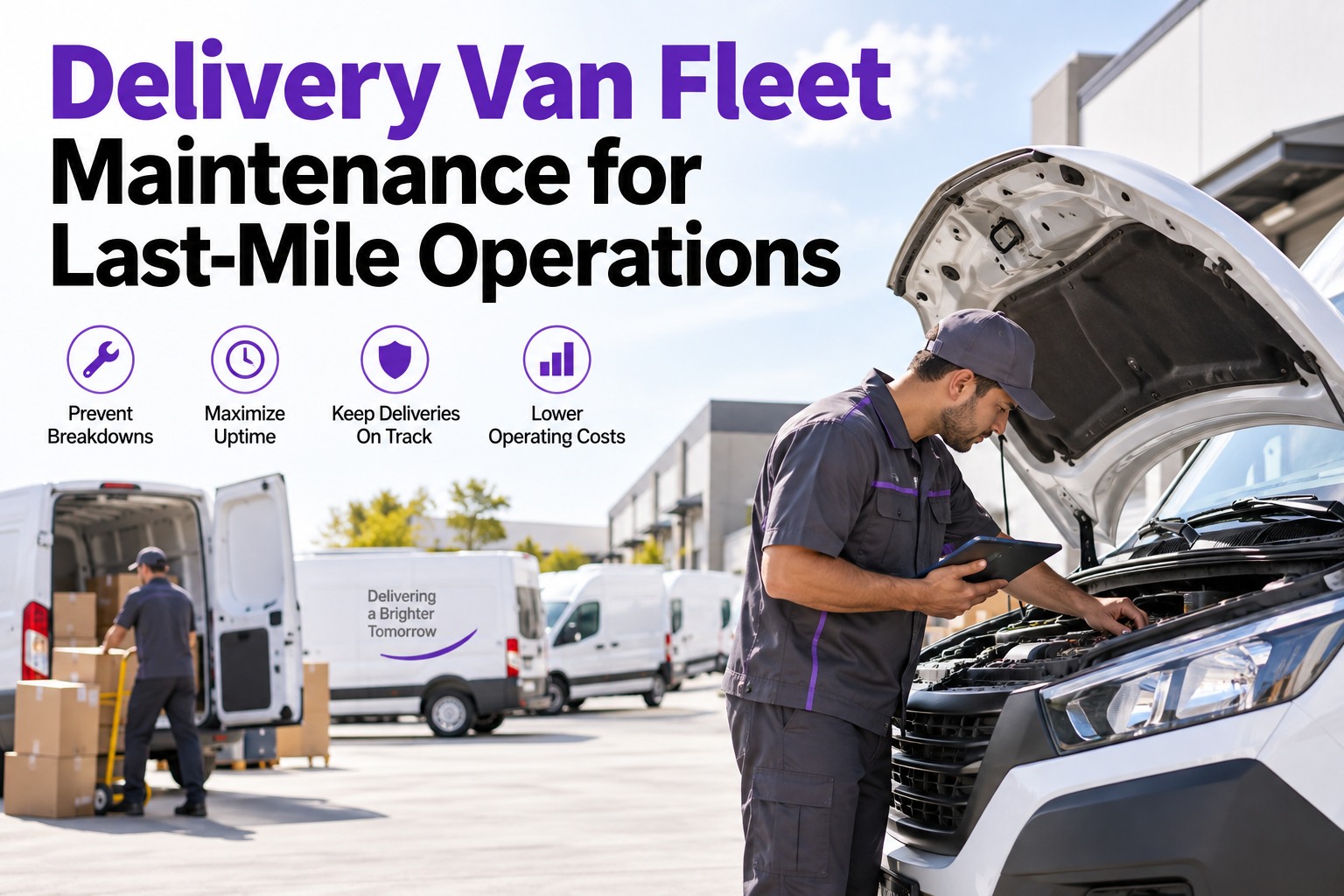
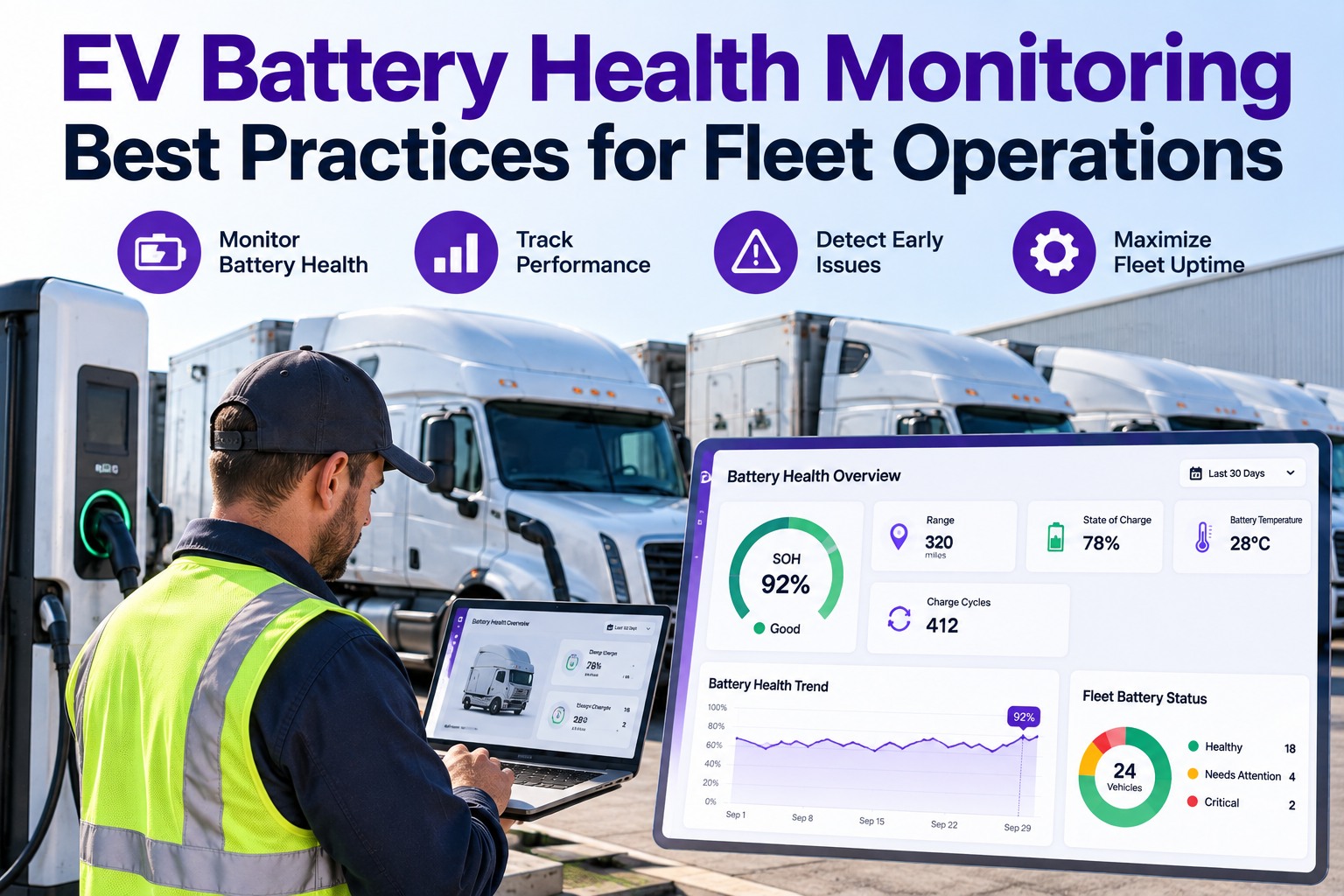
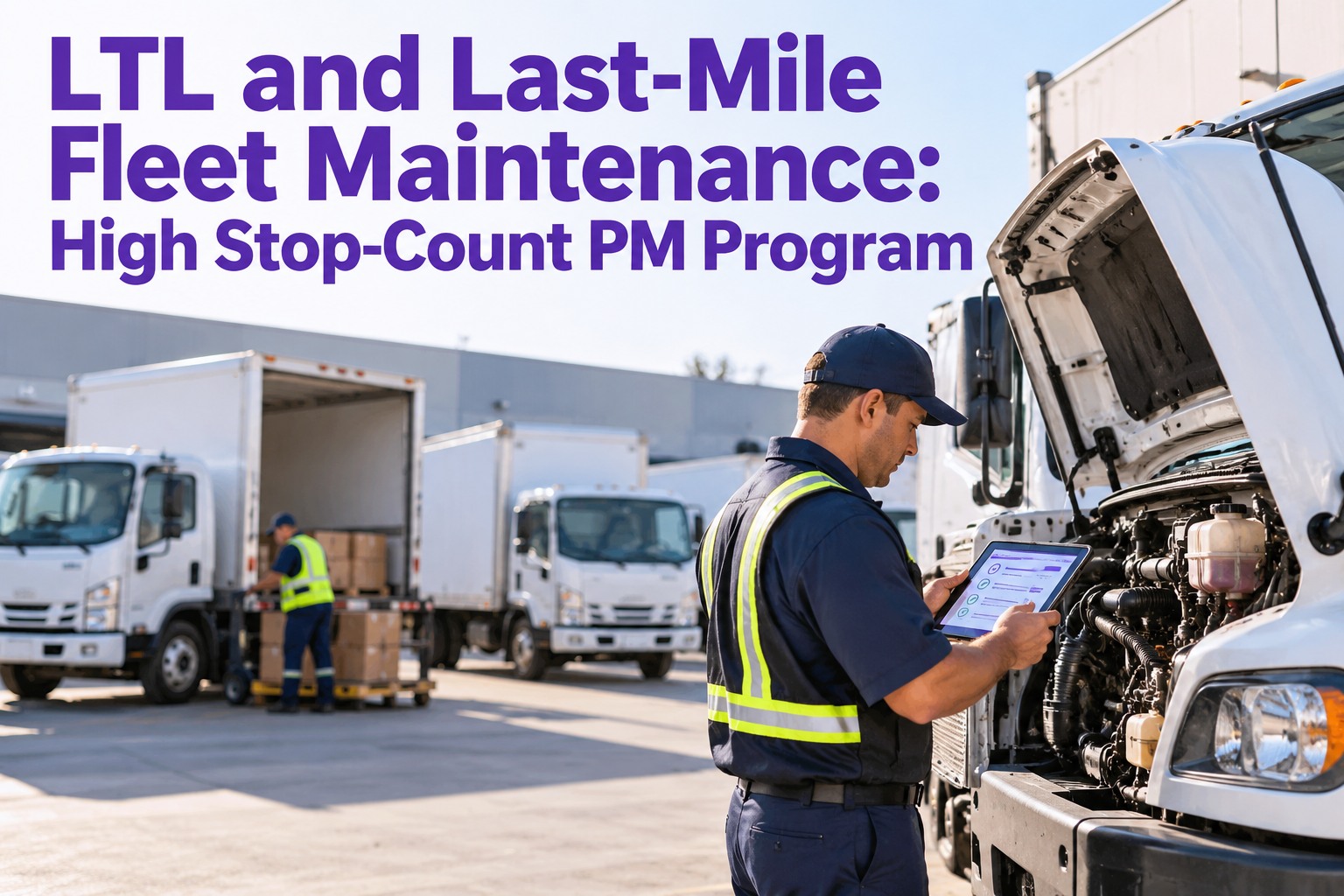
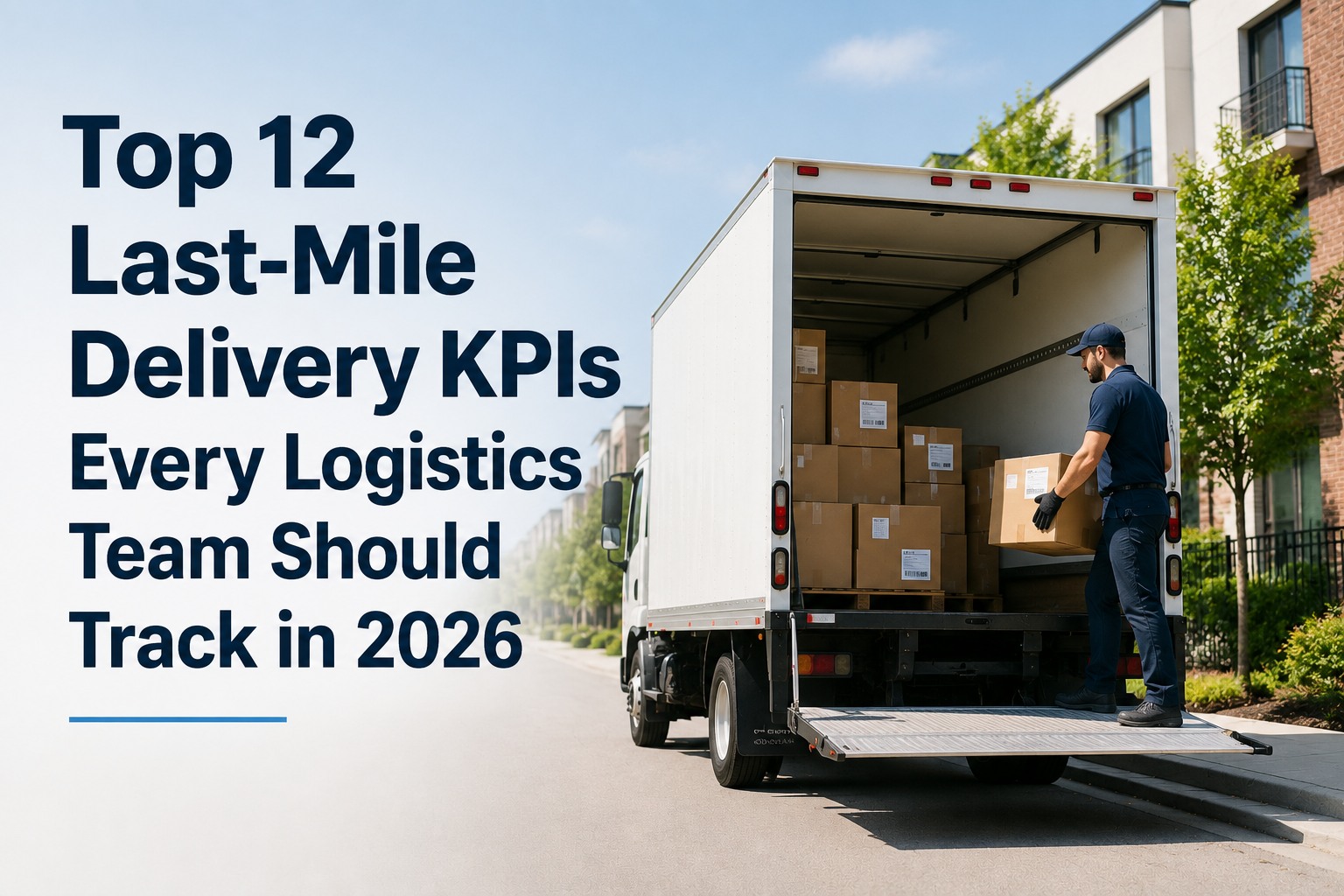
A last-mile van at 40,000 miles has had a fundamentally different life than a long-haul tractor at the same odometer. The tractor spent most of that mileage at highway speed in top gear; the van stopped and started 140 times a day, cycled its brakes 200 times a shift, opened and closed a cargo door every 8 minutes, and ran its climate control the whole time. Miles look identical on paper — but the wear that showed up isn't. Which is why a van fleet running the same PM schedule as a truck fleet ends up with premature brake wear, cargo doors that fail early, and battery/electrical problems nobody saw coming. Last-mile needs its own program. Start free and run a van-specific PM program.
Last-Mile Vans · Short-Cycle Wear · Stop-and-Go PM
A Van Fleet PM Program Built for the Way Last-Mile Actually Wears Trucks Out
Delivery vans don't fail like long-haul tractors — they fail from stop-count, door cycles, and idle time, not from miles. Truck Inspection & Maintenance Management Software runs a van-specific PM path built around the wear patterns that actually matter on last-mile routes, so a 40,000-mile Sprinter is serviced for what it did, not what the mileage suggests.
140 stopstypical last-mile daily stop count
200 cyclesdaily brake applications per van
4-6× wearrate on stop-and-go vs. highway miles
Why Miles Don't Tell the Real Story on a Delivery Van
Mileage is a fine proxy for wear on a long-haul truck because most of the miles happen the same way — 65 mph, top gear, minimal load transitions. Last-mile is the opposite of that. Two vans with identical odometers can have wildly different mechanical states based on how they ran the miles.
LONG-HAUL TRUCK · 40,000 MI
How the miles happened
- Top-gear highway cruise ~85% of the time
- ~20 brake applications per shift
- ~4 door cycles per day (fuel, breaks)
- Idle ratio 10-15%
- Cargo load stable, weight consistent
- Climate control moderate use
LAST-MILE VAN · 40,000 MI
How the miles happened
- Stop-and-go city ~90% of the time
- ~200 brake applications per shift
- ~140 door cycles per day
- Idle ratio 30-50%+
- Load weight varies constantly through route
- Climate on continuously, doors open constantly
Same odometer, different wear On identical mileage, the last-mile van has cycled its brakes 10× more often, cycled its cargo door 35× more often, and idled its engine 3-5× longer. That translates to brake pads worn twice as fast, door mechanisms wearing at their cycle limit, and battery/starter systems taking meaningfully more abuse. Which is why hours-based and cycle-based PM triggers catch these where miles-based ones miss.
What Actually Wears on a Last-Mile Van
Six categories account for almost every unscheduled repair on a last-mile fleet. Every one of them scales with cycle count, not mileage — and every one has a specific PM cadence that catches wear before it becomes a breakdown.
🛑
Brakes
Pads wear 2-3× faster than long-haul. Rotors warp from repeated heat cycles. Every 8-10K miles for inspection, not 25K.
Cycle proxy: brake events per day
🚪
Cargo doors
Roll-up doors, sliding side doors, rear barn doors. Hinges, cables, latches, rollers — all rated for a finite cycle count.
Cycle proxy: door open events per shift
🔋
Battery & charging
Constant start-stop stresses the alternator and battery more than continuous drive. Weak battery + cold morning = no-start call at 6:30 a.m.
Cycle proxy: engine starts per day
⚙️
Transmission
Automatic transmissions in vans see 10× more shift events than highway trucks. Fluid degrades faster; solenoids fail earlier.
Cycle proxy: engine hours + idle ratio
🛞
Tires & suspension
Constant load changes and curb impacts on urban routes. Suspension bushings and shocks wear faster than on smooth-highway routes.
Cycle proxy: harsh events + load cycles
❄️
HVAC & blower
Constant use with doors open kills evaporator cores and blower motors 2-3× faster. Failed AC in July gets drivers off the truck.
Cycle proxy: engine hours (climate runs whenever engine does)
The Van PM Cadence That Actually Works
Instead of the 15K/45K/100K interval that suits long-haul tractors, delivery vans respond better to a shorter, tighter cadence keyed to both miles and hours. Four services, each about half the interval a long-haul truck would run — because the wear happens twice as fast.
A-service
Every 5,000 mi or 250 hrs
- Oil & filter
- Chassis lube
- Brake pad thickness measurement
- Tire pressure & tread check
- Battery voltage & load test
B-service
Every 15,000 mi or 750 hrs
- Everything in A-service
- Cabin air filter
- Cargo door hinge lube & adjustment
- Transmission fluid check & top-off
- Alignment check
C-service
Every 30,000 mi or 1,500 hrs
- Everything in B-service
- Brake fluid flush
- Transmission fluid replacement
- Cabin filter + engine air filter
- Spark plugs (gas vans)
D-service
Every 60,000 mi or 3,000 hrs
- Everything in C-service
- Coolant flush
- Serpentine belt & tensioner
- Rear differential fluid
- Suspension bushings + shocks inspection
The Daily Van DVIR — Different Priorities
Vans under 10,001 lbs GVWR aren't federally required to run a §396.11 DVIR — but the fleets doing last-mile safely all run one anyway, because the driver walkaround is where daily defects surface. The van DVIR emphasizes different items than the diesel Class 8 checklist.
🛞
Tires + wheel wells
Curb rash, sidewall damage from tight urban maneuvering. Cuts near the sidewall are stops.
🚪
Cargo doors — all of them
Every door opens and closes cleanly. Latches engage. No warning lights on interior door sensors.
💡
Lights & strobes
Turn signals, brake lights, backup lights, amber strobe (where equipped). Urban visibility depends on all of these.
🪞
Mirrors & camera
Side mirrors adjusted, backup camera functional, no cracks. Urban driving fails without full visibility.
📦
Cargo area condition
Shelves secure, tie-down points intact, no loose items. A shifting load in stop-and-go is a driver-injury risk.
⛽
Fluids & fluids only
Coolant, oil, brake fluid, washer fluid checked at cold engine before start. Under-hood is a 30-second scan on a van, not a walkaround.
Van-Specific PM, Not a Truck Program Downsized
Truck Inspection & Maintenance Management Software runs a delivery-van PM path built around short-cycle wear — miles-and-hours dual triggers, cycle-count PM for high-cycle components (brakes, doors, batteries), and a van-length DVIR template that emphasizes the walkaround items that actually catch defects on last-mile operations. Fleets running Sprinters, Transits, ProMasters, or step vans use it to cut premature brake and door failures and extend vehicle life through the whole depreciation curve.
Van Fleet KPIs — What to Watch
Fleet-level KPIs for last-mile look different than long-haul. Route completion rate matters more than out-of-service days; downtime cost is stops-not-made, not miles-not-driven. Five KPIs that tell you a van fleet is running healthy.
KPI 01
Route completion rate
% of dispatched routes completed without vehicle breakdown. The single most important number in last-mile.
Target: > 98%
KPI 02
Morning ready %
% of assigned vans that fire up and pass the DVIR at start of shift. Below 95% means overnight defects aren't getting addressed.
Target: > 96%
KPI 03
Brake life per axle
Miles per brake pad set — the leading indicator of urban wear intensity. Trending down means routes are more aggressive or a driver behavior issue.
Target: fleet-baseline
KPI 04
Battery replacement cadence
How often batteries are being replaced. In urban start-stop, 2-3 years is typical; earlier suggests charging system issues.
Target: 30+ months
KPI 05
Roadside call rate
Roadside assistance events per 100,000 route miles. Every event is a stopped route, a driver stranded, and a customer waiting.
Target: < 2 per 100K
Common Van-Fleet Program Mistakes
Fleets moving from long-haul practices to last-mile usually make the same set of mistakes in the first year. Each is fixable, and each shows up when a big-truck PM program gets used on vehicles it wasn't built for.
01
Running long-haul PM intervals
15K first-service intervals on a Sprinter running last-mile means brake pads are already worn thin by first inspection. A-service every 5K on the van is right; 15K is wrong for these routes.
02
Ignoring engine hours
A van at 25K miles and 1,200 engine hours has 30% idle time. That truck needs hours-based service on the transmission, not just miles-based on the engine.
03
No cargo-door PM
Doors are treated as "fix it when it breaks" — but they cycle 30-50K times a year. Hinge lube, latch adjustment, and cable inspection every B-service catches wear cheap.
04
Skipping battery load tests
In urban start-stop, a battery weakens gradually before failing suddenly. Load-test every A-service (every 5K/250 hrs); catch weak ones during scheduled work, not at 6 a.m. dispatch.
05
Under-inflated tires
Vans running heavy morning loads and light afternoon returns need pressure checked cold, not at end of shift. Under-inflation kills fuel economy AND tire life together.
Frequently Asked Questions
Do delivery vans need an FMCSA DVIR under §396.11?
Only if they're over 10,001 lbs GVWR (which most cargo vans aren't) OR being used in interstate commerce for hire. A cargo Sprinter running local delivery in one state isn't federally required to have a DVIR. That said, most professional last-mile fleets run a daily driver walkaround anyway — it's the single best way to catch defects before they become breakdowns, and it satisfies most commercial insurance requirements. Our software runs the walkaround as a shorter van-scoped check, not the full Class 8 DVIR.
Start free with a van-scoped walkaround
Which vehicles count as "delivery vans" for this kind of program?
The program covers any purpose-built delivery vehicle — Mercedes Sprinter, Ford Transit, Ram ProMaster, Nissan NV, Chevy Express — and it also works for step vans (Freightliner MT, Utilimaster) and larger cutaway box trucks used for local delivery. What makes a vehicle "last-mile" isn't its class or make; it's the operating pattern: high stop count, short-cycle wear, heavy door use, urban routes. If the vehicle is running that pattern, this program fits, whether it's a 6,500-lb cargo van or a 26,000-lb box truck.
Contact us to check your vehicle mix
How do we track cycles when the odometer only tracks miles?
A few sources feed cycle proxies. Engine hours come from the ECM and telematics — every modern van reports them. Door cycle counts come from door switch signals if the van has connected telematics (Ford Pro Intelligence, Samsara VG34, Geotab GO9 with input harness). Brake events can be inferred from harsh-braking events in telematics. Where a truck lacks a signal, hours-plus-mileage is usually a good enough proxy — a van at 300 idle hours has cycled a lot of everything, whether or not you counted specifically. Our software captures whatever signals your telematics provides and falls back to hours + miles where signals are missing.
Start free with cycle-proxy tracking
Is this PM cadence more expensive than a standard long-haul schedule?
Per service, yes — you're doing more services. Per mile of operating life, no — you're preventing the failures that would otherwise take vehicles out of service and shorten their fleet life. Fleets that shift from long-haul intervals to a van-specific cadence typically see per-vehicle maintenance spend up 15-20% but total-cost-of-ownership down 10-15%, because brake replacements, alternator failures, and door repairs drop faster than the PM cost rises. The math almost always favors matching the PM to how the vehicle actually wears.
Contact us to model the TCO shift
Short-Cycle · High-Frequency · Van-Specific
Run Your Last-Mile Fleet on a PM Program Built for the Way It Actually Wears Out
Truck Inspection & Maintenance Management Software runs a delivery-van PM path with miles-and-hours dual triggers, cycle-count intervals on high-wear items (brakes, doors, batteries), and a van-scoped daily walkaround built for how last-mile fleets actually operate. Fleets running Sprinters, Transits, ProMasters, step vans, and cutaway box trucks use it to lift route completion above 98%, extend brake life through smarter cadences, and catch overnight defects before the 6 a.m. dispatch call.
No credit card required. Free for up to 3 trucks. Built for FMCSA-compliant fleets.