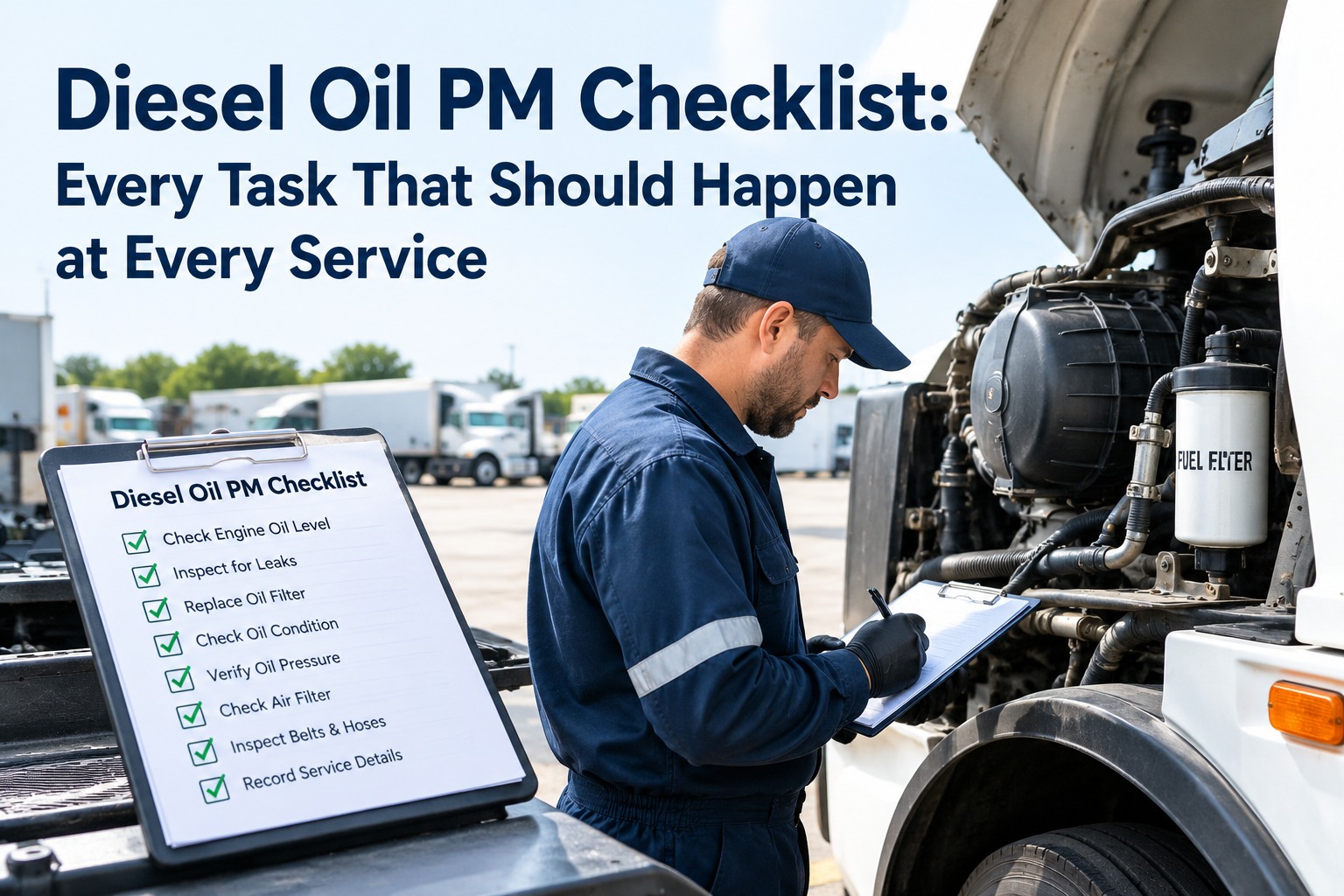
An oil change looks like the simplest PM on the board — drain, spin on a filter, fill, done. That's exactly why it's the task most often done incomplete. Skip the sample and you fly blind on wear metals. Skip the drain-plug washer and you chase a slow weep for a month. Skip the log entry and your interval history is fiction. This checklist lays out every task that should happen at every diesel oil service — the twelve steps top-performing fleets never skip, the torque and spec numbers that matter, and the sampling method that keeps your oil-analysis program honest. Start a free trial and run every oil PM off a checklist your techs can't shortcut.
The Diesel Oil PM Checklist: Every Task, Every Service
Twelve tasks separate a real oil PM from a quick drain-and-fill. Miss one and the cost shows up later — a weeping plug, a blind spot in your wear data, an interval nobody can prove. Here's the complete list, in order, with the specs that matter.
The 12-Task Master Checklist
This is the full sequence, start to finish. Every task earns its place — either it protects the engine, protects your data, or protects you in an audit. Work top to bottom and nothing gets left behind.
Idle to operating temp so contaminants stay suspended and drain out. Confirm viscosity and API rating against the engine plate — most heavy diesels want 15W-40 or 10W-30, CK-4 rated. Never substitute automotive oil.
Sample before you drain, from the middle of the oil column via a sample port or vacuum pump down the dipstick tube — never from the drain plug. A drain-plug sample is contaminated and wastes the lab fee.
Diesels hold more oil and drain slower. Allow 10–20 minutes for a complete drain, not the 90 seconds it takes to look empty. Residual old oil skews the fresh charge and shortens its life.
Check the crush washer or O-ring every time. A reused, flattened washer is the number-one cause of a slow drain-plug weep. Replace it — a copper gasket outlasts fiber or nylon.
Wipe the plug and the sealing surface. Reinstall and torque to the engine's number — commonly around 30–35 lb-ft. Hand-tight or gorilla-tight both fail: one weeps, the other strips the pan.
Back the filter out slowly and keep it level so it doesn't dump. Confirm the old gasket came off with it — a stuck double-gasket is a guaranteed blow-out on start-up.
Wipe the sealing face clean and verify no old gasket residue remains. A quality OEM or premium filter with the correct bypass-valve pressure rating goes on next — cheap filters cut filtration and cost engines.
For vertically mounted filters, pre-fill roughly ¾ full to cut dry-start time. Coat the new rubber gasket with fresh oil so it seats clean and comes off easy next service.
Spin the filter on by hand until the gasket contacts, then tighten per the filter's printed instruction — usually about ¾ turn past contact. Never wrench a filter on cold from the start.
Add the manufacturer's exact quantity through a clean funnel. Wait, then check the dipstick cold before starting. Overfill foams and blows seals; underfill starves the top end.
Start and idle. Watch the base of the filter and the drain plug for weep, shut down, and recheck the level once oil settles. Top up to the full mark. This is where a bad gasket shows itself — not on the road.
Record unit ID, mileage/hours, oil brand and grade, filter part number, sample ID, and date. Reset the oil-life monitor and the next PM trigger. An oil change with no log entry is an oil change you can't prove.
The Numbers Worth Taping to the Toolbox
Most oil-PM mistakes trace back to a handful of specs. Here are the ones techs reach for most — confirm each against your engine's plate, since exact values vary by model.
Turn This Checklist Into a Work Order Nobody Can Shortcut
Truck Inspection & Maintenance puts all twelve tasks on the tech's phone as a required checklist — sample logged, torque confirmed, filter part captured, photo of the reset. The oil PM won't close until every step is done, and the interval resets automatically for the next service. No paper, no guessing, no blind spots in your oil-analysis history.
The Oil Sample: Done Right vs. Done Wrong
Task 02 is the one most fleets get wrong — and a bad sample is worse than no sample, because it produces confident numbers off contaminated oil. Fleets that skip proper technique see 30–40% of samples flagged useless by the lab.
What Gets Skipped — and What It Costs Later
Every shortcut on this list has a delayed price tag. The task takes seconds now; the failure it prevents costs hours, dollars, or a roadside violation later.
Frequently Asked Questions
Both — whichever comes first. Highway trucks track well on mileage (commonly 15K–25K miles for heavy-duty), but trucks that idle heavily, run PTO equipment, or work stop-and-go accumulate engine wear the odometer never sees. A rough rule of thumb puts one engine hour near 25–30 highway miles, so a low-mileage truck with heavy idle can be well past due. Track both and let whichever hits first trigger the PM. Start free and schedule PMs on dual mileage-and-hours triggers.
Yes — that's the payoff of doing task 02 right every time. Once you have a clean trend of wear metals, soot, viscosity, and contamination across several services, you can push intervals out where the data supports it and pull them in where it doesn't. Fleets that sample well often extend safely and cut oil spend, while catching the one engine that's degrading early. The key is consistent, uncontaminated samples so the trend is real.
Because the drain plug sits at the bottom of the pan where the heaviest debris and settled contaminants collect. A drain-plug sample reads artificially dirty and doesn't represent the oil the engine actually ran on. Pull from the middle of the oil column with a sample port or a vacuum pump down the dipstick tube, while the oil is warm and before you drain. It's one extra minute that makes every dollar you spend on the lab worth spending.
A truck can look fine and be 10,000 miles into an interval it shouldn't be — or running a filter with a stuck double-gasket that's minutes from failure. The whole point of the checklist is that the cheap, invisible steps prevent the expensive, visible failures. Correct oil, filter, and sampling procedure is credited with extending engine life 30–50% versus drain-and-fill alone. "Seems fine" is not a maintenance record. Talk to our team about enforcing complete oil PMs across your fleet.
Make the Complete Oil PM the Only Oil PM
Truck Inspection & Maintenance turns this twelve-task checklist into a mobile work order your techs complete step by step — sample logged, torque confirmed, filter part captured, interval reset automatically. Paper DVIRs and PM spreadsheets get replaced with real-time compliance dashboards that keep PM compliance above 95% and your fleet DOT-ready year-round.