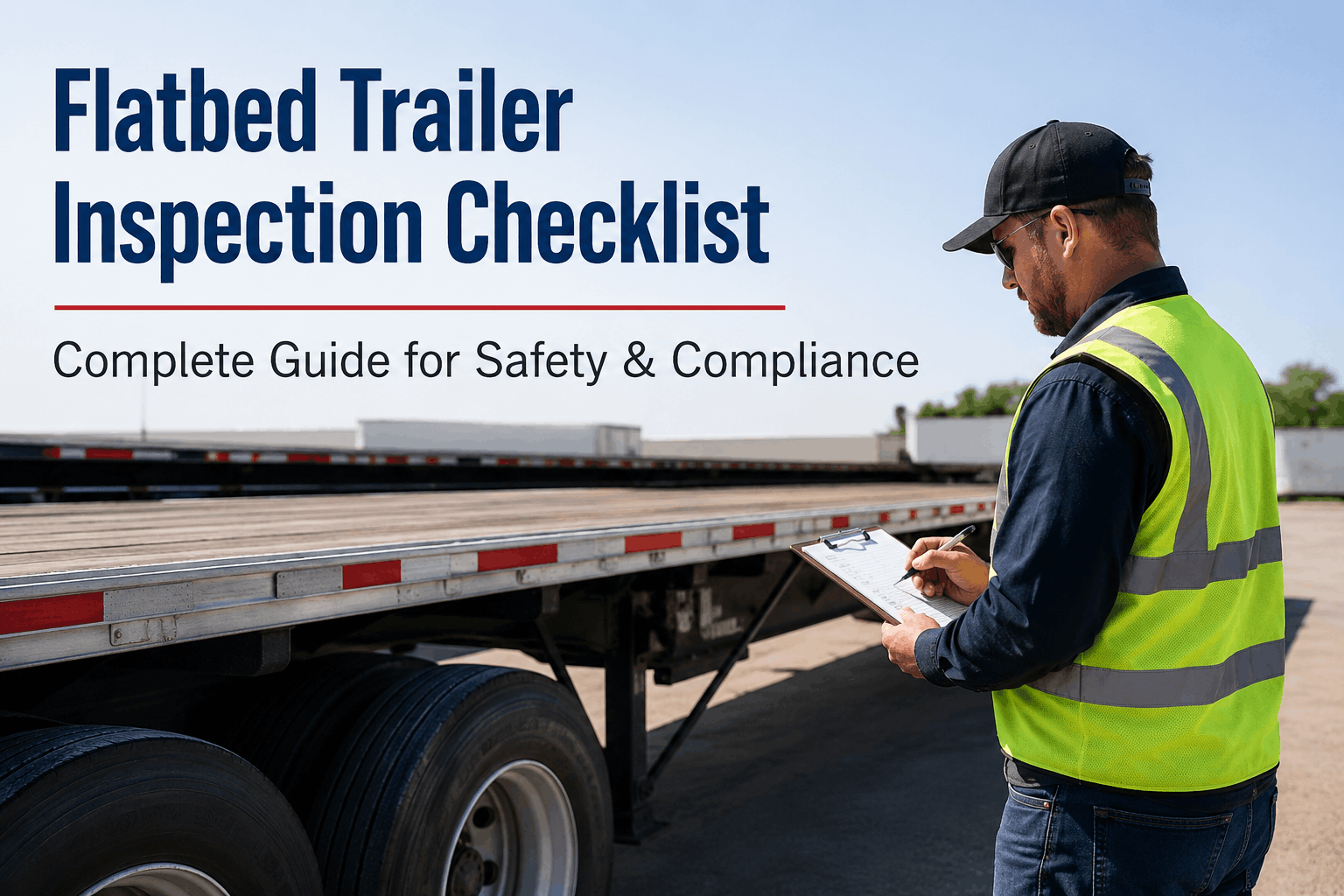
A tractor warns you when something's wrong. A trailer doesn't. A dry van rolls for months with a cracked roof panel, a hardened door seal or a soft floorboard and never complains — until a driver opens the doors on a water-stained load. This checklist walks the body one zone at a time, and shows how Truck Inspection & Maintenance Management Software turns each flagged item into a work order while the trailer's history follows its number across every tractor and yard. Start free and inspect the body zone by zone.

Dry Van · Body Inspection & PM

Dry Van Trailer Inspection Checklist: Floor, Roof, Doors & Walls

The box has no dashboard, so its damage stays silent until it's a cargo claim. Our software runs the body inspection as a guided digital form: the driver walks each zone, logs a defect with a photo, and it becomes a work order — with every reading kept against the trailer number, not the tractor. The silent damage finally has an early-warning system.
Dry van cutaway · body inspection zones
1 2 3 4 5 6
1Roof & seams 2Sidewalls & panels 3Floor & threshold 4Rear doors & seals 5Front wall / nose 6Lighting
Silent damageTwo things a ground-level walkaround can't seeFloor rot from moisture and roof punctures from overhead impacts are the costliest dry van defects — and both are invisible from the ground. Water, not wear, writes the biggest repair invoice.
#1lighting — most common roadside trailer finding
Rearwhere ~99% of floor failures begin

The Checklist, Zone by Zone

Walk the body front to back. Each zone carries the item to tick, the failure to expect, and a photo on anything you flag.

01Rear Doors & SealsTop fail: failed seal

A door that won't seal is a water-damage claim waiting for the next rainstorm.

Watch for: daylight around a closed door means the seal has already failed.
02Roof & Top RailTop fail: leaks

Small holes let water in and quietly destroy cargo; the roof is checked from above, not the ground.

Watch for: points of light seen from inside a closed van are roof or seam holes.
03Floor & ThresholdTop fail: rot at the rear

Hardwood or composite, the floor takes the weight — and nearly all failures start at the rear near the doors.

Watch for: a springy board is rot underneath, not just a loose plank.
04Sidewalls & PanelsTop fail: hidden anchor damage

Forklift and load-shift damage hits the liner and the logistics posts cargo is strapped to.

Watch for: a pulled anchor is often invisible until it fails under a load.
05Front Wall & StructureTop fail: cargo-shift impact

The nose takes the hit when a load shifts forward under braking.

Watch for: separation at a panel seam spreads with every load.
06Lighting & ElectricalTop fail: roadside citation

Lighting is the single most common roadside trailer finding — and the easiest to clear before it's a violation.

Watch for: one dark marker lamp is a stop that writes a CSA score.

Flag any item with a photo and it reaches the shop as a work order before the trailer rolls again. Start free and route body defects to the shop.

Every Zone Checked, Every Defect on the Record

Walk doors, roof, floor and walls on the phone; failed items become work orders with photos — and the proof the trailer was sound at loading is your defense against a cargo claim.

Repair It, or Replace It?

Not every finding pulls a trailer from service. Knowing the line keeps a cheap fix cheap and flags the one that isn't.

Repair — cheap insurance
  • Sealant touch-ups around rivets and seams
  • A worn door seal or gasket
  • A few soft floorboards at the rear
  • A small roof-panel puncture, patched
Replace or retire
  • Multiple soft spots across the floor
  • A large or brittle roof-panel failure
  • Nose or seam separation spreading structurally
  • Delamination through a full wall panel

Caught early, a leak is a tube of sealant and a seal; caught late, it's a floor replacement and a ruined load. The difference is who looked, and when. Book a demo to grade body condition with photos.

From Flagged Item to Work Order

A defect found on a trailer that moves between tractors and yards only helps if the finding travels with the trailer, not the driver.

1InspectWalk the six zones on a guided body form.
2Flag + photoA failed item is logged with an image.
3Work orderThe defect routes to the shop queue.
4Trailer historyIt lands on the trailer's own record.

Pulled from the pool to any tractor, the trailer brings its full body history with it. Start free and keep history on the trailer number.

Why Fleets Run Dry Van PM in Software

A dry van has no engine hours and often no odometer, so its maintenance has to be scheduled by the trailer, not the mile.

History by trailer numberOne record across every tractor and yard.
A/B/C service calendarMonthly, 6-month and annual PM per trailer.
Zone inspection templatesDoors, roof, floor and walls, every time.
Cargo-claim defensePhoto proof the trailer was sound at loading.
Defect to work orderA torn seal routes straight to the shop.
Parts on handSeals, floorboards and patch kits tracked in stock.

The result: the body gets the same discipline as the running gear, on its own schedule. Start free and run dry van PM across your pool.

Frequently Asked Questions

1How do you inspect a trailer floor and roof?
Walk the deck for soft or springy boards, probe for rot and delamination, and check the crossmembers underneath for rust. Leak-test the roof from above for punctures and open seams, and look for water stains inside. Book a demo to see the body walkthrough.
2What's the most common dry van defect?
Lighting is the most common roadside finding, but water intrusion through the roof, seals or floor is the costliest — it ruins freight, not just the trailer. Both belong on every body inspection. Book a demo to track both.
3Can roof or floor damage be repaired, or replaced?
Both, by severity. Small roof punctures patch and a few rear floorboards swap out; multiple soft spots across the floor or a large, brittle roof panel point to replacement. Catching it early keeps it in the repair column. Book a demo to grade damage with photos.
4How often should a dry van get PM?
A pre-trip visual of roof, panels, floor and seals; a monthly in-depth walk-through with the undercarriage; a quarterly leak test; and the §396.17 annual. Schedule it by the trailer, since there's no engine hour to go by. Book a demo to set the cadence.
Doors · Roof · Floor · Walls

Give the Box the Same Discipline as the Tractor

Truck Inspection & Maintenance Management Software walks the dry van zone by zone, routes every body defect to a work order, and keeps the history on the trailer number — so a silent leak becomes a scheduled repair, not a cargo claim.

No credit card required. Free for up to 3 trucks. Built for FMCSA-compliant fleets.