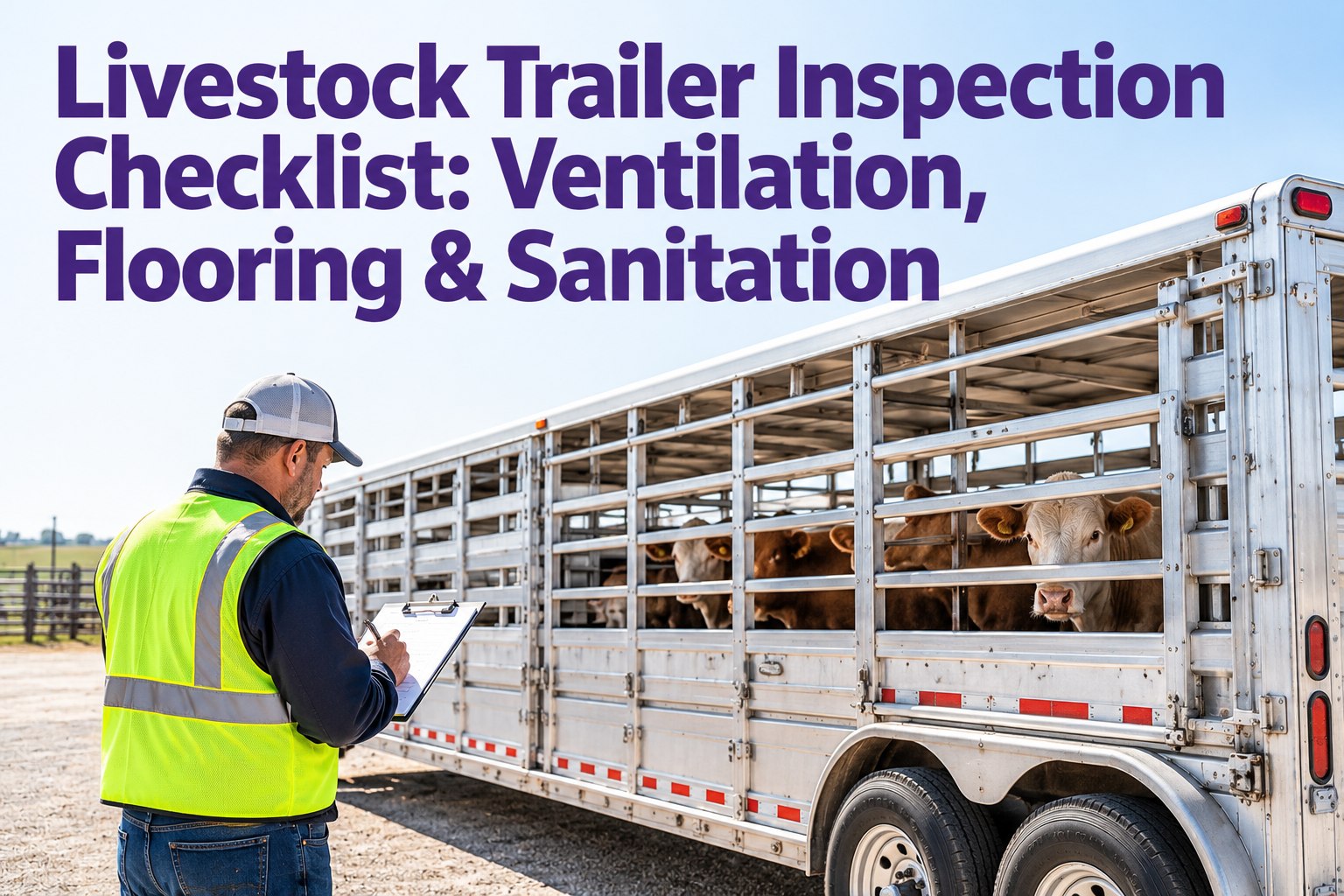
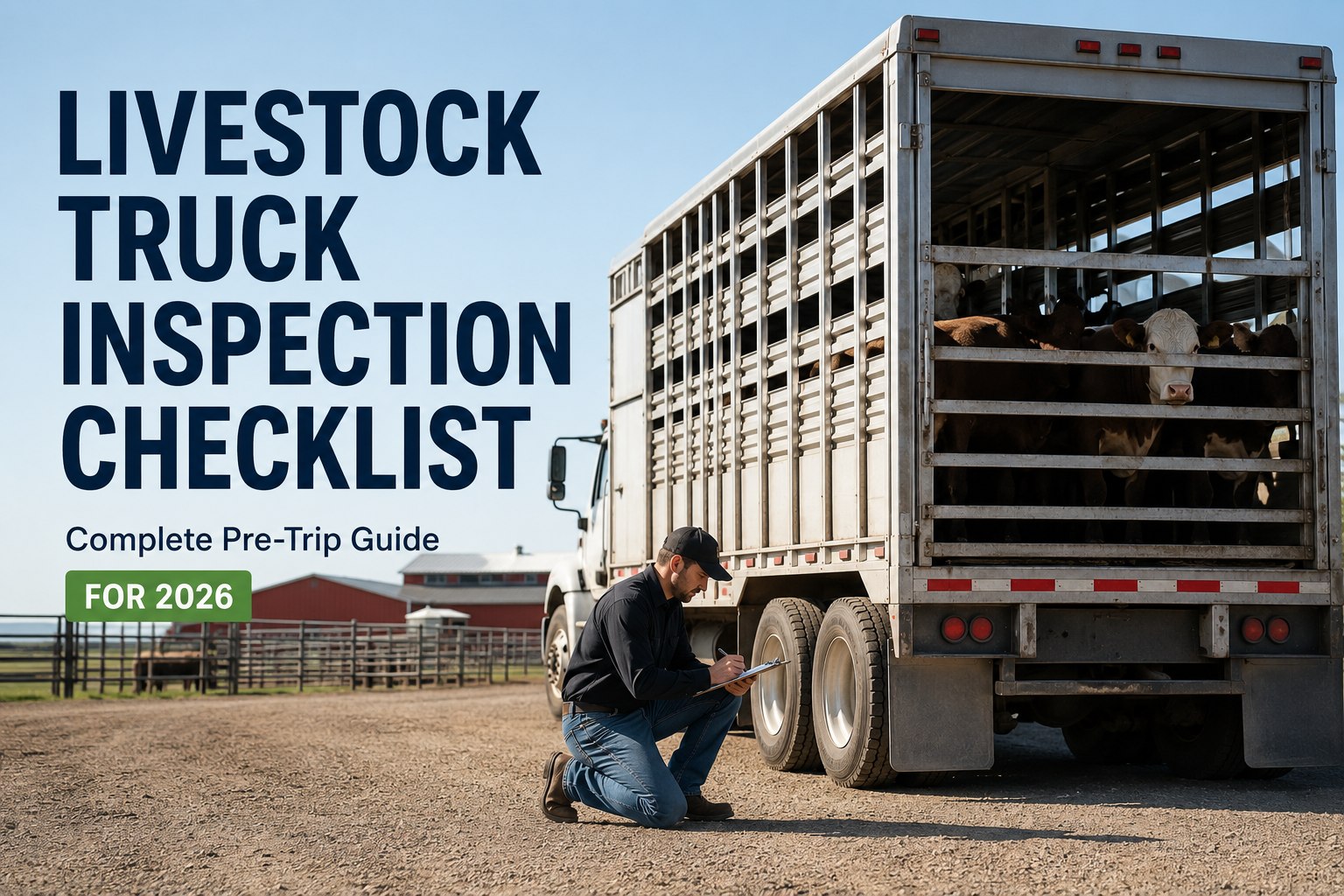
A livestock trailer hauls cargo that can't tell you something is wrong — and that changes everything about the inspection. A blocked vent becomes heat stress within minutes in summer sun; a soft floorboard becomes a fallen animal; a weak latch becomes a pile-up on the first hard brake. This checklist walks the trailer the way the animals experience it — air, footing, space, cleanliness, and a sound ride — and lets Truck Inspection & Maintenance Management Software (TIM) turn any defect into a tracked repair. Start free and run livestock trailer inspections on one record with TIM.
TIM · Livestock Trailer Checklist
Livestock Trailer Inspection Checklist: Ventilation, Flooring & Sanitation.
On a livestock trailer, a defect isn't just downtime — it's an animal in distress before the next stop. Ventilation, flooring, partitions, and sanitation are welfare-critical, and the most-cited violations are the preventable ones. This checklist covers what the load needs and what the trailer needs, and TIM turns every failed item into a graded work order before the animals are loaded.
Our promise: every flagged defect gets a 4-hour first response — acknowledged, graded, and assigned.
5
welfare areas, one inspection
4
stage wash-down, logged
1
record, check to repair
Why a Livestock Inspection Is Different
Most trailer inspections confirm the thing rolls safely. A livestock inspection has to confirm something living can travel in it safely — three things set it apart.
♥
The cargo is aliveA defect here means an animal suffers, is injured, or worse — not just a load delayed or a part replaced.
⚕
Welfare & biosecurity are the pointHeat, footing, crowding, and disease spread are the real risks — and the most-cited welfare violations.
⌂
You're inspecting an environmentThe trailer is the animals' space for the whole trip, so air, floor, and cleanliness matter as much as tires.
That's why the interior gets checked as hard as the running gear. Contact our team to build a livestock-specific inspection form.
What Every Load Needs
Before the checklist, the five things a trailer has to provide for the animals on board. Every item below protects one of these.
≋
AirVentilation that moves heat out
▦
FootingA sound, non-slip floor
⊟
SpacePartitions and room per head
✦
CleanDrainage and wash-down
⬓
SoundA roadworthy trailer
The Livestock Trailer Inspection Checklist
Walk these five areas before every load. Items marked CRITICAL are welfare or out-of-service checks — a fail takes the trailer out of use until it's corrected. Tick each as you go, and confirm space-per-head against the per-species rules before loading.
⊟
Gates, Partitions & Interior
Five areas, one walk-around, every item protecting a load that can't speak up. Start free and capture every item on one record with TIM.
The Wash-Down Between Loads
Sanitation isn't a wipe-down — it's a four-stage routine that protects the next load from the last one's pathogens. Do it in order, every time.
1
Dry clean-outRemove bedding, manure, feed, and debris before any water touches the trailer.
→
2
Pressure washWash floor, walls, dividers, gates, and ramp so the surface is clean before disinfectant.
→
3
DisinfectApply an approved disinfectant at label rate and allow the full dwell time.
→
4
Dry, log & photoDry the trailer, record the wash, and photograph the interior as proof.
That last step — the record and the photo — is what the receiving farm wants to see. Contact our team to log wash-downs with every inspection.
BIOSECURITY
A trailer is a disease vector until it's cleaned. Livestock trailers can carry pathogens such as PRRS or PEDv from one farm to the next, which is why USDA/APHIS treats them as a biosecurity risk and many receiving farms will not unload a trailer without a documented wash-down. Federal law doesn't mandate one exact procedure, but in commercial hauling the documentation is effectively expected — so the wash isn't done until it's logged.
The Failures That Hurt a Load
When a livestock trip goes wrong, it's usually one of these — and every one is a checklist item above.
✕
Blocked vents, heat stressManure-packed slats cut airflow, and a trailer in summer sun overheats within minutes — the most common welfare finding.
✕
Soft floor, fallen animalRot or corrosion weakens the deck until an animal's weight finds the soft spot — and serious floor damage is an out-of-service order.
✕
Weak latch, pile-upA divider that pops on a hard brake lets animals crowd and crush — a preventable, often-cited welfare risk.
✕
Undocumented wash, refused loadNo wash record means the receiving farm turns the trailer away at the gate — a wasted trip and a biosecurity breach.
Every one starts as a checklist item someone skipped. Start free and make sure nothing gets skipped with TIM.
How TIM Helps
From Walk-Around to Work Order — With the Wash Logged
A livestock trailer has two records that matter: the inspection and the wash-down. TIM keeps both on one unit history — a failed item becomes a graded work order, and the four-stage wash is logged with photos — so welfare defects are fixed before loading and the biosecurity proof travels with the trailer.
1Walk the five areas
→
2Defect graded
→
3Work order routed
→
4Wash logged & stored
Welfare-area checklistAir, footing, space, sanitation, and roadworthiness in one guided mobile inspection.
Critical-item flagsA failed vent, floor, latch, or wash marks the trailer out of use until corrected.
Defect becomes a work orderA flagged item routes to the shop the moment it's filed — no re-keying.
Wash-down log with photosThe four-stage clean recorded and time-stamped as biosecurity proof.
Photo on every defectRot, a bent post, or a packed vent documented for the technician.
Per-unit historyEvery inspection, repair, and wash kept against that trailer — produced on demand.
Frequently Asked Questions
What's the most important part of a livestock trailer inspection?
Ventilation and flooring, because both fail fast and both hurt animals directly. Blocked vents let a trailer overheat within minutes in summer sun — the most common welfare finding — and a weak or slick floor causes fallen animals and loading injuries. Those are the welfare-critical items that take a trailer out of use until corrected, where a cosmetic issue wouldn't. Partitions, drainage, and roadworthiness still matter, but air and footing are where the fastest harm happens.
Start free and flag welfare-critical items with TIM.
How should a livestock trailer be cleaned between loads?
In four stages, in order: a dry clean-out to remove bedding, manure, and debris; a pressure wash of the floor, walls, dividers, gates, and ramp; an approved disinfectant applied at label rate with the full dwell time; then drying the trailer, logging the wash, and photographing the interior. The documentation matters as much as the cleaning — many receiving farms refuse to unload a trailer without proof it was washed.
Why does the wash-down need to be documented?
Because a livestock trailer can carry disease between farms. Pathogens like PRRS and PEDv move from one load to the next on a trailer that wasn't properly cleaned, so USDA/APHIS treats trailers as a biosecurity risk and receiving operations protect themselves by requiring proof of wash-down. Federal law doesn't mandate one exact procedure, but in commercial hauling a logged, photographed wash is effectively expected before a trailer is unloaded.
What floor problems take a livestock trailer out of service?
Serious floor damage — rot and soft spots in wood, corrosion in aluminum, or rust and sag in steel cross-members — because the floor carries the full weight of the animals and a weak spot can let one fall through. Slick or worn footing is also a welfare problem, since it causes loading injuries and downer animals. Leak-proof flooring is a state and USDA requirement, so floor integrity is both a safety and a compliance check.
Why use a digital checklist for livestock trailers?
Because a livestock trailer carries two things that have to be proven — that it's safe for animals and that it was cleaned. A digital inspection sends a failed welfare item straight to the shop as a work order with a photo, flags a critical fault as out-of-use on the spot, and keeps the wash-down log and photos on the same unit record. On a trailer where a missed defect means animal harm or a refused load, closing that gap is the whole point.
Air · Footing · Space · Clean · Sound
Inspect It Like Something's Life Depends on It
A livestock trailer carries cargo that feels every defect and can't report any of it. Ventilation, flooring, partitions, and sanitation aren't line items — they're the difference between a calm trip and a welfare incident, between a clean trailer and a refused load. A welfare-first walk-around catches the problems early, and TIM turns them into tracked repairs while logging the wash-down proof — so the trailer that rolls out is ready for the animals, not just the road.
No credit card required · Free for up to 3 trucks · Welfare checklists, wash-down logs, and critical-item flags built in