Dry van trailers are deceptively simple assets — no engine, no transmission, no driver — and that's exactly why fleets neglect them. The trailer has no operator pre-trip telling dispatch that brakes feel soft, no engine fault codes, no telematics screaming for attention. It just gets dropped at a customer, picked up by someone else, and rolls until something breaks at 70 mph or a roadside inspector finds it. The numbers: "Inoperable Required Lamp" is the #1 CSA vehicle maintenance violation industry-wide. Tire issues drive nearly 1 in 4 out-of-service violations. Annual federal inspection is mandated under FMCSA 49 CFR 396.17, with records retained 14 months minimum. And every $1 spent on preventive maintenance saves $4-$8 in emergency repairs and downtime. This guide is the working PM schedule fleet managers use for dry van trailers — daily DVIR, 30/90-day PM-A, 6-month PM-B, annual DOT inspection — plus the 8 critical component areas where dry vans actually fail. Print it for shop walls, or run it as a digital DVIR linked to work orders. Start your free trial and run dry van trailer maintenance on software built for it.
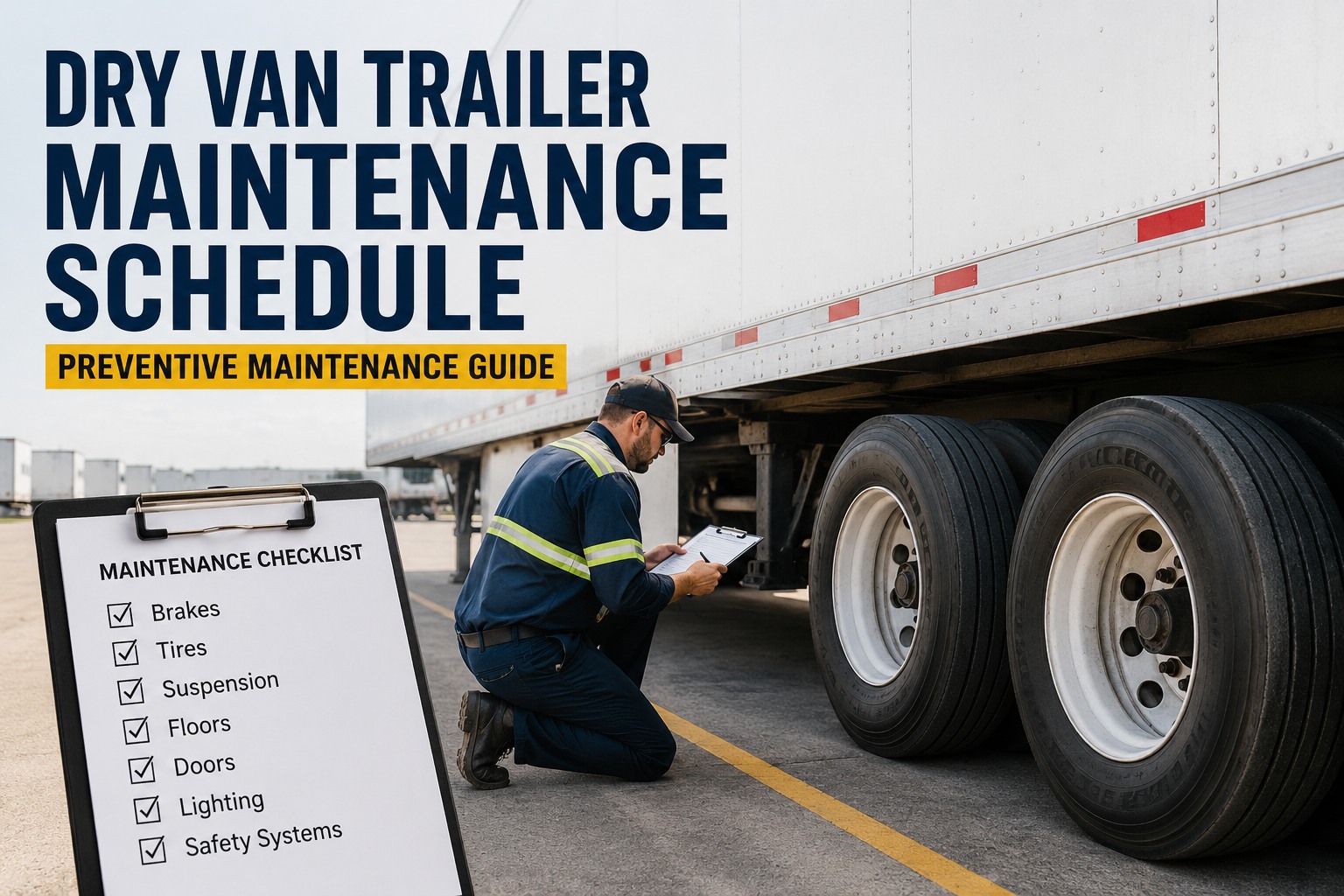
Dry Van Trailer Maintenance Schedule
Complete preventive maintenance guide — daily DVIR through annual DOT — plus 8 critical component focus areas.
Why Dry Van PM Is Different From Tractor PM
Tractor PM is engine-driven — oil changes, fuel filters, coolant. Dry van PM is structural and braking-system driven. The trailer has no oil to change, but it has 8 tires, brake components on 4 axles (8 wheel-ends), 16+ lights, two big doors, and 4,000+ pounds of floor that gets walked on by forklifts daily. Each one fails differently:
No Operator Feedback Loop
A trailer has no driver tapping the dashboard. Issues compound silently between drops until a roadside inspection or breakdown surfaces them.
Federal Mandate
49 CFR 396.17 requires annual periodic inspection. 49 CFR 396.3 mandates systematic PM. Records retained 14 months. Lapses = automatic CSA hits.
8 Tires, 8 Wheel-Ends
A 53' trailer has 8 tire positions and 8 wheel-end assemblies. Each is a failure point. Bearing failures and tire blowouts dominate roadside events.
Lights Fail Constantly
16+ lights per trailer get hit, vibrated, water-intruded. "Inoperable Required Lamp" is the #1 CSA Vehicle Maintenance BASIC violation industry-wide.
The 5-Tier PM Schedule for Dry Van Trailers
Effective dry van PM uses nested intervals — daily inspections feed into short-cycle PM, which feeds into major service, which feeds into annual DOT certification. Each tier builds on the one below it:
Pre-Trip / Post-Trip DVIR
Driver walks around trailer: lights, tires (visual + air pressure tap), brake adjustment, coupling devices, kingpin, landing gear, doors, mud flaps, reflective tape, ABS warning lamp. Mandated by 49 CFR 396.11. Retain 3 months minimum.
Walk-Around & Tire Audit
Calibrated tire pressure check on all 8 positions, tread depth measurement, lug nut torque audit, brake adjustment quick-check, lubrication of landing gear and door hinges, electrical connection cleaning at 7-way pigtail.
Light Shop Service
Lift trailer, spin wheels, check brake adjustment under each axle, inspect brake drums for cracks, all lighting bench-tested, ABS module diagnostic scan, suspension/air bag inspection, door seal and hardware check, floor inspection.
Intermediate Service
Everything in PM-A plus: wheel-end seal check, hub temperature scan, slack adjuster replacement assessment, S-cam bushing inspection, air valve testing, kingpin lubrication, roof and sidewall integrity check.
Major Service
Everything in PM-B plus: wheel-end repack with grease, brake shoe measurement and replacement evaluation, suspension torque audit, complete electrical harness inspection, undercoating refresh, full air system test.
Federal Annual Inspection
Comprehensive inspection per FMCSA Appendix A. Qualified inspector signs and dates the certification. Sticker on roadside front of trailer. Records retained 14 months. Failure to maintain = CSA score damage.
Run the full PM schedule on software built for it.
Truck Inspection & Maintenance auto-schedules every interval (daily DVIR through annual DOT), routes defects into work orders, tracks parts and labor per trailer, and produces FMCSA audit-ready records on demand. Free for up to 3 trailers. Contact support to plan your trailer fleet rollout.
The 8 Critical Component Areas — Where Dry Vans Actually Fail
Not every component carries equal risk. The 8 areas below drive most roadside violations, breakdown calls, and CSA hits on dry van trailers. PM attention concentrated here delivers the highest ROI:
Brake System
S-cam, brake shoes, drums, slack adjusters, air chambers, air lines. Brake violations = automatic OOS. Inspect adjustment monthly, drums and shoes every PM-B, full brake reline at PM-C if needed.
Tires & Wheel-Ends
8 tire positions, federal minimum 2/32" tread, max 11.5 PSI delta between duals. Wheel bearing failures cause wheel separations. Hub temperature scans catch early bearing issues.
Suspension
Air ride: air bags, height control valves, shock absorbers. Leaf spring: bushings, U-bolts, equalizers. Sagging trailers eat tires unevenly and damage cargo from road impact.
Lighting & Electrical
16+ lamps (marker, brake, turn, ABS, reverse, license plate, ID bar), 7-way pigtail, harness, splices. #1 CSA violation. Spec LED for 5-10x life. Inspect every pre-trip.
ABS System
49 CFR 393.55 mandates functional ABS on trailers built after 1998. ABS warning lamp must illuminate at startup, extinguish during operation. Module diagnostic scan every PM-A.
Floor
Oak, laminate, or composite. Forklift damage, rot from water intrusion, gap-fill failures. Floor compromise = cargo claims and customer chargebacks. Visual inspection every PM-A.
Doors & Seals
Roll-up: cables, springs, tracks, hinges, seal. Swing: hinges, hold-backs, latches, gasket. Water intrusion ruins cargo and accelerates floor rot. Lubricate hinges weekly.
Coupling & Landing Gear
Kingpin (lubricated, no excessive wear), upper coupler plate (no cracks), landing gear (full crank cycle, foot pads intact). Kingpin failures = catastrophic disconnects.
The Cost of Skipping PM — A Reality Check
Carriers running reactive maintenance instead of preventive routinely pay 4-8x more for the same repair after roadside failure. Three common scenarios show the math:
The Trailer Fleet ROI — 75 Dry Vans, Year 1
Trailer PM ROI is unusually defensible because every avoided roadside event is a documented dollar figure. The math below is for a 75-trailer dry van fleet — typical mid-size regional or OTR operation:
Frequently Asked Questions
How often does a dry van trailer need preventive maintenance?
The working schedule: daily DVIR by the driver (mandated by FMCSA 49 CFR 396.11), weekly walk-around with tire pressure and torque audit, PM-A every 30 days or ~15K miles, PM-B every 90 days or ~30K miles, PM-C every 6 months or ~60K miles, and the federal annual inspection every 12 months. High-mileage trailers running 100K+ miles annually compress these intervals proportionally.
What's the #1 dry van trailer maintenance violation?
"Inoperable Required Lamp" — by a wide margin. Lighting is the most-cited CSA Vehicle Maintenance BASIC violation industry-wide. Marker lights, brake lights, ID bars, and the ABS warning lamp fail constantly from vibration, water intrusion, and impact damage. The fix is cheap (often a $5 bulb), but the CSA points and out-of-service violations carry real cost. Specifying LED lighting and walk-around lighting check every pre-trip is the discipline that prevents it.
Is annual DOT inspection legally required for trailers?
Yes — FMCSA 49 CFR 396.17 mandates a periodic inspection at least every 12 months for every commercial motor vehicle, including trailers. A qualified inspector (per 49 CFR 396.19) performs the inspection per Appendix A. The certification sticker must be displayed on the roadside front of the trailer. Records must be retained 14 months minimum. Failure to maintain current annual inspection results in immediate out-of-service.
What's the ROI of preventive vs reactive trailer maintenance?
Industry data shows $4-$8 saved per $1 spent on preventive maintenance. The math: a $85 brake adjustment caught in PM becomes a $680 roadside repair when it fails on the highway. A $340 wheel bearing service becomes a $2,800 wheel-off event. A $420 tire replacement becomes a $1,850 blowout call. Multiply those across a 75-trailer fleet and Year 1 PM ROI typically runs $250K-$350K. Sign up free to see the math for your fleet.
Should I use mileage or calendar intervals for trailer PM?
Both — running concurrently with whichever hits first. Calendar intervals catch time-based degradation (fluid breakdown, rubber seals, corrosion, lubrication breakdown) regardless of usage. Mileage intervals catch wear-based degradation (brakes, tires, bearings). A trailer that sits 4 months between long-haul cycles still needs PM-A even if the odometer barely moved. A high-utilization trailer hitting 15K miles in 3 weeks needs PM-A even though the calendar says one week.
How does maintenance software actually help trailer fleets?
Three concrete wins. (1) Auto-scheduling — PM-A, PM-B, PM-C, and annual DOT all schedule from one date entry per trailer. No spreadsheet, no missed intervals. (2) Defect-to-repair chain — driver DVIR defects auto-route to work orders, mechanics close with photo evidence, next driver sees the repair. (3) Audit export — FMCSA-ready records produce in under a minute. Talk to our team for trailer-fleet-specific configuration.
Run dry van trailer PM on software built for it.
Truck Inspection & Maintenance auto-schedules every interval, captures DVIR defects with photo evidence, routes them to work orders, and produces FMCSA audit-ready records. Free for up to 3 trailers. No hardware. No contracts.