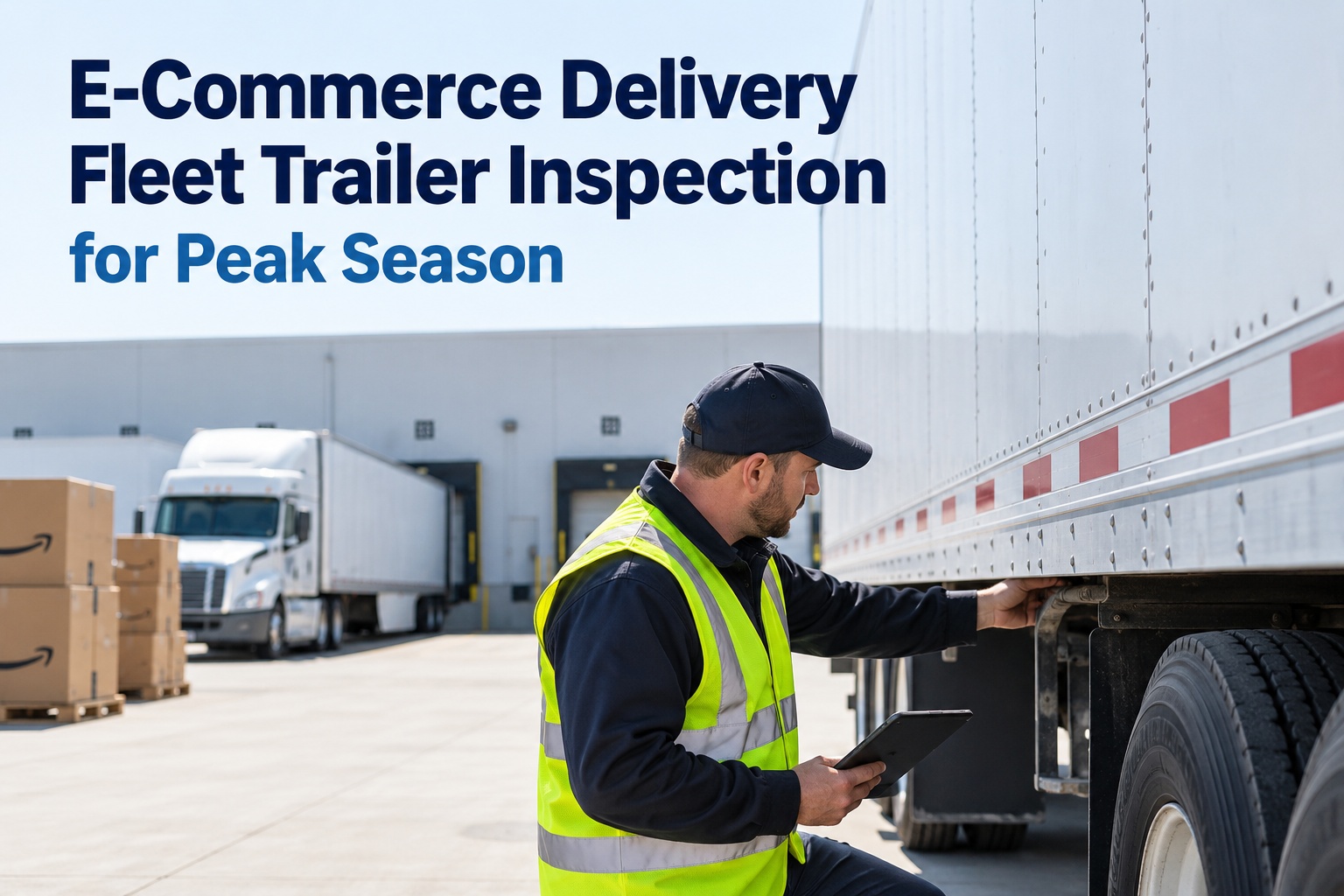
For eleven months of the year, your trailer PM program runs on a comfortable calendar. Then peak hits. Volume climbs roughly 40% overnight, trailers that used to sit now cycle continuously, and the shop windows you relied on vanish because every asset is committed to a dock. The trailers work four times harder exactly when you have the least time to inspect them — and that's when defects turn into missed dispatches during the one season you can't afford to miss one. This guide lays out a trailer inspection program built for that inversion: how to front-load readiness before the surge, run exception-only servicing during it, and use the season's data to come out stronger. Start a free trial and get your fleet peak-ready before Q4 lands.
Trailer Inspection Built for Peak Season
Peak inverts everything: maximum trailer stress, minimum shop time. A calendar-based inspection program breaks under that load. Here's the pre-surge, in-surge, post-surge model that keeps capacity rolling and every trailer audit-ready.
Why Peak Breaks a Normal PM Program
The trailer inspection routine that works all year is calendar-driven and assumes trailers rotate through the yard where you can service them. Peak season violates both assumptions at once — and that's why fleets that don't adapt get caught.
Trailers that idled between runs now cycle continuously. Tires, brakes, and lights accumulate wear at a rate your normal PM interval was never built to catch.
Every trailer is committed to a dock or a lane. The quiet afternoons you used for scheduled PM are gone — pulling a trailer for service now means giving up capacity you can't spare.
A missed dispatch in April is an inconvenience. In December, with peak surcharges and SLA penalties, an out-of-service trailer is lost revenue you can't recover until January.
The Three-Phase Peak Trailer Program
Stop thinking of peak as one long emergency. It's three distinct phases, each with its own inspection priority. Get the phasing right and the surge runs itself.
Front-load everything. Every trailer that will run peak gets a full inspection and any deferred repair closed out now, while shop time still exists. The goal: enter the surge with a fleet that needs nothing.
No scheduled pulls. Inspections happen where the trailer already is — at coupling, at the dock, on the driver's DVIR — and only genuine defects trigger a shop visit. Safety-critical issues route instantly; everything else is logged and batched for post-peak.
Work down the deferred backlog while volume normalizes, and mine the season's data. Which trailers threw the most defects? Which components failed under 4x load? That's next year's pre-surge checklist, written for you.
The Trailer Components That Fail Under 4x Load
Peak stress concentrates on a predictable set of components — the same ones that top the roadside out-of-service charts. These are the items your pre-surge blitz has to get right, because they're the ones that will strand a trailer mid-December.
Continuous stop-and-go dock cycling burns linings and knocks slack adjusters out of spec faster than any highway duty. Brakes are the single top trailer out-of-service category — and 41% of all OOS orders at the 2025 Roadcheck.
More couplings, more cord connect/disconnect cycles, more vibration — lighting is the top vehicle-defect category at roadside. A dead trailer lamp is both a violation and a night-delivery safety risk during the darkest months.
4x the miles means 4x the wear, heat, and pressure loss. Underinflated, overloaded tires fail catastrophically — and tire defects drive a meaningful share of large-truck crashes.
Every extra hookup is another cycle on the kingpin and locking jaws. Under peak coupling frequency, a marginal kingpin becomes a separation risk — the failure mode you cannot let happen on a loaded holiday run.
Run the Whole Program From One Mobile Platform
Truck Inspection & Maintenance is built for exactly this rhythm. Blitz the fleet pre-surge with mobile DVIRs and closed-out work orders, run exception-only checks during peak with instant defect routing to the shop, and pull per-trailer defect history afterward to rebuild next year's readiness list. Paper checklists and PM spreadsheets get replaced with one system that keeps every trailer rolling and audit-ready through the surge.
The KPIs That Tell You Peak Is Under Control
Peak season is too fast for gut feel. These four numbers tell you whether the program is holding — or whether you're sliding into reactive mode.
Share of peak trailers that entered the surge with zero open defects. This is the number that determines how quiet Phase 2 will be — aim for near 100% before volume spikes.
Trailer out-of-service events per week during peak. A well-run pre-surge blitz drives this down hard — every roadside OOS in December is a capacity and SLA hit.
Hours from a flagged defect to a closed work order. Instant routing keeps safety-critical turnarounds same-shift instead of losing a trailer for days.
Count of Phase-2 non-critical defects waiting for recovery. Watch it grow through peak and shrink in Phase 3 — a backlog that never clears means next peak starts behind.
Frequently Asked Questions
Work backward from when your volume actually spikes — for most e-commerce fleets that's late October, with the surge running through mid-January. Start the blitz far enough ahead that you can inspect every peak trailer and close the full deferred-repair backlog before shop windows disappear, typically several weeks out. The whole point of Phase 1 is that it happens while you still have slack; if you're blitzing in November you've already lost the window. Start free and schedule the blitz as a batch PM across your peak fleet.
No — you're not skipping anything required. FMCSA § 396 requires trailers to be maintained in safe operating condition, drivers to complete DVIRs, and safety-critical defects to be corrected before operation. The exception-only phase doesn't relax any of that: DVIRs still happen every trip, and any safety-critical defect still pulls the trailer immediately. What you're deferring is non-safety discretionary work — a cracked mud flap, a cosmetic issue — to a post-peak window, which is fully compliant. The phased model is about timing elective work, never about running unsafe equipment.
This is exactly why the program leans on mobile, in-place inspection instead of yard-based PM. The driver's pre-trip and post-trip DVIR, plus a quick check at every coupling, put eyes on the trailer wherever it is — no return-to-base required. A mobile platform captures those checks from a phone, routes any defect straight to the nearest shop as a work order, and keeps a per-trailer record even for assets that spend the whole surge on the road. The inspection follows the trailer instead of waiting for it.
Enter the surge with a zero-defect fleet. Almost every peak breakdown traces back to a known issue that was deferred into the busy season instead of closed before it. If you do nothing else, run the pre-surge blitz: inspect every peak trailer, clear the backlog, and confirm no annual inspection lapses mid-peak. It converts December from firefighting into exception handling. Talk to our team about building your peak-season trailer program on Truck Inspection & Maintenance.
Make This Peak the One Nothing Breaks During
Truck Inspection & Maintenance runs the full pre / in / post-surge model on one mobile-first platform — batch DVIRs to blitz your fleet ready, instant defect routing to keep trailers rolling through the surge, and per-trailer history to make next peak easier than this one. Replace paper DVIRs and PM spreadsheets with a system that cuts breakdowns, passes DOT audits, and keeps capacity moving when every dispatch counts.