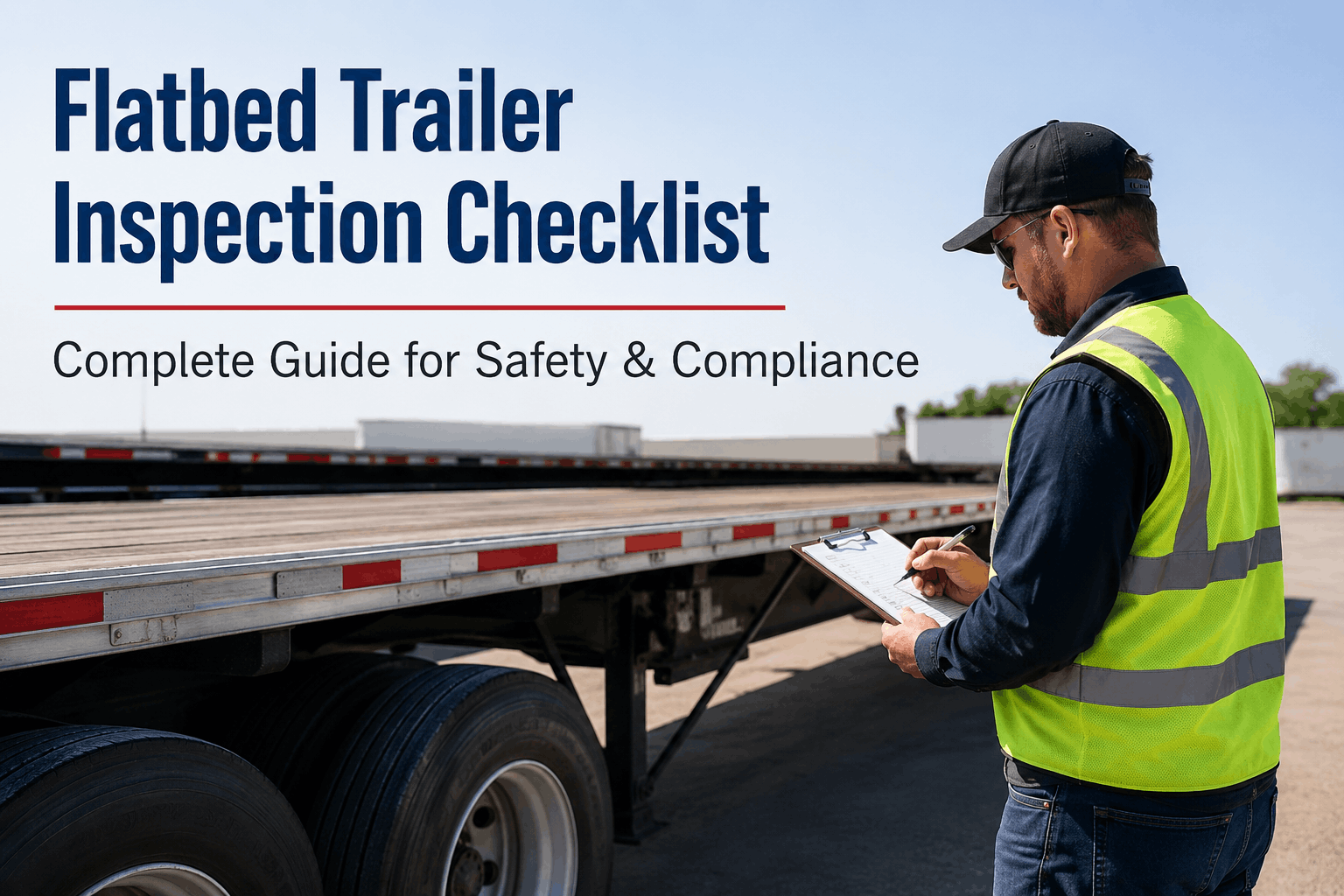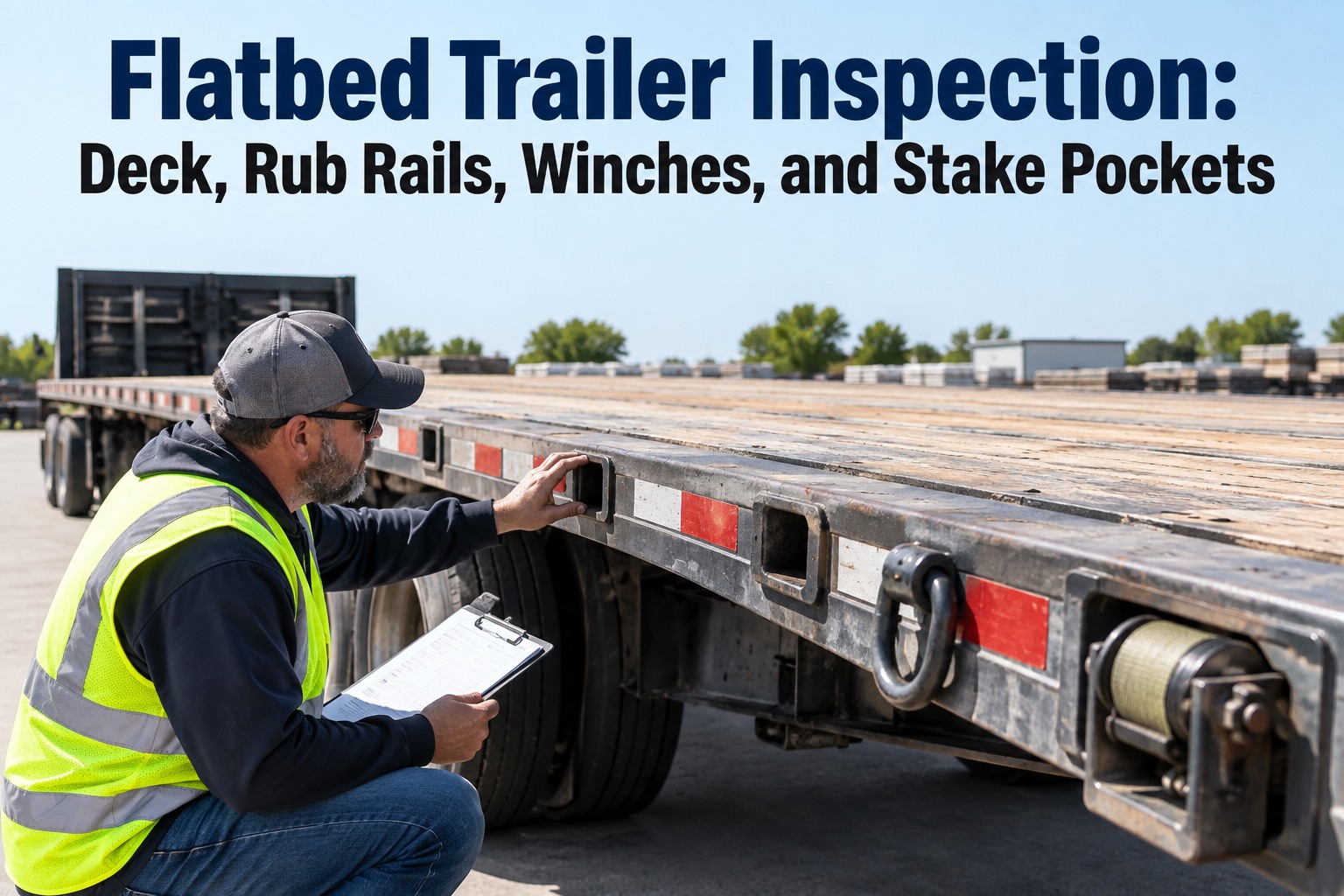
Everything roadworthy points at the tractor — brakes, tires, lights — while a flatbed's deck, rub rails, winches, and stake pockets get treated like furniture. But that's the load-bearing hardware holding 45,000 lbs onto an open platform at highway speed, and a stake pocket with a broken weld gives no warning: the load looks tight until the first hard brake finds the weak point, and there's no wall to catch it. This guide walks the four flatbed-specific systems a standard inspection skips — deck, rub rails, winches, and stake pockets and D-rings — and what fails a DOT check. Our truck inspection and maintenance management software turns each into a guided mobile check, so a cracked weld or soft board gets caught and routed to the shop before the scale house. Start a free trial and give every anchor point its own inspection record.
The Flatbed Trailer Inspection Guide
An enclosed van hides a load; a flatbed depends on hardware you can see — deck boards, rub rails, winches, stake pockets, and D-rings — and one cracked anchor weld puts cargo on the road. Our truck inspection & maintenance management software turns each of these into a guided mobile check with a photo at every anchor point, so a silent defect becomes a work order before it becomes a lost load or a roadside OOS. See it on your own trailers — hit Start Free Trial below, or talk to our team.
Why Flatbeds Fail Where Vans Pass
A dry-van inspection and a flatbed inspection are not the same job. On a van, the body contains the cargo — the walls do most of the securement work, and inspectors focus on brakes, tires, and coupling. On a flatbed, the securement hardware is the safety system, and it's exposed to weather, road salt, and the constant abrasion of chains and straps. Federal cargo-securement rules in 49 CFR Part 393 set minimums — not suggestions — for how open-deck loads are held, and the anchor points that hold them get inspected against the manufacturer's rated capacity, not eyeballed. Contact our team to see how the software maps these rules to your fleet.
- Walls contain the load
- Securement is mostly internal
- Deck rarely load-critical for tiedowns
- A shifted load stays inside the box
- Hardware is the securement system
- Anchor points rated and inspected individually
- Deck boards and cross-members are load-bearing
- A shifted load leaves the trailer
The Four Flatbed-Specific Systems
Beyond the brakes, tires, and lights every trailer shares, a flatbed has four systems that a standard inspection never touches — and each one fails in its own quiet way. In our software, each becomes a required step in the flatbed inspection template, so no driver can mark a trailer done while skipping the winch track or the D-rings.Start free and build these four systems into a guided flatbed checklist.
Check wood decks for cracked, split, rotted, or missing boards; steel decks for bent, cracked, or corroded cross-members. The deck is load-bearing — a soft board under a chain binder is a failure point, and cracked flatbed floor boards are a documented inspection defect.
The perimeter rail protects the trailer and routes straps inboard. Inspect for cracks, dents, broken welds, and separation from the deck. Rub rails are not rated anchor points — but if drivers hook to them anyway, intact welds are the difference between a buffer and a broken strap.
Winches must mount tightly with no looseness or structural damage; ratchets must engage and hold without slipping under load. Inspect sliding-winch tracks for secure mounting and positive end stops so unused winches can't slide off. Frayed winch straps get replaced, not run.
The rated anchor points that do the real work. Check for cracks, deformation, broken welds, and separation from the frame. Verify each against its rated capacity — D-rings commonly run 5,000–10,000 lbs. A cracked weld at the attachment point is invisible until the load is gone.
The Silent Anchor: Where Flatbed Loads Actually Escape
The dangerous flatbed failures don't announce themselves. A binder that clicks tight and a strap that pulls snug both feel identical over a sound anchor and a cracked one. The difference only shows up when the load moves.
These are exactly the defects paper DVIRs and spreadsheets lose. Our software makes each anchor point a positioned field with a mandatory photo, so a hairline weld crack becomes a logged, trendable record instead of a note that never leaves the cab.Start free and log every anchor point by position with photo evidence.
One Software System for Flatbed Inspections, PM & Repairs
Our truck inspection and maintenance management software replaces paper DVIRs and PM spreadsheets with guided mobile inspections that record each stake pocket, D-ring, winch, and deck section by position — so a hairline weld crack or a soft deck board shows up as a flagged defect before it's a lost load or a roadside violation. Flagged defects route straight to the shop as work orders, certified-mechanic sign-offs are tracked, and every record stays audit-ready with photos attached — helping fleets lift PM compliance above 95% and stay DOT-ready year-round.
The Anchor-Point Reference Card
Not every point on a flatbed is a legal place to hook a tiedown. This is the difference between a rated anchor and a convenient one — get it wrong and you fail on securement even when the hardware itself is intact.Book a demo and we'll build these ratings into your PM checklist.
| Component | Rated anchor? | Inspect for |
|---|---|---|
| Stake pockets | Yes | Cracks, deformation, broken welds — verify capacity |
| D-rings | Yes (5k–10k lbs) | Weld integrity, separation from deck, corrosion |
| Winch tracks | Yes | Secure mounting, positive end stops, smooth slide |
| Winches | Yes | Tight mount, ratchet holds, no slip under load |
| Rub rails | No | Cracks & broken welds — protection, not anchorage |
| Deck / cross-members | Structural | No cracked boards, no cracked or bent members |
What Puts a Flatbed Out of Service in 2026
The 2026 CVSA Out-of-Service Criteria took effect April 1 and raise the stakes on structural and securement defects specifically. Two things matter most for open-deck operators.Sign up free to inspect against the current 2026 thresholds.
A single crack 3 inches or longer in a stressed or load-bearing area — or a crack through 20% or more of a weld or parent metal — is an out-of-service condition. On a flatbed, that includes the frame, cross-members, and the mounts your anchor hardware is welded to.
The combined working load limit of all tiedowns must equal at least half the cargo weight, and every tiedown must attach to a rated anchor point. Sound hardware on paper means nothing if it's cracked, corroded, or not rated for the load hanging off it.
Frequently Asked Questions
Catch Flatbed Defects in the Bay, Not on the Interstate
Our truck inspection and maintenance management software gives you one place for inspections, PM, and repair tracking — guided flatbed checks with deck, rub rails, winches, stake pockets, and D-rings recorded by position, 2026 OOS thresholds built in, defects auto-routed to work orders, certified-mechanic sign-offs tracked, and photo-verified records audit-ready all year. Fleets use it to cut breakdowns, pass DOT audits, and give drivers a maintenance system they'll actually use — so no securement defect, PM, or DOT record slips.