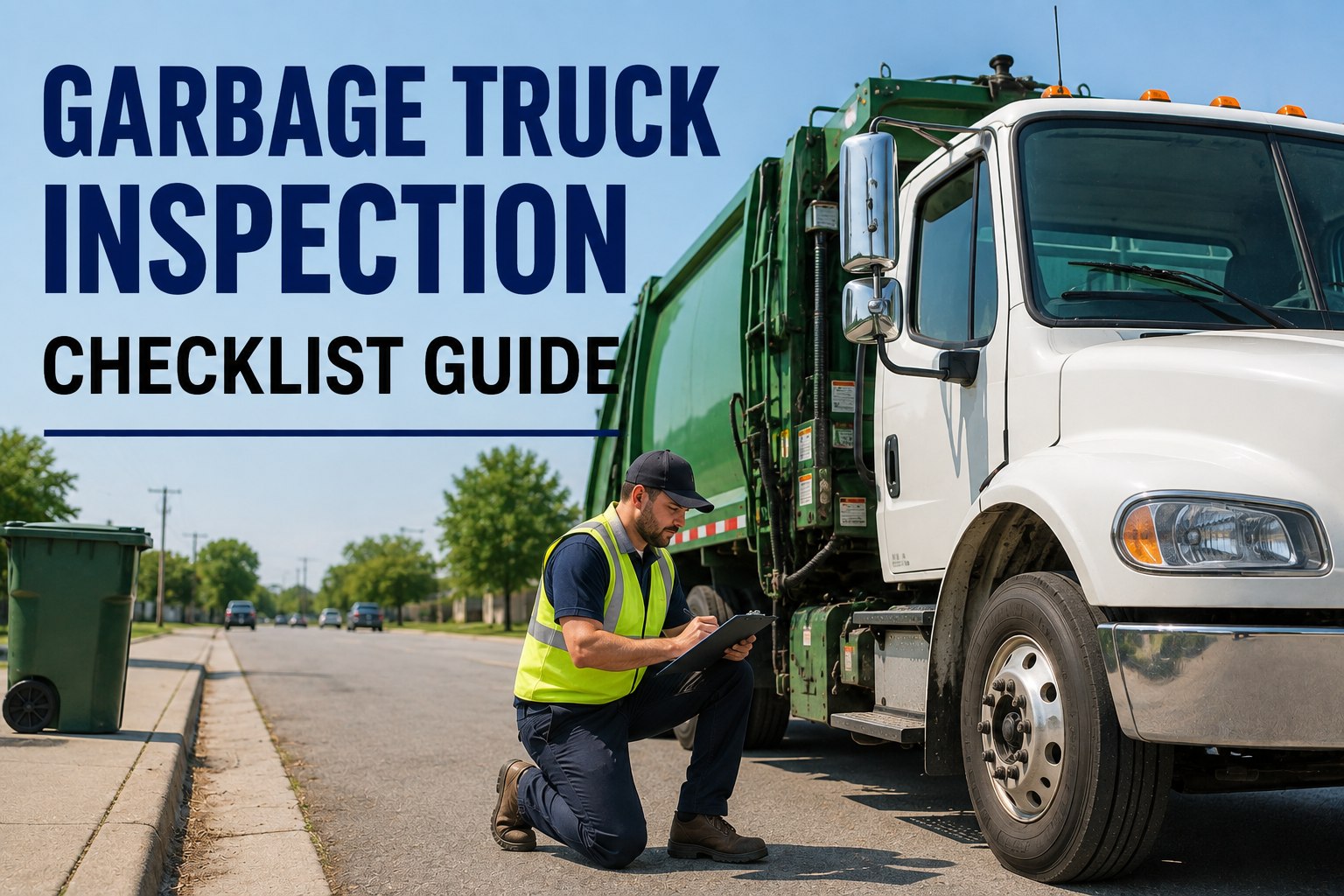
A garbage truck is not a standard commercial vehicle — it's a hydraulic-driven work platform on a heavy-duty chassis, spending most of its day at low speeds with high-frequency stops, lift cycles, and pack cycles that stress components ordinary trucks never touch. The average refuse truck operates 8–10 hours per shift, lifts 500–1,500 containers, packs the load 40–60 times, and reverses more often than any other class of commercial vehicle. That combination of hydraulic work, low-speed maneuvering, and constant driver dismount creates failure modes that a generic DOT pre-trip checklist doesn't catch — hydraulic hose ruptures, packer blade wear, tipper arm cracks, hopper seal leaks, PTO engagement failures, and rear-visibility problems that cause the majority of refuse-truck fatalities. This guide gives you the complete garbage truck inspection checklist: standard DOT items every commercial vehicle needs, plus the refuse-specific systems (hydraulics, packer, lift arms, hopper, PTO) that only apply to waste operations. It also covers route-specific hazards, load management, and how digital DVIR software turns a 15-minute paper walkaround into a 3–5 minute voice-guided workflow with photo evidence and defect routing to maintenance. Ready to digitize refuse-fleet inspections? Start a free trial of our fleet inspection software, or reach out to our support team for a walkthrough.
Refuse Fleet Safety Guide
Garbage Truck Inspection Checklist PDF (Free Fleet Template)
DOT-compliant plus refuse-specific: the hydraulic system, packer body, lift arms, and PTO — the components generic checklists miss but daily route work destroys.
120+
Inspection points covered
7
Refuse-specific systems
§392.7
FMCSA compliance built-in
Why Refuse Trucks Need a Specialized Checklist
Garbage trucks operate under conditions that break components generic pre-trip checklists don't cover. Here are the four operating realities that make a refuse-specific inspection essential.
1,500
Container lifts per shift
Hydraulic actuators, tipper arms, and lift mechanisms cycle constantly. Any wear, leak, or crack shows up fast.
40–60
Pack cycles per load
Packer blade extends and retracts under 2,000+ PSI. High-pressure hoses, seals, and blade guides wear at every cycle.
30%+
Reverse driving time
More reverse driving than any other commercial vehicle class. Backup alarms, cameras, and mirrors must work perfectly.
$85K+
Avg refuse-truck repair
Neglected hydraulic problems cascade into cylinder rebuilds, blade replacements, and hopper repairs. Prevention is 10x cheaper.
Safety RealityRefuse trucks account for one of the highest fatality rates among commercial vehicle categories — mostly rear-strike, pedestrian collision, and hydraulic release incidents. Every one of these has a specific pre-trip inspection point that could have caught it. Systematic daily inspection is life-safety, not paperwork.
The Refuse-Specific Systems Standard Checklists Miss
Every garbage truck has seven systems that don't exist on a standard tractor-trailer. Each one has its own failure modes, inspection points, and safety implications.
Hydraulic System
2,000+ PSI hoses, cylinders, pumps, reservoir, filter. High-pressure failure sprays hot oil under pressure — serious injury risk.
Packer Body & Blade
Blade guides, packing plate, cylinder rods, wear pads. Blade seizure or crack under load causes body damage.
Lift Arms / Fork System
Front-load forks or side-load arms. Cracked welds, worn pins, hydraulic leaks at cylinder end-caps.
Tipper & Hopper
Hopper door seals, tipper cylinder, safety latch, rear ejection panel. Failure risks load release during operation.
PTO & Drive Coupling
Power take-off engagement, driveshaft, seals, control valves. Failure disables all body function.
Backup Systems
Backup alarm, backup camera, backup lights. Mandatory for refuse operation. Any failure grounds the truck.
Route Equipment
Cart cameras, GPS/route computer, emergency stops, guard rails, side platform (if equipped for standing helper).
Standard DOT Inspection Points
The standard commercial-vehicle inspection under FMCSA §392.7 still applies to every refuse truck. Here are the common items that every walkaround starts with.
Approach — no lean, no fluid puddles under vehicle
Fresh oil or hydraulic fluid puddles = defect requiring diagnosis before departure.
Engine oil, coolant, power steering, transmission fluid
All at correct levels. Any low reading suggests a leak somewhere in the system.
Belts and hoses — no cracks, no wet spots
Especially important on trucks running compressor drives for auxiliary systems.
Air compressor mounted secure, no oil leaks
Air brake system supports both driving and body systems on many refuse configurations.
Windshield, wipers, mirrors — clean, no cracks
§393.60, §393.78, §393.80. Any windshield crack in driver's field of vision = defect.
Headlights, turn signals, marker lights — all functional
§393.24, §393.25, §393.11. Any bulb out = citation risk on roadside inspection.
Steer tires — tread minimum 4/32, no visible damage
§393.75: heavy front-axle load on refuse trucks. Any exposed cord or sidewall damage = OOS.
Drive tires — tread minimum 2/32, matched pairs on tandem axles
§393.75: drive tires wear fast under low-speed stop/start operation. Check daily.
Rims and lug nuts — no cracks, no missing nuts, no rust streaks
Rust streaks from lug positions = loose nuts. Common on trucks with heavy body loads.
Brake chambers and slack adjusters — securely mounted, no leaks
§393.47: refuse trucks brake constantly. Any chamber leak or misadjusted stroke = defect.
Suspension components — airbags inflated, shocks not leaking
Heavy body loads plus low-speed operation wear suspension components faster than highway use.
Frame rails — no cracks, no evidence of overload damage
§393.201: cracked frame near body mount = major defect requiring immediate repair.
Fuel tank — mounting straps secure, cap sealed, no leaks
§393.65: mounting exposed to more vibration than highway trucks. Check straps daily.
Refuse-Specific: Hydraulic System
The hydraulic system is what makes a garbage truck actually work — and it's where the most failures happen. High pressure, high cycle count, and constant heat means daily inspection is non-negotiable.
Hydraulic reservoir — fluid level between MIN and MAX marks
Low fluid indicates leak somewhere in system. Never top off without finding the leak first.
Hydraulic fluid color and clarity — amber/red, not milky or dark brown
Milky fluid = water contamination. Dark brown = overheated or oxidized. Both require service.
Hydraulic hoses — no bulging, no cracks, no wet spots at fittings
High-pressure hoses can rupture with no warning. Any visible defect grounds the truck.
Hydraulic cylinders — no rod scoring, no seal leaks, no wet cylinder bodies
Rod scoring lets contamination past seals. Wet body indicates active leak requiring service.
Hydraulic pump — no wet spots on mounting, no unusual noise at PTO engagement
Pump failure typically starts with whining noise before catastrophic loss.
Hydraulic filter — no visible damage, service indicator not in red zone
Filter service indicator shows when replacement needed. Ignoring it damages the pump.
Control valves — no visible damage, all handles/electric solenoids functional
Test each control briefly at start of shift. Sticking valve = replace before it fails on route.
Emergency stop button — accessible, protective cover intact, tests functional
E-stop must instantly kill hydraulic power. Test at every pre-trip.
Safety RuleNever trace a suspected high-pressure hydraulic leak with your hand. High-pressure hydraulic injection injuries can cause tissue damage requiring amputation. Use cardboard or wood to locate leaks, and never work on pressurized systems.
Refuse-Specific: Packer Body & Blade
The packer body compacts the load using hydraulic force. Blade damage, guide wear, and cylinder leaks all cause dramatic and expensive repairs.
Packer blade — no cracks in blade or mounting brackets
Blade cracks propagate fast under packing loads. Weld repair is temporary; replacement is the fix.
Blade guides and wear pads — visible, not excessively worn
Worn guides let blade drift out of alignment, damaging body walls. Replace guides at 50% wear.
Packing cylinder rods — no scoring, no bent rods
Bent or scored rods indicate the blade contacted something it shouldn't have. Investigate cause.
Packing cylinder end-caps — dry, no oil leaks at seals
Leaking end-cap = failing seal. Fluid loss accelerates as pressure cycles continue.
Body walls and floor — no cracks, no bulges from overload
Wall bulge indicates chronic overload or blade guide failure. Address body before next load.
Body-to-frame mounts — secure, no cracked welds
Mount cracks propagate under packing loads. Immediate repair required if found.
Refuse-Specific: Lift Arms & Forks
Front-load, side-load, and rear-load configurations each have their own lift mechanisms — but all share the same failure modes: cracked welds, worn pins, and hydraulic leaks.
Lift arm structure — no cracked welds, no bent members
Weld cracks appear first at high-stress corners. Grinding away paint reveals hidden cracks.
Pivot pins — greased, secured, not visibly worn
Worn pins cause loose arm motion during lift. Replace pins and bushings together.
Lift cylinders — no rod scoring, no wet spots at end-caps
Same criteria as packing cylinders. Leaks accelerate under cycle load.
Fork tips or gripper jaws (per configuration) — not bent, secure mounting
Bent forks fail to seat properly on container, causing drops. Straighten or replace.
Fork or arm safety latch — engages properly, no visible damage
Safety latch prevents container drop if hydraulic pressure fails. Non-negotiable safety item.
Lift pressure relief valve — functional, not stuck
Relief valve prevents cylinder failure at over-pressure. Test at pre-trip if procedure allows.
Turn this 120-item checklist into a 4-minute voice inspection
Guided walkaround including refuse-specific hydraulic and body systems. Voice-triggered photos. Auto-routing of safety-critical defects.
Refuse-Specific: Tipper, Hopper & Ejection
The rear of a refuse truck has specific mechanisms for load discharge that don't exist on standard trucks. Failure here means loads can shift, doors can release unexpectedly, or ejection mechanisms can fail mid-cycle.
Tipper cylinder — no rod scoring, no leaks at seals
Tipper failure at partial dump can leave load partially discharged in unsafe position.
Tipper safety prop — accessible, functional, not damaged
Prop must engage automatically when body raised. Life-safety item for maintenance access.
Hopper door seals — intact, not torn
Torn seals leak load fluid onto roadway. Environmental violation risk in most states.
Hopper door latches — engage fully, no bent hardware
Latch failure allows load spillage during transport. Inspect at every pre-trip.
Ejection panel (packer trucks) — moves freely, no debris jam
Debris behind ejection panel prevents full load discharge at landfill.
Rear door interlock — prevents packing when rear door open
Interlock prevents catastrophic body damage if operator forgets to close before packing.
Refuse-Specific: PTO & Drive Coupling
The power take-off is what drives all body functions — packer, lift, tipper. If PTO fails, the truck can drive but cannot work.
PTO housing — no external damage, no oil leaks
External oil = internal seal failure. Continued operation destroys internal gears.
PTO engagement — smooth engagement, no grinding sounds
Grinding = worn engagement dogs or synchronizer. Replace before catastrophic failure.
Driveshaft from PTO to hydraulic pump — no vibration, U-joints tight
Physical shake test at U-joints. Any play = imminent failure.
PTO shield or guard — securely mounted, no damage
Guard prevents drive components contacting maintenance workers or road debris.
Control cable or electric switch — moves smoothly, springs back to neutral
Sticking control = failure risk during operation. Lubricate cable or replace switch.
Refuse-Specific: Backup & Visibility Systems
Refuse trucks reverse constantly on residential and commercial routes. Backup safety equipment is federally required on most refuse configurations — and failure of any single component grounds the truck.
Backup alarm — audible at 15 feet minimum, activates in reverse
Alarm must be loud enough to alert pedestrians. Non-functional alarm = truck stays parked.
Backup camera — clear image on cab display, no cracked lens
Blind-spot coverage requires functional camera. Dirty or cracked lens = defect.
Backup lights — both functional, aim covers rear working area
Backup lights required for safe reverse operation, especially early morning routes.
Side mirrors — both driver and passenger side, adjusted correctly
§393.80: convex mirrors add wide-angle coverage for backup situations.
Cross-view mirror or fender mirror — functional if equipped
Cross-view catches pedestrians in front blind zone. Common on front-load configurations.
Standing platform & grab rails (if equipped) — secure, no damage
Standing helper platforms must be secured and rated. Broken grab rail = truck grounded.
Route-Specific Load Management
Refuse routes create load conditions no other commercial vehicle experiences. Weight distribution, center of gravity, and load-shift risks all need pre-departure verification.
Weight Distribution
Verify empty-weight before route. Check gross weight after route before highway transit to disposal site. Overload citations common.
Center of Gravity
Refuse loads shift high in body as loading progresses. Rollover risk on cambered corners and steep exit ramps.
Route Hazards
Low branches on residential routes, tight commercial dumpster placements, weight-restricted bridges. Route brief before departure.
Landfill Access
Disposal site conditions vary daily. Muddy scales, tight turnarounds, cross-slope tipping. Prep drivers on daily hazards.
Digital DVIR: 120 Items in 4 Minutes
The 120-item paper checklist above is what a proper refuse truck pre-trip requires. Nobody actually walks through it item-by-item on paper twice a day. Digital DVIR with voice input turns compliance into a workflow.
PAPER CHECKLIST
15–20 min
120 items to remember and mark
Hand-written defect notes
Refuse-specific items often skipped
No photo evidence of hydraulic leaks
Filed and often lost
No auto-routing of defects
DIGITAL DVIR
3–5 min
Guided refuse-specific walkaround
Voice-dictated findings
All body systems covered systematically
Photo capture on voice command
Auto-filed with timestamp
Safety-critical defects auto-routed
Time saved per DVIR
12–15 minutes — twice per driver per day, 250 days per year, entire fleet
Refuse-Fleet Compliance & Safety Chain
Pre-trip inspection is only step one. Here's how the compliance chain works from inspection to citation to CSA score to insurance.
01
Pre-Trip Under §392.7
Every driver, every day, before route start. Refuse-specific plus DOT-standard items covered systematically.
02
DVIR Under §396.11
End-of-shift report documenting hydraulic, body, and drive-system defects. 3-month retention required.
03
Maintenance Response
Hydraulic leaks, blade wear, PTO issues routed to shop by priority. Safety-critical items ground the truck immediately.
04
Roadside & Municipal Enforcement
DOT inspection plus municipal environmental enforcement. Load spillage and leakage citations are separate from DOT.
05
Fleet Insurance & CSA Impact
Refuse fleets have some of the highest insurance rates. Documented inspection compliance directly affects premiums.
Frequently Asked Questions
Purpose-built for commercial fleets
Refuse-fleet inspection in 4 minutes, DOT plus refuse-specific
Voice-guided walkaround covering 120+ inspection points. Standard DOT items plus hydraulic system, packer body, lift arms, PTO, tipper, and backup safety systems. Voice-triggered photos for hydraulic leaks and body defects. Auto-routing of safety-critical defects to maintenance. FMCSA §392.7 and §396.11 records with 3-month retention. Everything a refuse fleet needs to make daily pre-trip a workflow instead of a paperwork chore.
No credit card required • AI-powered inspection platform • Trusted by fleets across North America