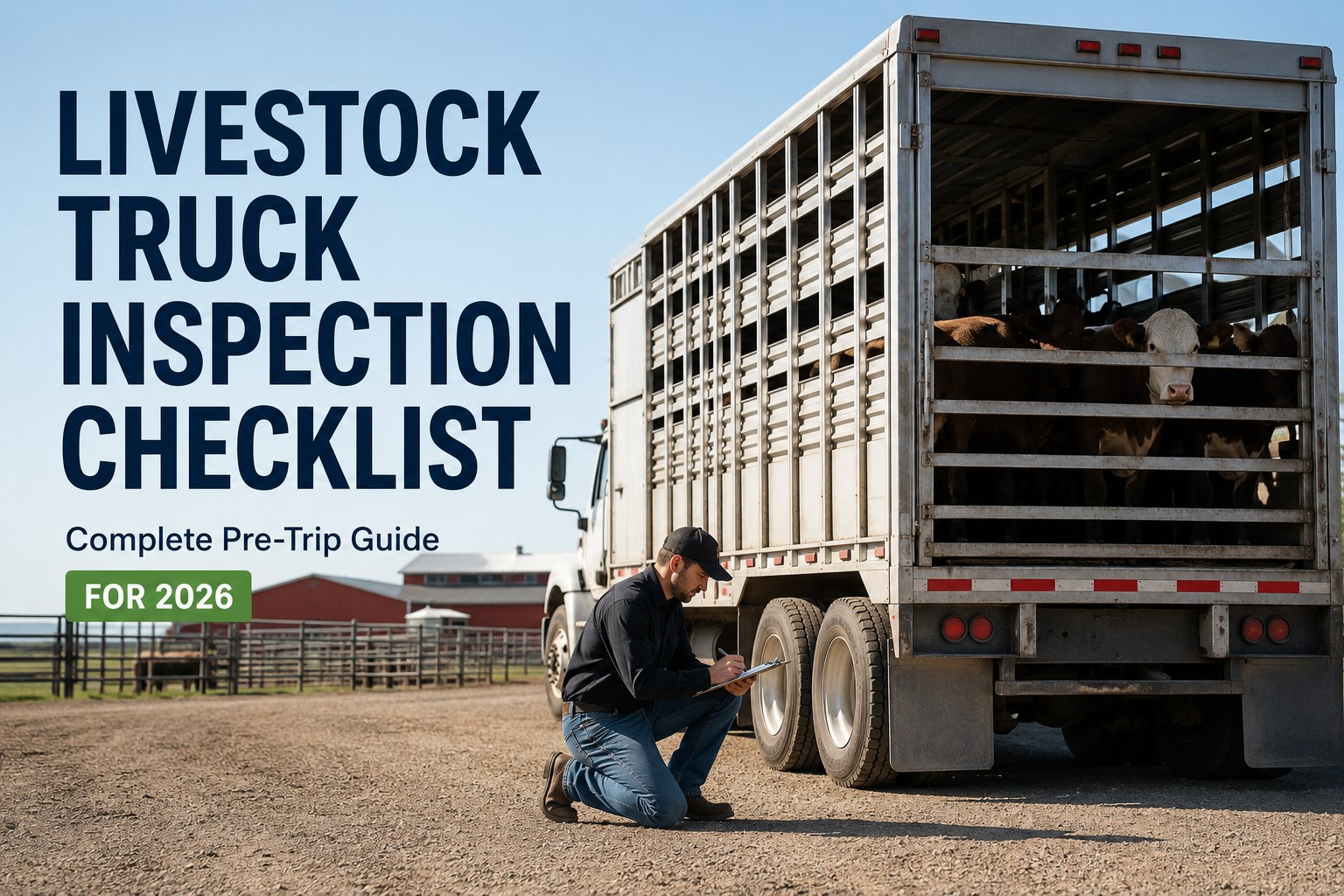
Livestock trucks haul something no other freight carrier moves — a cargo that's alive, shifts under braking, kicks, stresses, and is regulated by federal animal welfare law on top of the standard DOT framework. The USDA Transport Guidelines mandate 12-15 sq ft of floor space per cattle animal, 20% spacing between animals, and proper ventilation. Violations carry penalties up to $2,500 per infraction. Any livestock trailer over 10,000 lb GVWR falls under FMCSA 49 CFR Part 390 — daily DVIR, annual inspections, driver logs (with the special HOS exemption for livestock haulers). And every load now operates under heightened biosecurity awareness, with HPAI detected in dairy cattle and ongoing FMD prevention protocols. A generic DOT pre-trip form misses the components that actually matter for livestock — floor integrity, divider locks, ramp condition, ventilation, biosecurity wash-down. This guide gives you the complete 40-point livestock truck inspection checklist (organized across 8 animal-welfare-specific sections), stocking density reference, biosecurity protocol, and the digital DVIR workflow that handles dual USDA + DOT compliance. Start your free trial and run livestock inspections on software built for them.
Livestock Truck Inspection Checklist
Complete 8-section, 40-point pre-trip inspection covering animal welfare, biosecurity, ventilation, and DOT compliance.
Why Livestock Trucks Need a Specialized Inspection Form
A regular DOT DVIR covers brakes, lights, tires, and frame — the mechanical baseline. A livestock DVIR adds animal-welfare items mandated by USDA and recommended by BQA: floor integrity, divider locks, ramp condition, ventilation, and biosecurity wash-down. Both are required when hauling livestock — the welfare items aren't optional just because DOT doesn't explicitly mandate them:
Mechanical Items Only
DOT + USDA Welfare Items
The Complete 40-Point Livestock Inspection Checklist
Here is the full pre-trip inspection form. Print it for paper use or import it directly into Truck Inspection & Maintenance for guided digital DVIRs. Every item is interactive — tap to check off as you walk the trailer. Sections marked CRITICAL are immediate Out-of-Service if any item fails:
Floor & Footing
Dividers, Gates & Ramp
Ventilation & Climate
Biosecurity & Cleanliness
Lighting & Reflectors
Brakes & Air System
Tires, Wheels & Suspension
Documentation & Weather Plan
USDA Stocking Density Reference — Don't Overload
One of every three livestock loads industry-audited shows stocking density violations. Overcrowding raises injury rates by ~60% and triggers penalties up to $2,500 per infraction. Use this table to load right every time — by animal type and average weight:
Cattle (Mature)
1,200-1,400 lb finished steers. Maintain 20% spacing between animals; never wedge load.
Feeder Cattle
600-800 lb feeders. Less mature, slightly tighter spacing acceptable; floor footing critical.
Hogs (Market)
240-280 lb market hogs. Cooler/wetter operations than cattle; bedding and ventilation essential.
Sheep / Goats
Mature sheep ~150 lb, goats ~120 lb. Tight tolerance to drafts; check side vent settings.
Dairy Cattle
1,400-1,600 lb Holsteins. Slightly more space than beef due to size; biosecurity priority post-HPAI detections.
Horses
Mature horse, individual stalls or partitions strongly recommended. Footing & rubber matting non-negotiable.
Run livestock inspections on software built for them.
Truck Inspection & Maintenance loads the 40-point livestock checklist with guided photo capture, biosecurity wash-down logs, USDA + DOT dual-format export, and PM scheduling per trailer. Free for up to 3 vehicles. Contact support to plan your rollout.
Biosecurity Wash-Down Protocol — 5 Steps Between Loads
Livestock trailers are documented disease vectors for foot-and-mouth (FMD), HPAI, brucellosis, and pseudorabies. The wash-down protocol below is the USDA-aligned standard between loads. Truck Inspection & Maintenance logs each step with photo and time stamp for biosecurity audit defense:
Remove Solids & Bedding
Scrape and shovel out all manure, soiled bedding, and feed residue. Dispose at designated waste site — never near another livestock operation.
Pressure Wash Interior
High-pressure rinse all interior surfaces — floor, walls, ceiling, dividers, gates, ramps. Remove all visible organic matter; disinfectants don't work on contaminated surfaces.
Apply Disinfectant
USDA-approved product (Synergize, Virkon-S, or equivalent). Follow label dilution rate. Minimum 5-10 minutes contact time before rinse — boot bath logic applies to trailers too.
Wash Exterior & Wheel Wells
Manure on tires and wheel wells is the #1 farm-to-farm disease vector. Spray and rinse wheels, splash guards, mud flaps, and chassis before leaving the wash bay.
Document & Dry
Photo-log the cleaned trailer. Allow surfaces to air-dry fully before reloading. Reapply fresh bedding only to a dry trailer; wet bedding compromises disinfection.
Hot Weather vs Cold Weather — Loading Considerations
Animal welfare regulations don't allow loading in conditions that compromise welfare. Temperature, humidity, and trip length drive the decision. Use this side-by-side guide before every load:
Hot Weather Loading
Cold Weather Loading
The Cattle Hauler ROI — 8-Trailer Operation, Year 1
Livestock fleets running 5-15 trailers see measurable ROI from digital welfare-focused inspections. The math below is for an 8-trailer operation hauling cattle on regional routes, typical for a mid-size cow-calf or feeder operation:
Frequently Asked Questions
Are livestock truck inspections legally required?
Yes, on both fronts. DOT requires daily DVIRs and annual inspections for any livestock trailer over 10,000 lb GVWR under FMCSA 49 CFR Part 390. USDA Transport Guidelines additionally mandate animal-welfare compliance — floor integrity, stocking density (12-15 sq ft per cattle), ventilation. Welfare violations carry penalties up to $2,500 per infraction even when the DOT side passes.
What's the difference between a livestock DVIR and a regular DVIR?
A regular DVIR covers DOT-mandated mechanical items (brakes, lights, tires, frame, coupling). A livestock DVIR adds animal-welfare items: floor integrity, non-slip surfaces, divider locks, ramp condition, ventilation, biosecurity wash-down, stocking density. Both are required when hauling livestock — welfare items aren't optional under USDA regulations. Sign up free to load the dual-compliance form.
How much floor space is required per cattle animal?
USDA Transport Guidelines mandate 12-15 sq ft per mature cattle animal, with 20% spacing between animals. Feeder cattle (600-800 lb) need 9-11 sq ft. Dairy cattle (Holsteins) need 14-18 sq ft due to larger frame size. Industry audits show stocking density is violated on roughly 1 of every 3 hauls — typically through wedge loading or last-minute add-ons.
How often should a livestock trailer be cleaned and disinfected?
After every load. Foot-and-mouth (FMD), HPAI, brucellosis, and pseudorabies all spread farm-to-farm via dirty trailers and contaminated wheel wells. The 5-step wash-down protocol above is the USDA-aligned standard. Carryover bedding or manure from a prior load = biosecurity violation and audit exposure.
What's the most critical inspection point on a livestock trailer?
Floor integrity. The floor carries 100% of animal weight, and a soft spot, rotted board, or corroded cross-member can give way mid-haul — animal injury or fatality, full load disruption, immediate USDA citation. The checklist above puts floor & footing as Section 1 for that reason, and flags it CRITICAL for OOS enforcement.
Do livestock haulers get HOS exemptions?
Yes — under FMCSA, livestock haulers within 150 air-miles of the source are exempt from HOS rules during loading and the immediate transit, recognizing the welfare risk of stranded animals. Outside that radius, standard HOS applies. The exemption doesn't excuse welfare violations; rest stops still must include water access and welfare checks. Talk to our team for a livestock-specific compliance walkthrough.
Run the 40-point livestock inspection on software built for it.
Truck Inspection & Maintenance imports the full checklist, runs guided digital DVIRs with photo capture, logs biosecurity wash-down steps, and produces dual USDA + DOT export. Free for up to 3 vehicles. No hardware. No contracts.