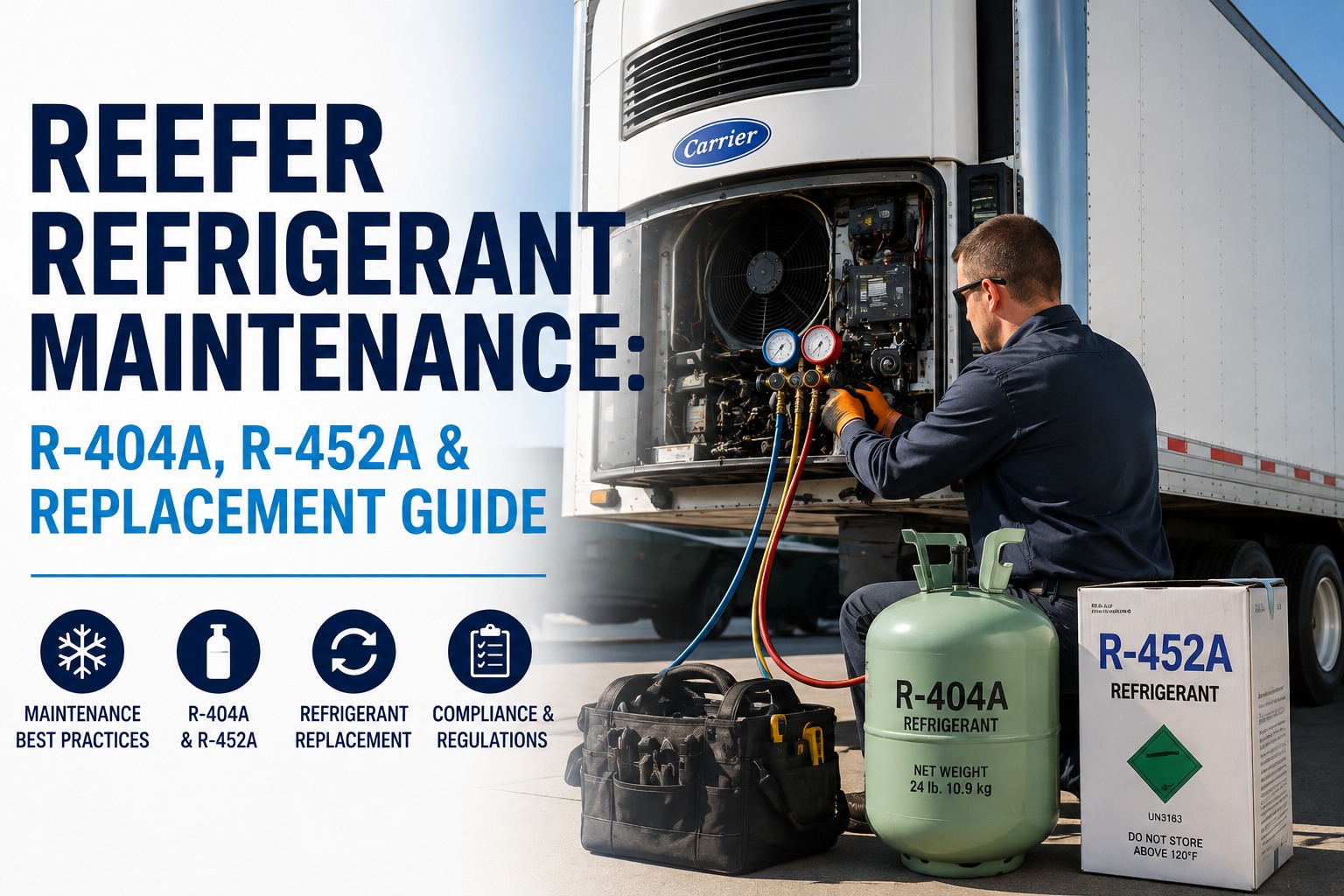
Reefer refrigerant maintenance is one of the most regulated, most expensive, and most misunderstood parts of running a refrigerated fleet. The refrigerant inside a Thermo King, Carrier Transicold, or similar reefer unit isn't just a maintenance item — it's an EPA-regulated substance under the AIM Act, subject to phasedown schedules, technician certification requirements, leak-reporting rules, and financial penalties that can reach $37,500 per day per violation for unauthorized venting. On top of the regulatory complexity, the industry is mid-transition from R-404A (the workhorse refrigerant for two decades with a GWP of 3,922) to R-452A (GWP 2,140) and beyond to lower-GWP alternatives that may be mandated by 2026–2030. Fleet managers making purchase decisions today face a specific question: keep servicing existing R-404A units, transition to R-452A drop-in replacements, or plan for the next generation of refrigerants entirely. Getting this wrong doesn't just cost money — it can strand assets when refrigerant becomes unavailable or price-inflated beyond service viability. This guide walks through the complete framework: how reefer refrigerants actually work, the R-404A vs R-452A head-to-head, the EPA phasedown timeline, leak detection and repair methods, service interval schedules, cost analysis, and how fleet software tracks refrigerant charge, leaks, and technician certifications across a reefer fleet. Ready to track refrigerant across every reefer unit? Start a free trial of our fleet maintenance software, or reach out to our support team for a walkthrough.
Reefer Refrigerant Maintenance: R-404A, R-452A & Replacement Guide
EPA-regulated refrigerant management for reefer fleets. R-404A vs R-452A head-to-head, phasedown timelines, leak detection, service intervals, and the fines for getting it wrong.
How Reefer Refrigeration Actually Works
Before making refrigerant decisions, understand what refrigerant does in a reefer unit. The four-stage vapor-compression cycle is the same physics as your home refrigerator — just running at higher capacity to cool a 53-foot trailer full of frozen product.
R-404A vs R-452A: Head-to-Head
Every reefer fleet is somewhere on the transition path from R-404A to R-452A. Here's the head-to-head comparison across the attributes that matter for fleet operations and regulatory compliance.
The EPA Regulatory Framework
Reefer refrigerant is one of the most heavily regulated substances in fleet operations. Four specific EPA rules apply — and violations carry serious financial penalties.
AIM Act (American Innovation and Manufacturing Act)
Mandates 85% phasedown of HFC production and consumption by 2036. Establishes allocation quotas for R-404A and other high-GWP refrigerants. Drives industry-wide transition to lower-GWP alternatives.
Section 608 Certification (Stationary)
Technicians servicing stationary refrigeration and container systems must hold Section 608 certification. Type II applies to high-pressure systems typical in reefer units.
Section 609 Certification (Mobile)
Technicians servicing mobile AC systems require Section 609 certification. Different from 608 but often required for full reefer service coverage.
Venting Prohibition (Clean Air Act)
Intentional venting of refrigerant is prohibited. Refrigerant must be recovered before service or disposal. Violations carry fines up to $37,500 per day per violation.
Refrigerant Leak Detection: 5 Methods
Leaks are the number-one refrigerant maintenance issue and the number-one compliance risk. Five detection methods each have their place — usually applied in sequence based on leak severity.
Reefer PM Schedule: Refrigerant-Specific
Reefer refrigerant service follows its own schedule alongside regular reefer PM. Six intervals cover the full refrigerant lifecycle from routine inspection to major service.
Refrigerant Charge Check
Verify sight glass condition, discharge pressure normal, no evaporator icing. Visual inspection only — no recovery required.
Full Pressure & Temperature Test
Suction and discharge pressures, subcooling, superheat measurements. Verifies charge amount and system performance.
Electronic Leak Inspection
Handheld leak detector scan of all fittings, service ports, evaporator coil, and condenser coil. Documented inspection required for compliance.
Compressor Oil Analysis
Sample compressor oil for moisture, acid, and metal content. Detects internal wear or refrigerant contamination before compressor damage.
Full System Recovery & Recharge
Recover all refrigerant, evacuate system, verify no moisture or non-condensables, recharge with fresh refrigerant to spec. Documented per EPA rules.
Leak Repair & Retrofit
Documented leak repair when detected. Consider R-452A retrofit at compressor rebuild or major service intervals to align with phasedown timeline.
Track refrigerant across every reefer unit
Charge amount logged per unit. Leak inspections documented for EPA compliance. Technician certifications tracked. Retrofit history archived.
The R-404A to R-452A Retrofit Decision
Every reefer fleet with R-404A units has to decide when to retrofit to R-452A. Six factors determine the right timing for your specific units.
Frequently Asked Questions
Most current reefer units use R-404A (legacy HFC being phased down) or R-452A (current pragmatic replacement). R-404A has a GWP of 3,922 and is subject to EPA allocation restrictions under the AIM Act. R-452A has a GWP of 2,140 — 45% lower — and is drop-in compatible with most Thermo King and Carrier Transicold units with minor service adjustments. Newer units may use even lower-GWP refrigerants as they become available. Track refrigerant type per unit in our fleet software.
Depends on six factors: unit age (older than 8 years may run to end-of-life; newer units should retrofit), current R-404A pricing (once above $50/lb, retrofit becomes immediate ROI), leak history (recurrent-leak units retrofit first), compressor compatibility per OEM guidance, fleet standardization value, and contract requirements from cargo customers. Most fleets retrofit at next major service interval rather than doing standalone retrofit events — combining the labor makes economic sense.
Four rules apply: the AIM Act mandates 85% HFC phasedown by 2036, Section 608 certification is required for technicians servicing stationary/container refrigeration systems (Type II for high-pressure), Section 609 covers mobile AC systems, and the Clean Air Act's venting prohibition mandates refrigerant recovery before service with fines up to $37,500 per day per violation. Leak rate thresholds require repair when annual loss exceeds 20% of full charge for commercial refrigeration.
Standard schedule: charge check every 250 hours, full pressure and temperature test every 500 hours, electronic leak inspection every 1,000 hours, compressor oil analysis every 2,000 hours, full recovery and recharge annually, and immediate documented repair when leaks are detected. Retrofit consideration at compressor rebuild or major service intervals. Track service schedules per unit and technician certifications with our team.
Five methods used together: handheld electronic leak detector (most accurate for small leaks and PM inspection), UV dye testing (best for intermittent or hard-to-locate leaks), soap bubble test (traditional and reliable for known-area leaks), pressure decay test with nitrogen (verifies leak exists before recharging), and ultrasonic detection (works in noisy shop environments and detects large leaks fast). Most fleets set an internal 10% annual loss threshold for repair — well below the EPA's 20% commercial refrigeration threshold — to prevent cargo loss risk.
A managed program for a 20-reefer fleet typically runs $18,000–$28,000 annually — covering scheduled leak inspections, refrigerant top-ups, annual full service, compressor oil analysis, and technician certification maintenance. A neglected program on the same fleet typically costs $65,000–$150,000 annually in emergency top-ups, cargo loss claims from failed units, compressor rebuilds, EPA compliance exposure, and emergency service premium rates. Managed program saves $47,000–$120,000 annually plus regulatory protection. Try tracking free: sign up here.
Every reefer, every refrigerant charge, tracked
Refrigerant type and charge amount per unit. Leak inspection history documented for EPA compliance. Technician certifications tracked and expiration alerts. Retrofit history archived. Cargo loss events correlated with maintenance patterns. Everything a reefer fleet needs to protect cargo value, meet EPA rules, and stay ahead of the refrigerant phasedown timeline instead of running reactive on a regulated system.