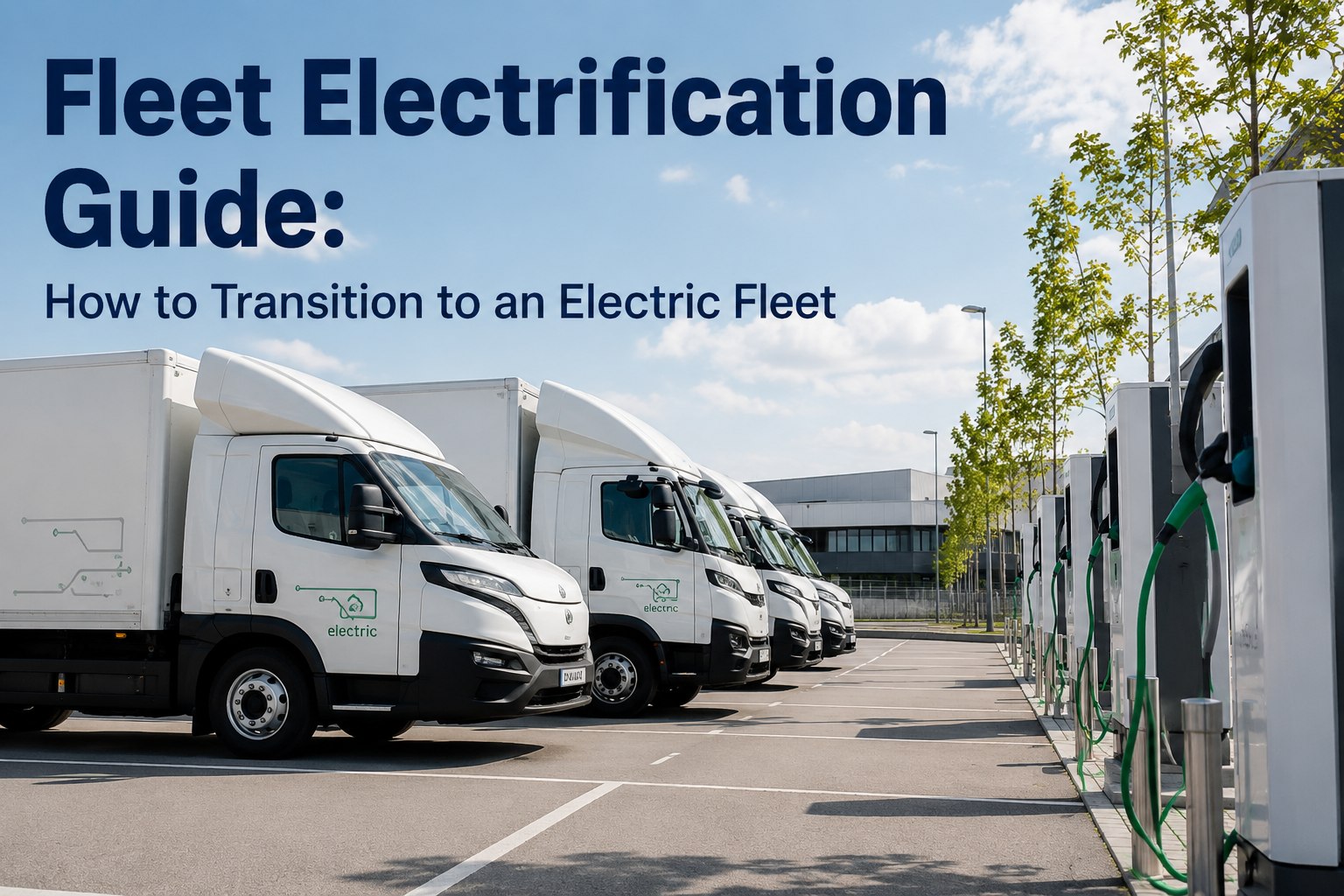
Fleet electrification hit its tipping point in 2026. 87% of fleet operators plan EV adoption within five years, 64% already operate at least some electric vehicles, and 36% expect 20–50% of their fleets to be electric by mid-2026. Light commercial EVs now deliver up to 13% lower total cost of ownership than diesel equivalents, maintenance runs 25–40% lower thanks to fewer moving parts and regenerative braking, and the fuel savings alone hit $0.10–$0.30 per mile on high-utilization duty cycles. Yet 68% of fleet managers still cite charging infrastructure as the primary barrier to broader EV adoption — because the biggest lesson from early adopters isn't about picking the wrong vehicles, it's about underestimating the operational transformation required. Fleet electrification is not a vehicle swap. It's a rebuild of your routing, your energy contracts, your depot layout, your technician training, and your maintenance workflows — all at once. Fleets that treat it as a strategic multi-year initiative see 30–45% better TCO outcomes than fleets that rush aggressive 1–2 year timelines that typically end in expensive program abandonment. This guide walks through the 2026 tipping-point evidence, the route suitability decision matrix that identifies which vehicles to electrify first, the 6-phase transition roadmap that actually works, the charging infrastructure economics (L2 vs DCFC), TCO components across acquisition and operation, cold-weather range realities, and how Truck Inspection & Maintenance helps manage inspections across a mixed diesel+EV fleet — free forever for up to 3 vehicles.
Transitioning Your Fleet to Electric: The Complete 2026 Guide
The 6-phase roadmap that turns EV pilots into deployed fleets — without the aggressive-timeline crashes.
Why 2026 Is The Tipping Point
Fleet electrification stopped being a "someday" conversation this year. Four converging forces flipped the strategic math for commercial operators — and the fleets that didn't start planning last year are running out of runway to catch up:
TCO Superiority Achieved
Light commercial EVs now beat diesel equivalents by 13% on total cost of ownership. Urban and regional Class 4–6 trucks have crossed the cost-parity line. The economic case exists without any sustainability premium.
Regulatory Pressure Rising
California ACT mandate for Class 2b–8, EU CO2 targets, corporate ESG disclosure requirements, and municipal ZEV zones are converting sustainability from optional to compliance-mandatory across major markets.
Incentive Windows Closing
30C charging infrastructure tax credit (through June 2026), state rebates, and utility make-ready programs can offset 30–50% of infrastructure costs. Multiple federal programs have sunset dates approaching fast.
Infrastructure Bottleneck
Vehicles ship in weeks. Charging infrastructure takes 6–12 months. Utility service upgrades can take 18+ months in dense markets. Fleets that wait until they need infrastructure will not have it in time.
The Route Suitability Decision Matrix
Not every vehicle in your fleet is a candidate today. Understanding which vehicles are ready to electrify — and which need to wait — is the single most important early decision. Get it wrong and pilots fail loudly. Get it right and TCO wins carry the entire program:
Best-Fit Candidates
20–40% of most fleets qualify today with strong positive TCO.
- Return-to-depot routes with predictable daily mileage
- Daily use under 80% of rated range (buffer for degradation)
- Urban last-mile delivery, dense stop density
- Utility fieldwork, shuttle services, refuse
- Overnight depot availability for L2 charging
Viable Soon
30–50% of most fleets become viable as tech and infra mature.
- Regional runs 200–400 miles with mid-day charging option
- Route-shareable vehicles with peak demand flexibility
- Vehicles due for replacement in 2–4 years
- Mixed duty cycles where reserve capacity acceptable
- Locations pending utility service upgrades
Wait for Later Phase
20–30% of most fleets should stay ICE until conditions change.
- Long-haul OTR routes exceeding 400 daily miles
- Remote or rural routes without charging infrastructure
- Heavy refrigerated transport (reefer draws range fast)
- Emergency response requiring guaranteed availability
- Extreme cold-climate operations without pre-conditioning
The 6-Phase Transition Roadmap
Fleets following this phased approach achieve 30–45% better TCO outcomes than fleets that skip to deployment. This is a 3–7 year journey done properly, not a 12-month sprint. Skip phases at your own risk:
Fleet Assessment & Route Analysis
Inventory every vehicle by class, age, duty cycle, daily mileage, and depot access. Overlay against EV availability by class. Identify the 20–40% of best-fit candidates. Output: prioritized electrification candidate list ranked by TCO impact.
TCO Modeling & Business Case
Full 5–15 year TCO across acquisition, energy, maintenance, incentives, and residual value. Model against diesel baseline. Layer in duty cycle, utility rate structure, and cold-weather range loss. Get finance and operations aligned before capital request.
Pilot Program (3–10 Vehicles)
Deploy on best-fit routes. Install initial charging infrastructure. Gather 6–12 months of real-world data on energy use, maintenance patterns, seasonal range, and driver acceptance. Pilots reveal operational realities planning cannot predict.
Charging Infrastructure Buildout
Utility engagement for service upgrades (6–18 month lead time). Depot L2 for daily charging, DCFC for opportunity/pass-through. Load management systems. This phase is where aggressive timelines crash — infrastructure is the critical path, not vehicles.
Scaled Deployment
Roll out to full best-fit segment as infrastructure comes online. Migrate viable-soon routes as vehicle tech matures. Retrain technicians for high-voltage systems. Adjust routing, dispatch, and duty cycles for EV constraints.
Optimization & Mixed-Fleet Operations
AI-powered routing that assigns EVs to their optimal duty cycles. Energy management to charge during off-peak rates. Continuous TCO tracking. Long-haul stays ICE until infrastructure and tech catch up — no forced electrification.
Charging Infrastructure — The Real Numbers
Infrastructure is the line item that surprises most fleet operators — because vehicle capex is visible while charging capex is invisible until you're in it. Here's the honest breakdown across the three charging tiers commercial fleets deploy:
120V Standard Outlet
Emergency backup only. Not viable for commercial fleet daily charging.
240V Depot Charging
The workhorse of commercial fleet charging. Overnight depot deployment is the standard model.
DC Fast Charging
Opportunity charging for mid-day top-ups and long-haul route enablement.
The Real Cost of Depot Deployment
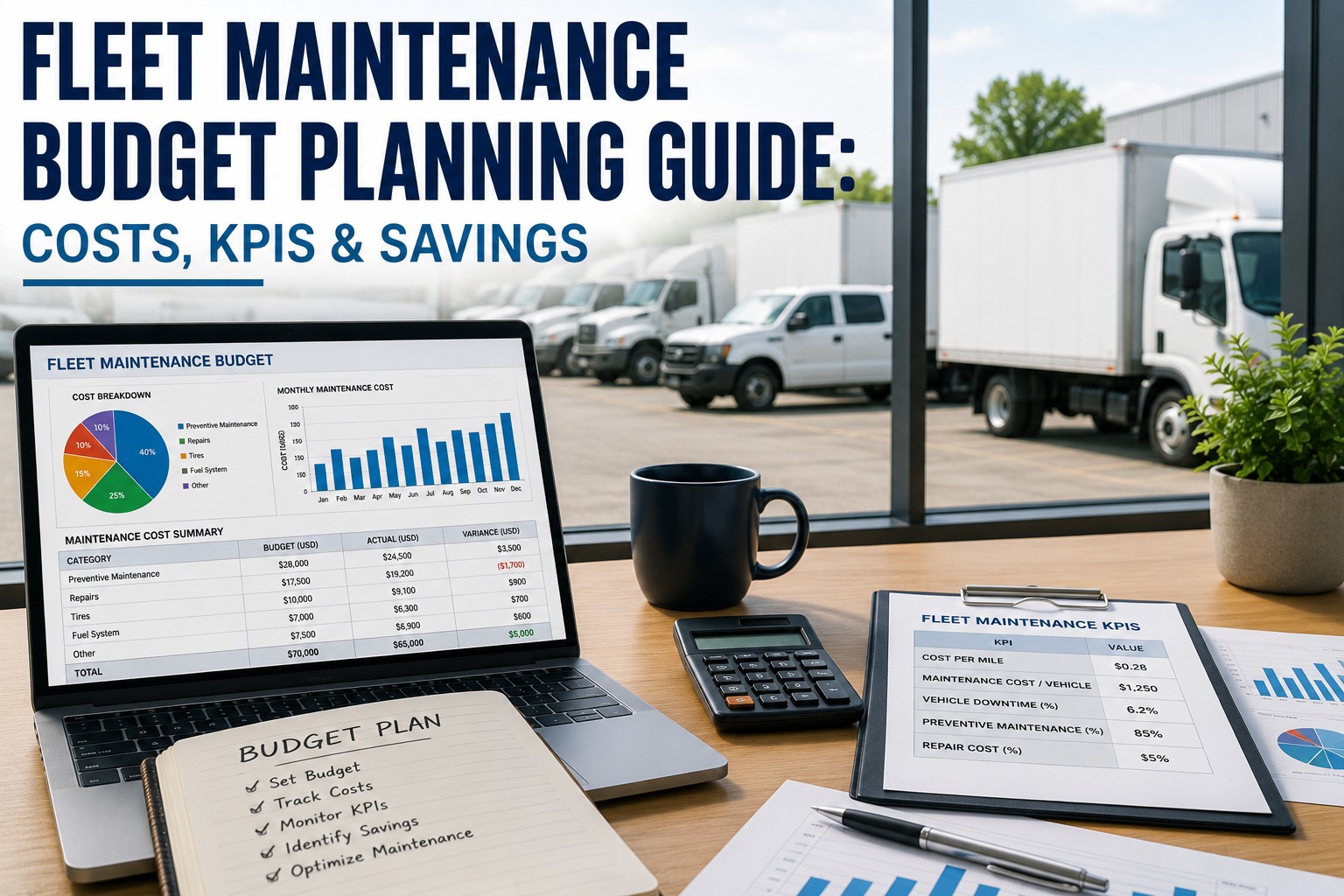
A 20-vehicle Level 2 depot deployment realistically totals $100,000–$200,000 in infrastructure before incentives — including hardware, electrical service, panel upgrades ($5K–$25K), conduit runs ($50–$150 per linear foot), and permits ($500–$2,500). Utility make-ready programs and the 30C tax credit through June 2026 can offset 30–50%. Budget $300–$500/year maintenance per L2 charger, $600–$800+ for DCFC.
Total Cost of Ownership Components
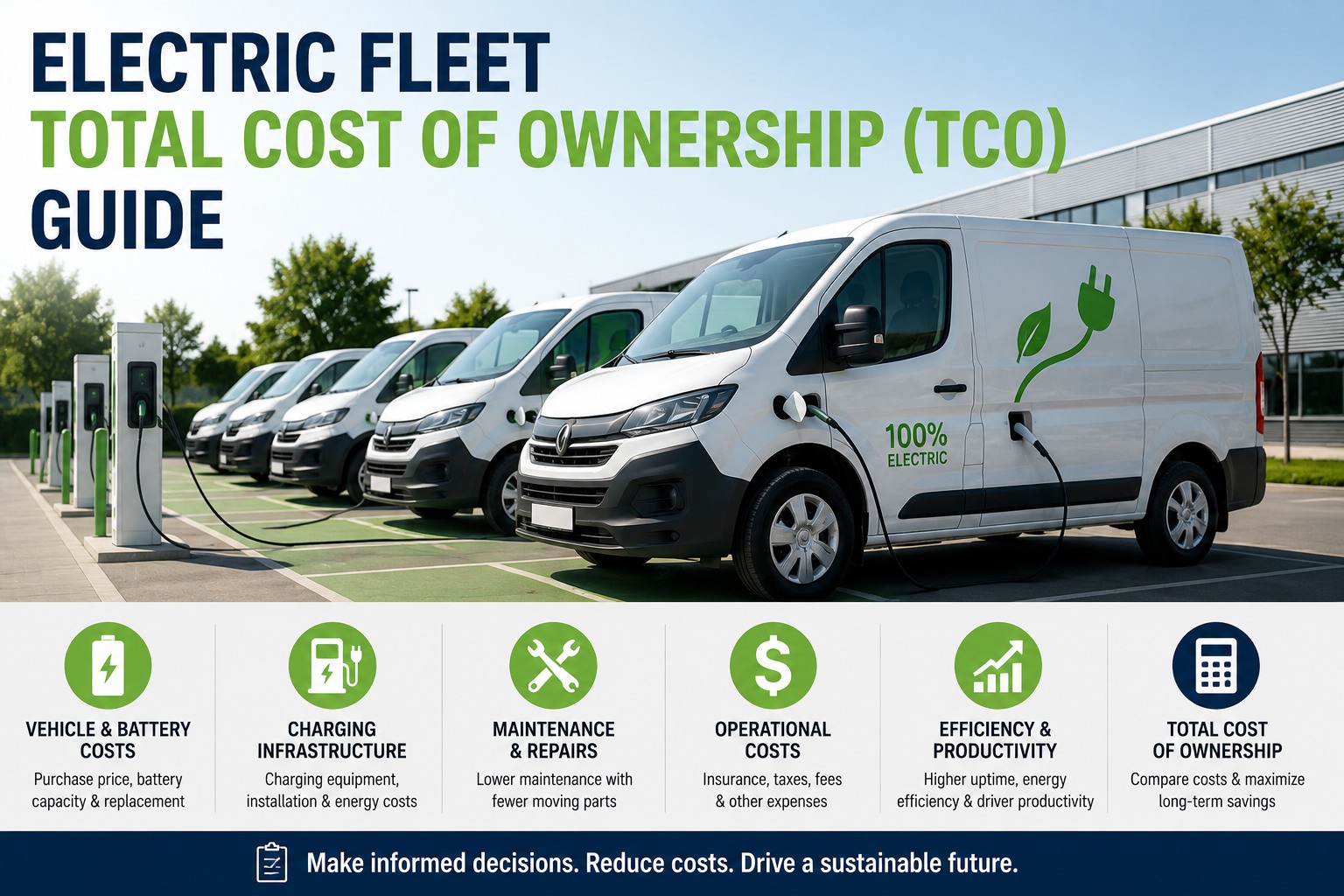
TCO analysis is the single most important calculation in the entire electrification decision. It's also the calculation vendors do the least honestly. Here's the six categories that must be modeled for a defensible business case:
Vehicle Acquisition
Light commercial EV: 30–50% premium over diesel. Class 8 EV truck: $150,000–$400,000 (vs $120K–$180K diesel). Federal & state incentives can offset 20–40%.
Energy vs Fuel
EV electricity: $0.03–$0.10/mile depending on rate. Diesel: $0.20–$0.35/mile. Fuel savings alone: $0.10–$0.30/mile. Fleet-wide savings compound fast.
Maintenance
EVs run 25–40% lower maintenance. No oil changes, no fuel filters, no exhaust system, no transmission (mostly). Regen braking extends pad life 2–3×.
Infrastructure
L2 port: $3K–$7K installed. DCFC: $50K–$500K+. 20-vehicle depot: $100K–$200K. Amortized across 10-year infrastructure life against savings.
Incentives & Credits
Federal Commercial Clean Vehicle Credit (up to $40K). 30C infrastructure credit (through June 2026). State rebates, utility programs — offset 30–50% often.
Residual Value
Highly uncertain. Battery health at trade-in is the wild card. Some early EVs show strong residuals; others suffer from tech obsolescence. Model conservatively.
Managing inspections across diesel + EV? Truck Inspection & Maintenance handles both.
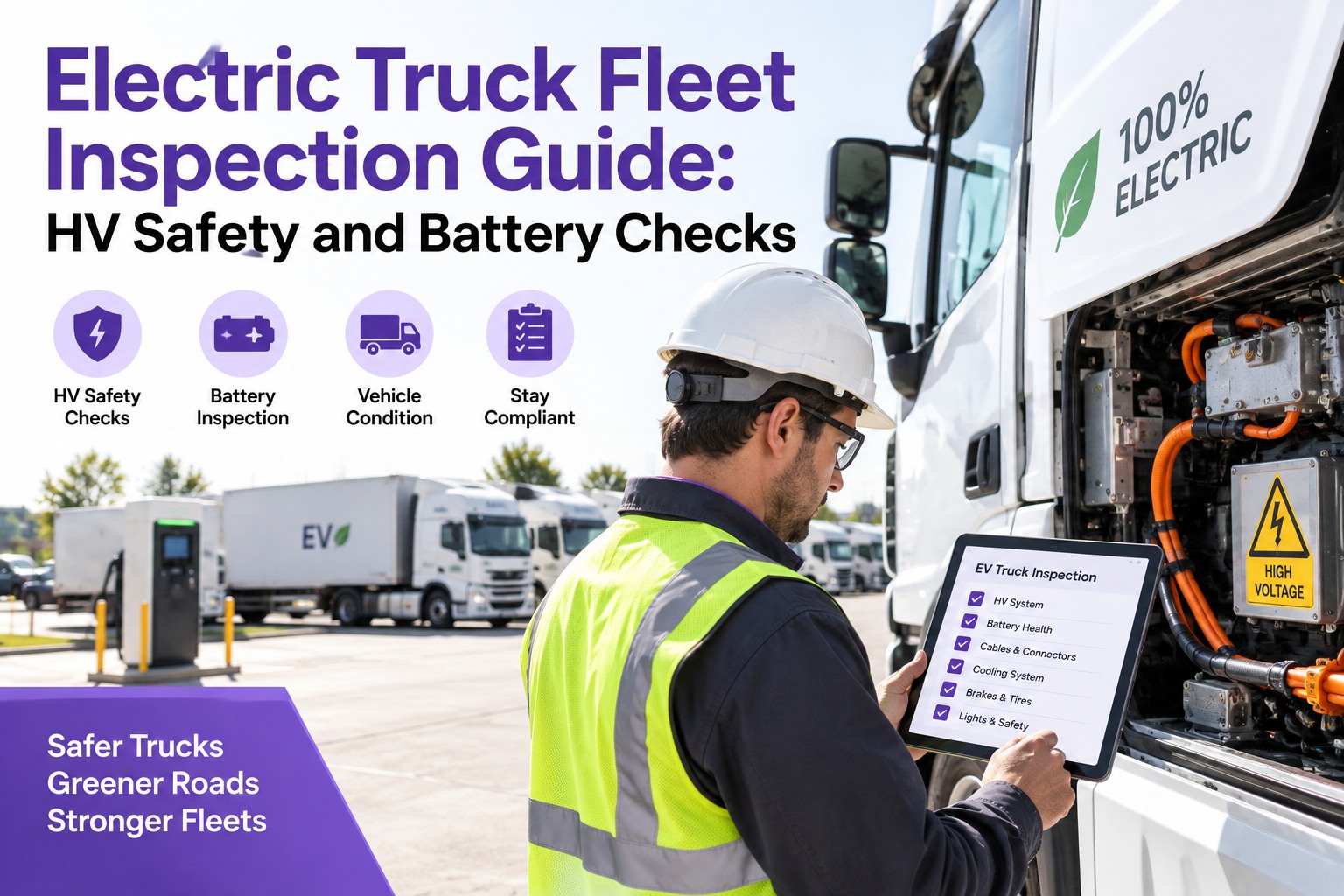
Electrification is a 3–7 year mixed-fleet reality — you'll run diesels alongside EVs the entire way. Truck Inspection & Maintenance handles inspections across every vehicle type in your fleet, with EV-specific templates for battery health, charging system checks, and high-voltage safety — plus full DOT-compliant DVIRs for diesels. All in one system. Sign up free for up to 3 vehicles.
The Cold Weather Range Problem
The single most under-discussed risk in fleet electrification planning is winter range performance. Lithium-ion batteries lose 20–40% of rated range below -10°C, and HVAC energy demand can double. Models built on OEM spec range crash into reality in January:
Range Loss Below -10°C
Lithium-ion chemistry loses efficiency in cold. Internal resistance rises. Battery must warm before delivering full power. Winter routes see dramatic range reduction.
HVAC Energy Demand
Cabin heating in EVs draws from the same battery that powers the drivetrain. Heated seats, heated steering, and pre-conditioning while plugged in reduce this dramatically.
Max Daily Use Rule
Plan routes at max 80% of rated range to buffer for battery degradation (2–3% per year) and winter conditions. Vehicles at 100% today become marginal in year 3.
Pre-Conditioning Window
Warm battery and cabin while plugged in before dispatch. Preserves range. Winter fleets that pre-condition religiously see 30–50% less winter range loss vs those that don't.
The 6 Transition Risks That Kill Programs
Every abandoned fleet electrification program failed for one or more of these reasons. Address them before deploying vehicles, not after:
Skipping the Pilot
Going straight from planning to full deployment. Pilots reveal charging bottlenecks, route adjustments, and seasonal issues that planning cannot predict. 6–12 months minimum.
Underestimating Infrastructure Timeline
Vehicles arrive in weeks. Utility service upgrades can take 18+ months. Start infrastructure work months before vehicle orders — the reverse kills programs.
Ignoring Cold-Weather Range Loss
Sizing routes on OEM spec range with no winter buffer. Trucks stranded on Day 2 of the first cold snap = program credibility over. Model winter separately.
Forcing Wrong-Fit Routes
Trying to electrify long-haul OTR or refrigerated transport before technology supports it. Better to phase properly than to force EVs onto routes they can't serve.
Skipping Technician Retraining
High-voltage systems demand qualified technicians. OEM training, safety certifications, specialized diagnostic equipment. Untrained shops = safety risk + failed repairs.
Aggressive 1–2 Year Timelines
Aggressive timelines produce program abandonment. Realistic timelines produce operational fleets. 3–7 years for full transition is the successful pattern.
Frequently Asked Questions
How long does full fleet electrification realistically take?
3–7 years for complete transition of a mixed fleet. Aggressive 1–2 year timelines typically result in operational failures and program abandonment. The successful pattern is phased: assess & TCO model (6–12 months), pilot (12–18 months), infrastructure buildout (12–24 months), scaled deployment (18–36 months), and ongoing optimization. Long-haul OTR routes may remain ICE for 5+ years pending charging infrastructure and battery capacity improvements. Fleets that treat this as a strategic multi-year initiative see 30–45% better TCO outcomes than fleets that rush.
What's the actual cost of charging infrastructure?
Level 2 depot chargers cost $3,000–$7,000 per port installed. DC Fast Chargers run $50,000–$500,000+ per unit depending on power output. A 20-vehicle Level 2 depot deployment realistically totals $100,000–$200,000 before incentives — including hardware, electrical work, panel upgrades ($5K–$25K), conduit runs ($50–$150 per linear foot), and permits ($500–$2,500). Utility make-ready programs and the 30C tax credit through June 2026 can offset 30–50%. Budget $300–$500/year maintenance per L2, $600–$800+ for DCFC.
Which fleet vehicles are best for electrification today?
Return-to-depot vehicles with predictable daily mileage well within rated range (ideally under 80% for degradation buffer). Best candidates: urban last-mile delivery, utility fieldwork, shuttle services, refuse collection, dense-stop delivery routes. Long-haul OTR routes with 400+ daily miles are last to electrify — they need charging infrastructure density and battery capacity that don't exist yet. Most fleets find 20–40% of vehicles are excellent electrification candidates today, another 30–50% viable within 3–5 years.
How much does cold weather affect EV range?
Lithium-ion batteries lose 20–40% of rated range in temperatures below -10°C due to increased internal resistance and HVAC energy demand. Pre-conditioning the vehicle while still plugged in (warming battery and cabin) reduces this significantly — fleets that do it religiously see 30–50% less winter range loss. Plan routes at max 80% of rated range to buffer for degradation (2–3% per year) and winter conditions. Fleets in Minnesota or Alberta must model winter separately from summer range.
Are EV maintenance costs really lower than diesel?
Yes — 25–40% lower on average. EVs have far fewer moving parts: no oil changes, no fuel filters, no exhaust after-treatment, no traditional transmission service (most are single-speed), no belts, no spark plugs. Regenerative braking extends brake pad life 2–3×. Main EV maintenance items: tires (wear slightly faster due to higher torque and weight), coolant service, cabin filter, brake fluid, and eventual battery health monitoring. High-voltage battery replacement costs are significant but rare within first 8–12 years. Talk to our team about EV inspection workflows.
How does Truck Inspection & Maintenance help with mixed fleet management?
Fleet electrification is a mixed-fleet reality for 3–7 years — you'll run diesels alongside EVs the entire way. Truck Inspection & Maintenance handles inspections across every vehicle type in your fleet with configurable templates: DOT-compliant DVIRs for diesels, plus EV-specific checks for battery state of health, charging equipment condition, high-voltage cable integrity, and cooling system status. All defects route to shop as priority work orders. Free forever for up to 3 vehicles. Sign up in 10 minutes.
Your fleet will be mixed diesel + EV for years. Your inspection system should handle both from day one.
Truck Inspection & Maintenance covers DOT-compliant DVIRs for diesel trucks plus EV-specific inspection templates — battery health, charging equipment, high-voltage cable checks, cooling systems — with photo evidence, GPS location, and timestamps on every observation. Defects auto-route to shop as priority work orders. Free forever for up to 3 vehicles with no hardware and no contracts. Set it up in 10 minutes.