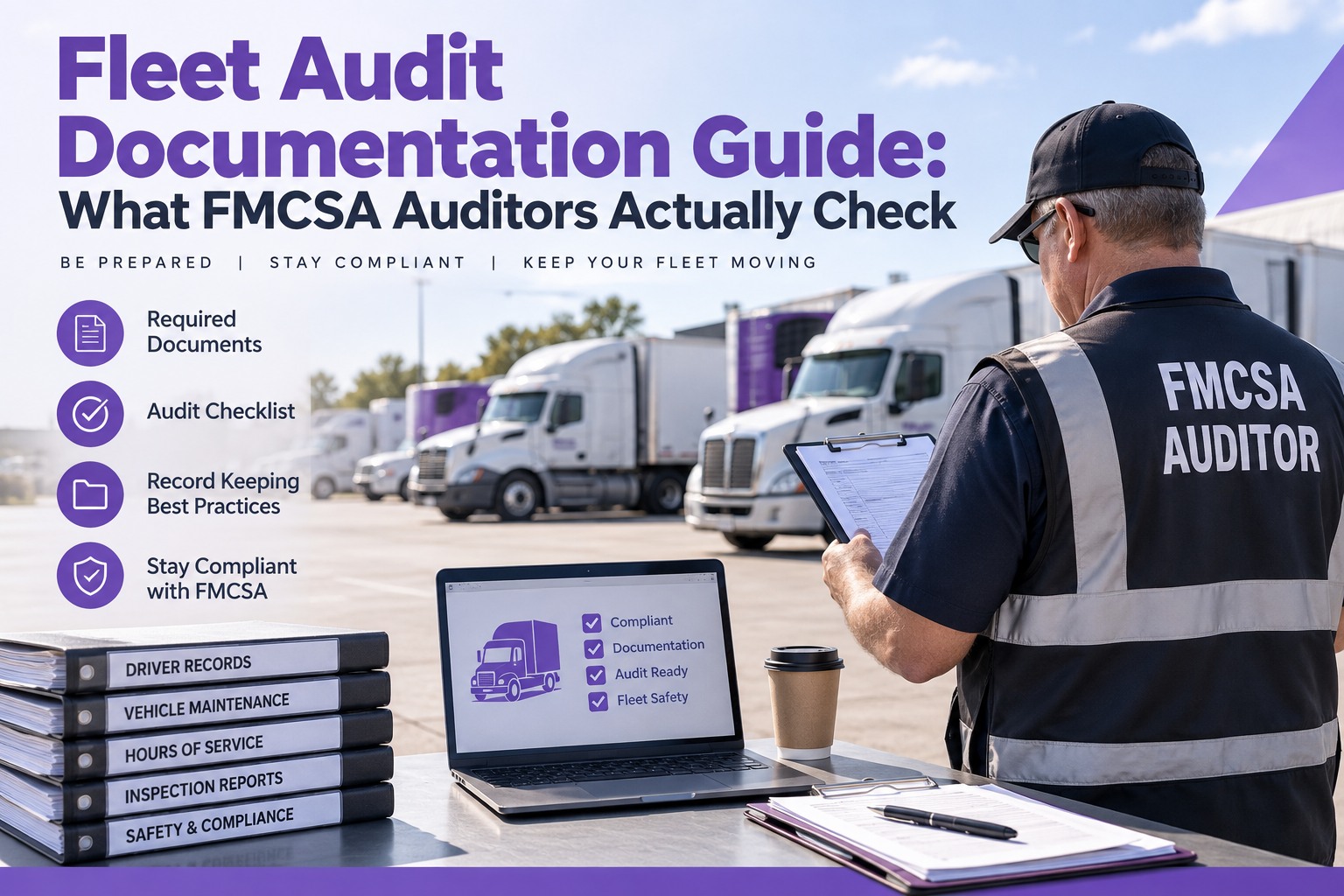
Every commercial trucking insurance renewal comes down to one moment: the underwriter opens the submission packet your broker sent, decides in the first five minutes whether the file is complete, disciplined, and defensible, and either quotes competitively or defensively based on what they see. Most fleets walk into that moment blind — sending whatever the broker asks for, missing three items, delivering everything two weeks late, and then wondering why the renewal came back 20% higher. It doesn't have to be that way. Underwriters ask for essentially the same document set at every mid-market fleet renewal — and knowing that list in advance, organizing each artifact the way underwriters actually read it, and delivering the package 60–90 days before expiration is the single highest-leverage move a safety director can make. This checklist gives you the exact document list underwriters request, how to organize each one for maximum credit, and how Truck Inspection & Maintenance produces the maintenance and DVIR half of the file automatically. Start a free trial to build the audit-ready file now.
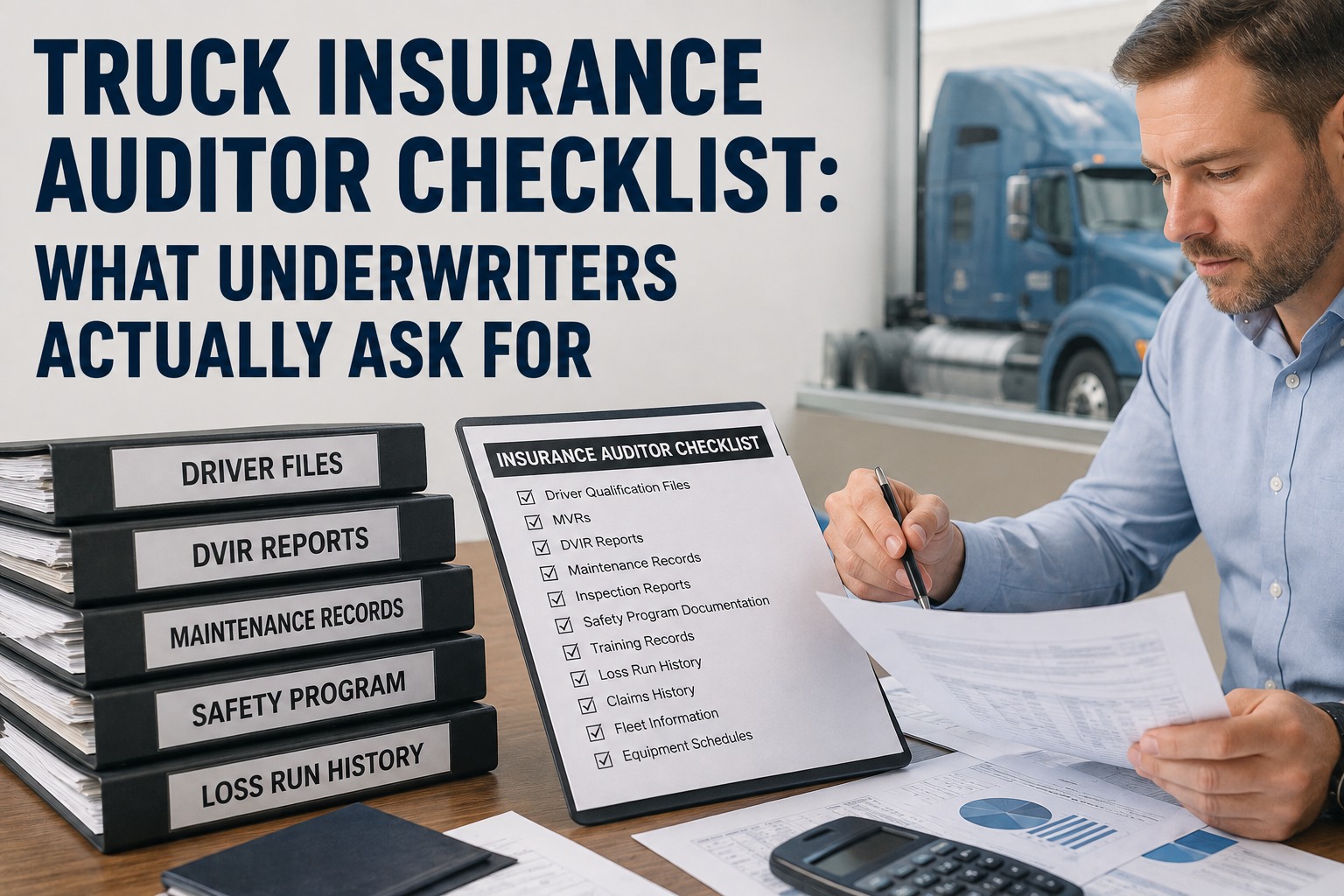
Truck Insurance Auditor Checklist: What Underwriters Actually Ask For
The exact document list underwriters request during a commercial truck fleet insurance audit — organized the way underwriters actually read it, with tips for producing each artifact for the best possible rate at renewal.
Two Kinds of Insurance Audit — Know Which You're In
Fleets often confuse the two. They are different processes, with different documents required, and mixing them up wastes time on the wrong prep. Both hit most fleets every year.
When: After policy period ends, to reconcile actual vs. estimated exposure
Reconciles the drivers, units, radius, and mileage you estimated at policy start against what actually happened. Result: refund, additional premium, or wash. Documentation-heavy but backward-looking.
When: 60–120 days before renewal, to price the next policy term
Evaluates your risk quality across CSA, driver files, maintenance discipline, safety programs, and loss history. Result: your next renewal number. Forward-looking; this is where prep pays off.
The Complete Underwriter Document List
Grouped by category the way underwriters actually organize a submission review. Every item earns its place in the file — missing any of them signals disorganization at best, concealment at worst.
SAFER snapshot printed within the last 30 days. Confirms active status, authority type, and any current out-of-service order.
Full current fleet — no retired trailers still on the schedule inflating premium. Cross-check against your ELD-registered units.
Underwriters reconcile reported mileage against IFTA. Discrepancies trigger scrutiny; matching numbers are silent proof of accuracy.
Local, regional, or long-haul percentages. Radius directly moves rate; a documented statement beats an assumption every time.
The single most-scrutinized document. Order from your current carrier 120 days before renewal — it takes weeks to arrive.
For any single claim over your carrier's threshold: what happened, corrective action taken, what changed to prevent recurrence.
Current reserves, expected resolution timeline, and any coverage disputes. Silence on open claims reads as concealment.
Current active drivers only. Include tenure — long-tenure drivers materially reduce priced risk.
Every active driver, current. An MVR older than 90 days weakens the file; an unverified MVR invalidates it.
Confirmation that DQFs meet 49 CFR 391 requirements — application, road test, medical, previous employer inquiries.
Written policy: minimum age, experience, MVR thresholds. Auto-disqualifiers spelled out. Proves selection discipline.
Initial training, annual refreshers, incident-triggered coaching. Records that connect events to actions taken.
DVIRs filed, defects flagged, chain-closure rate, average defect-to-repair time. Digital DVIR platforms produce this in one click.
On-time PM percentage by month, target vs. actual, 12-month trend line. 95%+ on-time is preferred-tier territory.
Every unit with current inspection date, signing technician, and link to that tech's 396.19 qualification evidence.
Sample of high-severity defects with the work-order thread — reported, repaired, certified, closed. Proves the loop closes.
Screenshot of your Safety Measurement System dashboard. Any BASIC above threshold: include your remediation plan.
Every roadside inspection in the year, violations received, and any DataQs challenges filed. Shows active management.
Substance testing, HOS, phone use, backing procedures, post-crash protocol. Written and dated, with revision history.
Systems deployed, adoption percentage, coaching workflow. Fleets with 100% telematics adoption get materially better pricing.
One page, signed by the safety director. Confirms the program cadence, review schedule, and executive oversight.
The Maintenance Half of the File — Automated
Truck Inspection & Maintenance produces items 13 through 16 automatically — DVIR compliance summaries, PM compliance reports with trend lines, annual inspection registers, and defect-to-repair work order histories — mobile-first, cloud-stored, and audit-ready every day of the year. When renewal season arrives, that half of the packet is already assembled.
How Underwriters Actually Read the Packet
Knowing the order of the underwriter's review lets you weight your prep effort where it matters most. This is roughly how the first hour of review unfolds at most commercial trucking desks. Start free and produce the highest-weighted docs directly from the platform.
First thing they check: your public SAFER profile, CSA BASICs, out-of-service history. If anything is above threshold, everything else gets read defensively.
Three years of loss frequency and severity. Frequency of small claims hurts more than one large loss. Trend line is critical.
Skim through MVR quality, tenure mix, hiring standards. Weak DQF discipline caps preferred-tier eligibility on its own.
DVIR summary, PM compliance percentage, work-order closure. This is where fleets differentiate — clean maintenance discipline is worth real premium dollars.
Written policies, telematics adoption, executive attestation. Ties the file together and confirms the program is real.
The Top 6 Reasons Renewals Come Back High
Brokers see these mistakes repeatedly. Each one costs premium dollars that better prep would have saved.
The 120-Day Renewal Prep Timeline
Backing out from renewal date, here's the cadence that consistently produces clean submissions and better pricing.
Request from current carrier immediately. They take 2–4 weeks to arrive.
Meet with broker. Review last year's file, identify gaps, agree on strategy.
Refresh MVRs, reconcile the unit schedule, close any open compliance gaps.
Pull maintenance reports, CSA screenshot, safety program summary. Full packet ready.
Broker submits to underwriters. Time for questions and market alternatives.
Compare quotes with coverage in mind, not just price. Bind before day 0.
Frequently Asked Questions
120 days for any fleet with prior loss history, CSA score issues, or more than 20 units. 90 days as a bare minimum for clean smaller accounts. Fleets that start at day 30 consistently pay 10–20% more than they would have with proper runway — not because the risk is different, but because the file arrives rushed and the underwriter has no time to credit evidence. Start free to keep the maintenance half of the file ready year-round.
Address the gaps proactively rather than hoping they aren't noticed. The underwriter will pull your SAFER profile and CSA data regardless — knowing what they'll see before they see it lets your broker frame issues instead of react to them. A gap you flag and explain is neutral; a gap they discover reads as concealment. If systemic gaps exist (paper DVIRs, no PM tracking, missing tech qualification files), address the root system before the next renewal cycle — not the file.
The document list scales down, but the underwriter's questions don't. Small fleets still get asked for loss runs, DQFs, DVIR discipline, and PM records — and a small fleet with tight files is often priced more favorably than a large fleet with fragmented systems, because tight files signal an engaged owner. The playing field is more level than many small-fleet operators assume, provided the paperwork discipline is real.
The value isn't the PDF at renewal — it's the discipline that produced the data going into it. Truck Inspection & Maintenance captures DVIRs, PMs, work orders, and inspection records as daily-operational activity rather than renewal-prep scramble. That means the on-time PM percentage the underwriter sees is real, the DVIR chain integrity is real, and the metrics you present are ones the underwriter can independently verify against the trend. Underwriters price documented reality higher than assembled paperwork. See how the platform delivers renewal-ready data.
Three things, in order: (1) address any CSA BASIC currently above threshold, since one above-threshold BASIC caps your tier eligibility no matter what else is in the file, (2) get PM on-time compliance above 95% and keep it there for a full quarter before renewal so the trend line is visible, and (3) tighten DQF discipline so every driver has current MVRs and complete files. Those three moves change tier eligibility for most fleets. Everything else in the checklist matters at the margin.
Turn the Auditor Checklist Into a One-Click Export
Truck Inspection & Maintenance is a mobile-first fleet maintenance platform that automates DVIRs, PM scheduling, work orders, and compliance recordkeeping — producing the maintenance and inspection sections of your renewal packet as a daily byproduct of operations. When your broker asks for the file, it's already assembled.