There's a specific moment in every fleet's operating day where compliance either holds up or collapses — and it's not at pre-trip, and it's not at roadside. It's the moment a dispatcher picks up a phone, scrolls to Truck #47, and assigns it a load. If the dispatcher can't see the open DVIR defect from Driver A's post-trip inspection the day before — the "grinding brake noise at slow speeds" that Driver A dutifully documented at end of shift — then Driver B walks up to a truck with an unrepaired safety defect and rolls out on a load. This isn't a hypothetical failure mode; it's how 73% of paper DVIRs fail. The report gets left in the cab, filed in a folder no one opens, or shuffled to a maintenance in-box that dispatch never checks. Under 49 CFR 396.11, dispatching a vehicle with an unrepaired safety defect carries per-occurrence civil penalties. Under § 396.13, a driver cannot operate a CMV without reviewing and signing the previous DVIR — but if dispatch already assigned the load, the driver's business incentive is to sign quickly rather than actually read. And when the truck gets pulled at roadside, the officer sees the same DVIR chain the FMCSA auditor sees: 89% of FMCSA compliance reviews audit DVIR records, and only 7% of paper-based fleets pass cleanly (versus 96% for digital). The dispatcher didn't know. Never actually meant harm. But operationally, dispatch without DVIR visibility is a broken system by design — the very step where truck-to-load matching happens is blind to the safety condition of that truck. Ready to close the visibility gap and prevent unsafe assignments before they happen? Sign up free for Truck Inspection & Maintenance today — no credit card required and give your dispatchers real-time DVIR visibility with automatic dispatch blocking on open safety defects, or contact our support team for a personalized walkthrough showing how top-performing fleets integrate DVIR data directly into their dispatch workflow.
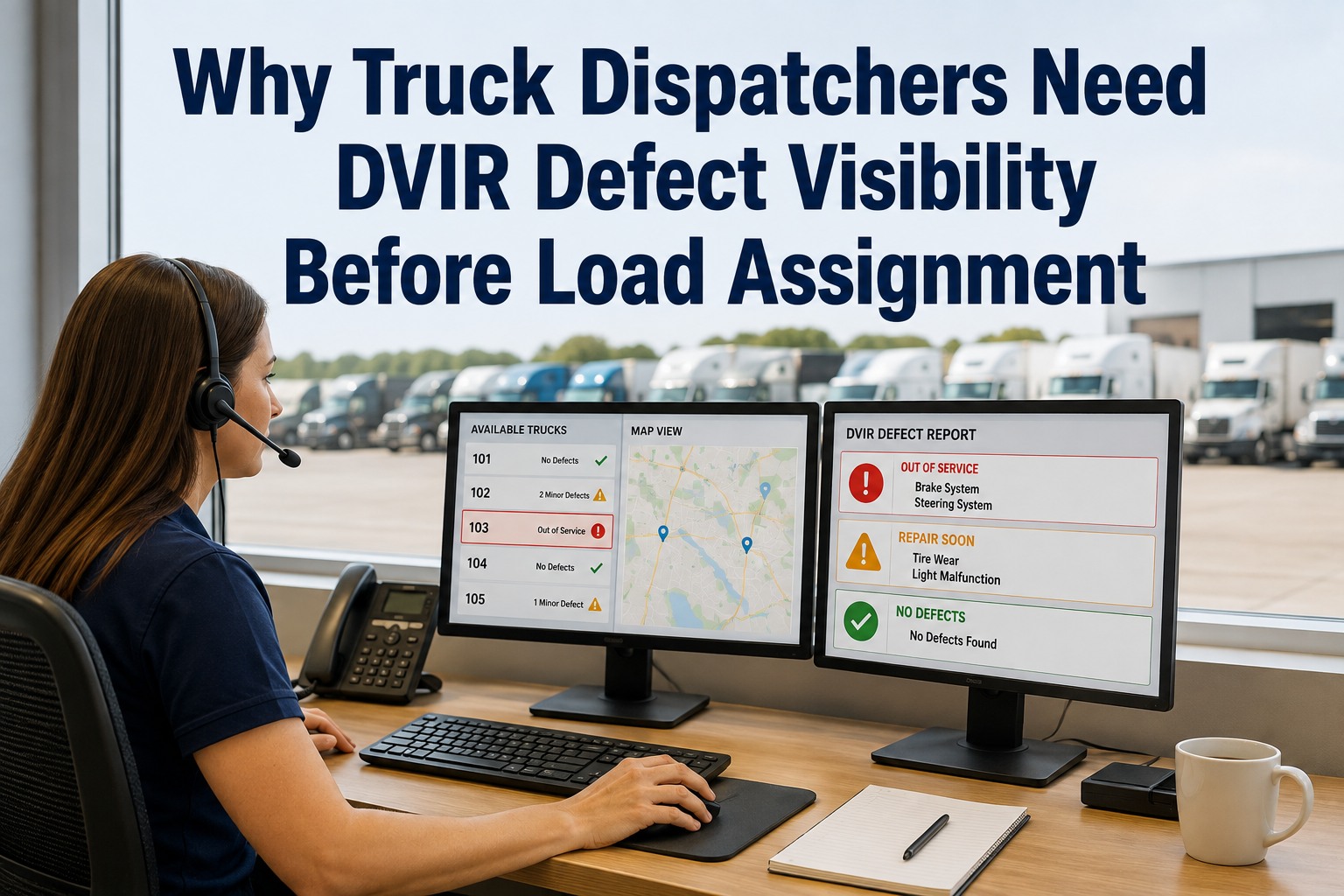
Why Truck Dispatchers Need DVIR Defect Visibility Before Load Assignment
The load doesn't get matched at roadside. It gets matched at dispatch. When dispatch is blind to open DVIR defects, unsafe trucks get assigned every day — and the cost hits everyone.
The Broken Dispatch Workflow — What Happens When Dispatch Is Blind
Without DVIR visibility, dispatch operates on a different set of information than maintenance or drivers. Here's what a typical broken workflow looks like on a paper-based or disconnected-systems fleet.
The 3-Signature Chain of Custody — Where Each Link Breaks
Under §§ 396.11 and 396.13, every defect must pass through 3 confirmations before the truck rolls again. Missing any signature is a citable violation — and dispatch visibility is what keeps every link intact.
The Fixed Workflow — Dispatch Sees Defects in Real Time
Digital DVIR-dispatch integration inverts every one of the failure modes above. Dispatch operates on the same information system as drivers and maintenance, and the software enforces the chain of custody automatically.
Turn dispatch into a safety-first system that can't assign unsafe trucks
Real-time DVIR defect visibility on the dispatch dashboard. Automatic dispatch blocking on open safety defects. 3-signature chain enforcement with mandatory acknowledgment before operation. Photo-verified defect capture. Truck Inspection & Maintenance software makes DVIR data available to dispatch, drivers, and maintenance in one shared system — because the dispatcher needs to see what the driver saw last night.
What Dispatch Needs to See — 6 Critical DVIR Data Points
Not every DVIR data point belongs on the dispatch screen. But these six are the difference between informed dispatch and blind assignment.
The 2026 eDVIR Final Rule — Regulatory Green Light
FMCSA published a final rule on February 19, 2026 (effective March 23, 2026) that explicitly authorizes electronic DVIRs under §§ 396.11 and 396.13. Every technical objection to eDVIR adoption is now gone.
The Cost of Broken Dispatch DVIR Visibility
Every unsafe assignment carries costs across four dimensions. Here's what happens when the dispatcher can't see the defect — and it isn't just the roadside citation.
Frequently Asked Questions
Dispatch is the single point in a fleet's daily workflow where truck-to-load matching happens. If the dispatcher can't see which trucks have open DVIR defects, unsafe trucks get assigned to loads by default — not by negligence, but by lack of information. Under 49 CFR 396.11, dispatching a vehicle with an unrepaired safety defect carries per-occurrence civil penalties, and 89% of FMCSA compliance reviews audit DVIR records specifically to identify this exact failure. Without dispatch visibility, the workflow breaks in a specific way: Driver A documents a defect at post-trip, the paper DVIR sits in a drop-box overnight, dispatch assigns the truck to a new load at 5 AM without knowing about the defect, Driver B signs the previous DVIR under time pressure without actually reading it, and the truck rolls out with an unrepaired safety condition. Real-time DVIR visibility on the dispatch dashboard prevents this cascade — dispatchers see red flags on trucks with open defects and route loads to safe alternatives. Truck Inspection & Maintenance software makes DVIR data visible across dispatch, drivers, and maintenance in one shared system.
Six critical DVIR data points belong on the dispatch dashboard: (1) Open defect status flag — simple red/yellow/green indicator per truck (red = open safety defect, do not dispatch); (2) Defect category and severity — brakes, tires, lights, coupling, etc. with severity level so dispatch understands whether a short local run is possible while a long-haul isn't; (3) Repair status and ETA — Awaiting Repair / In Progress / Repaired / Certified with estimated completion time; (4) 3-signature chain status — which of the required signatures are captured (Driver A submitted, Mechanic certified, Driver B acknowledged); (5) Time-since-last-DVIR — hours since the last DVIR was submitted per truck, flagging paperwork gaps before they become audit findings; (6) Defect history trend — recurring defects per truck over 30/60/90 days to identify chronic-issue trucks. Not every DVIR data point belongs on dispatch — but these six are the difference between informed dispatch and blind assignment.
Yes — and as of March 23, 2026, unambiguously so. Electronic DVIRs were already permissible under 49 CFR 390.32 since 2018, but the language in §§ 396.11 and 396.13 still read as though paper was the default, and auditors interpreted it inconsistently. That ambiguity is gone. FMCSA published a final rule on February 19, 2026 (Docket FMCSA-2025-0115, effective March 23, 2026) that explicitly added electronic DVIR language to both §§ 396.11 and 396.13. Digital signatures, mobile submission, and cloud storage are all fully compliant. All three chain-of-custody signatures (Driver A, Mechanic, Driver B) can be captured electronically with timestamps. The rule was supported by ATA, OOIDA, and NTTC. FMCSA explicitly stated the rule was intended to encourage carriers to adopt electronic, cost-saving methods. Two things the rule did NOT do: it did not ban paper (paper remains legal), and FMCSA declined to reinstate no-defect DVIR reporting requirements. Retention minimum remains 90 days from the date the report was prepared.
Under 49 CFR §§ 396.11 and 396.13 together, every reported defect must pass through 3 confirmations before the truck can be legitimately dispatched. Signature 1 — Driver A post-trip: at end of workday, driver inspects all 11 FMCSA components, documents any defects with description and severity, signs the DVIR. Signature 2 — Carrier/Mechanic repair certification: motor carrier official or mechanic repairs the reported defect (or determines repair not needed for safe operation) and signs certification on the original DVIR before next dispatch. Signature 3 — Driver B next-driver acknowledgment: next driver reviews the certified DVIR before operating and signs to acknowledge the repair — this is the most commonly missed signature of the three. Fixing the defect without capturing all three signatures is still a violation. Skipping any single signature breaks the chain of custody and creates a separate citable violation for both driver and carrier. Digital DVIR platforms enforce the complete chain by blocking dispatch until every signature is captured. Contact our team to see how Truck Inspection & Maintenance software enforces the 3-signature chain.
Under 49 CFR 396.11, dispatching a vehicle with an unrepaired safety defect carries per-occurrence civil penalties — the specific dollar amount adjusts annually with FMCSA inflation adjustments but runs in the thousands of dollars per violation. Beyond the direct civil penalty, the cost cascades across four dimensions. Immediate: roadside OOS event averaging $4,200+ per violation including citation, mandatory roadside repair at premium rates, tow if truck can't move, missed delivery window, and customer contract penalties. Downstream: CSA score impact on the SMS percentile for 12 months (with 2× severity weight for OOS under the 2026 CSA overhaul and "Driver Observed" double-counting). Audit: broken DVIR chains flagged during FMCSA compliance review — only 7% of paper-based fleets pass a focused audit without citations vs 96% for digital eDVIR. Catastrophic: if the defective truck is involved in an accident, plaintiff attorneys pull DVIR records to establish carrier negligence — dispatch-assigned truck with documented open defect creates extreme liability exposure that can reach seven figures in commercial vehicle accident cases.
Modern eDVIR platforms enforce dispatch blocking through integrated system state — the DVIR status on a truck controls whether that truck appears in the dispatchable pool. Specific enforcement mechanisms: (1) Open safety defect status automatically flags the truck with a red indicator on the dispatch dashboard and prevents load assignment via system rules; (2) Missing repair certification (signature 2 not captured) blocks dispatch until the mechanic signs off; (3) Missing next-driver acknowledgment (signature 3 not captured) prompts the driver to review and sign before the system releases the assignment; (4) Photo verification requirements on defect submission ensure defects are documented with evidence rather than glossed over; (5) Time-since-last-DVIR alerts flag trucks with unusually long gaps that suggest missed post-trips. The core principle: the same information system that manages dispatch, DVIRs, and maintenance work orders — one shared source of truth. When dispatch, drivers, and maintenance all operate on the same data, unsafe assignments become architecturally impossible rather than dependent on human vigilance. Try free: sign up here.
Truck Inspection & Maintenance software gives dispatch, drivers, and maintenance one shared source of truth
Real-time DVIR defect visibility on the dispatch dashboard. Automatic dispatch blocking on open safety defects with red-flag indicators. 3-signature chain enforcement — no signature can be skipped. Photo-verified defect capture with GPS timestamps. Instant defect routing from post-trip to maintenance to next dispatch. 2026 eDVIR Final Rule compliance built-in. Every element of DVIR-dispatch integration managed in one platform — because the moment truck-to-load matching happens is the moment safety visibility matters most.