The rear axle is one of the quietest components on a truck — until it isn't. A differential runs sealed and ignored for hundreds of thousands of miles, and the first sign most drivers get is a howl that means the gears are already chewing themselves up on low or contaminated oil. A five-minute oil-level check at every PM is what stands between a routine top-up and a carrier rebuild. This guide walks how to check differential oil, what the oil itself tells you, where rear axles leak, and how to set a drain interval that fits the duty. Start free and put every axle check on a schedule with TIM.
TIM · Differential Oil & Rear Axle
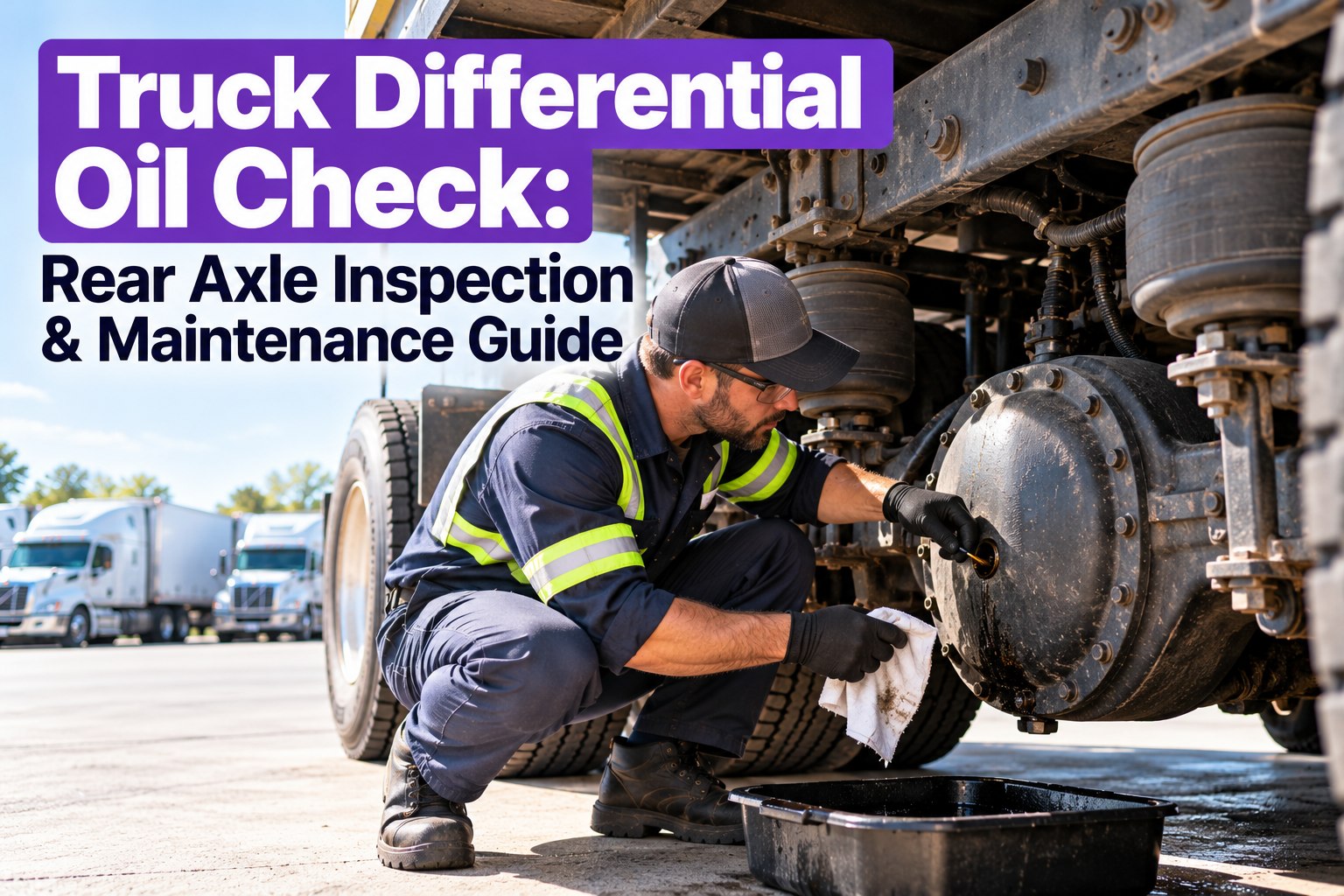
Truck Differential Oil Check: Rear Axle Inspection & Maintenance Guide
By the time a drive axle is whining, low or degraded lube has usually already damaged the gears and bearings. The fix is boring and cheap: check the level, read the oil, watch for leaks, and change it on an interval that matches the work. Truck Inspection & Maintenance Management Software (TIM) keeps that on rails — the axle check on every PM, a leak or metal finding turned into a work order, and the drain scheduled by mileage and duty so it's never "we'll get to it."
How to Check Differential Oil Level
The check is simple, but the details decide whether the reading means anything. Work it in order, with the truck cool and level.
1
Park level, let it coolA tilted or hot axle reads wrong — hot oil climbs the housing and hides a low level.
→
2
Clean the fill plugWipe the area around the fill plug so no dirt or grit falls into the housing when it's open.
→
3
Remove the fill plugThe fill plug is on the side of the carrier or cover — not the drain plug at the bottom.
→
4
Read the levelOil should sit right at the bottom of the fill hole. If you have to reach in, it's low.
→
5
Inspect the oilLook at what's on the plug and your finger — colour, smell, and any metal or grit.
→
6
Top up & resealAdd the grade on the housing tag until it reaches the hole, reinstall the plug, and note it.
◎The fill hole is the gauge — nothing else
A differential has no dipstick. The correct level is oil just reaching the bottom of the fill-plug hole with the truck level — not "some on the drain plug," not a measured quantity poured in blind. If the oil runs out when you crack the plug, it may be overfilled; if you can't touch it just inside the hole, it's low and something used or lost it.
Read the Oil: What It's Telling You
The lube that comes out on the fill plug or drain magnet is a free diagnostic. Learn to read it and you'll catch a failing axle long before it's audible.
Clear amberHealthy lube. Translucent, honey-coloured, no grit — exactly what you want to see.
Milky or foamyWater contamination, often through a failed seal or breather. It cancels any extended-drain claim — change it and find the entry point.
Metallic glitterGear or bearing wear. Copper points to a thrust washer or bearing cage, chromium to a roller race, aluminum to carrier contact.
Dark & burntOverheating — from overloading, low level, or a dragging component. Burnt-smelling lube has lost its film strength.
Gritty / sandyDirt or silicon ingress through a failed seal or a clogged breather — abrasive, and it accelerates everything else.
Heavy metal on the magnetic drain plug is a diagnosis, not a service — a light fuzz is normal, but chips and flakes mean the axle comes apart before it comes back. Contact our team to log oil-condition findings against each axle.
Where Rear Axles Leak
Most "low oil" findings trace to one of a few places. Knowing the usual suspects turns a puddle into a specific repair.
Pinion sealWhere the driveshaft enters the carrier — a classic leak that drips just ahead of the diff.
Axle shaft / wheel sealsLube showing at the hub ends; left alone, it contaminates brakes and starves the bearings.
Diff cover gasketSeepage along the cover seam from an aged gasket, loose bolts, or sealant that's let go.
Fill & drain plugsWeeping plugs from tired sealing washers or over-torqued, damaged threads.
Clogged breather blowbyA blocked vent builds case pressure that forces lube past a good seal — check the breather before you blame the seal again.
Rear Axle Inspection Checklist
Run this at every PM, and any time a driver reports noise or a drip. Tap each box you clear; anything you can't clear is a defect — log it, and if it's metal on the magnet or a low level with a leak, the axle gets diagnosed before it's dispatched.
A Howl Is the Axle's Last Warning, Not Its First
The whine everyone waits for means the damage is done. The level check, the oil read, and the leak walk are what catch it while it's still a top-up. TIM puts the axle check on every PM, turns a metal finding or a weeping seal into a tracked work order, and schedules the drain by mileage and duty — so the rear end is maintained, not mourned.
What Changes Your Drain Interval
There's no single number — the interval depends on the lube, the load, and the roads. Start from the OEM figure on the housing tag and adjust for the duty.
Synthetic vs conventionalConventional gear lube runs roughly 100,000 miles; a quality synthetic stretches linehaul drains to about 250,000–500,000 miles or 3–5 years.
Vocational & off-road dutyStop-and-go delivery drops a synthetic drain to around 120,000 miles; off-road and construction, with heat, dust, and shock loads, to about 100,000 miles or 2 years.
Heat, grades & loadHeavy haul, steep mountain grades, and high gross weight raise axle temperature and shorten the interval — heat is what ages gear oil.
Contamination & mixingWater or dirt ingress, and mixing different gear oils, cut lube life and generally void any extended-drain rating — change it and fix the cause.
OverfillingMore isn't safer — overfill raises operating temperature and forces lube out past the seals. The fill hole is the limit.
The housing tag rulesDana, Meritor, and Mack each publish approvals and viscosities; the tag on the axle overrides any generic chart, and an approved synthetic can extend the drive-axle warranty.
How TIM Keeps the Rear End Alive
A differential check scribbled on a paper PM sheet is forgotten the moment the sheet is filed. On one record per axle, every check and change becomes a history that drives the next service.
Axle check on every PMThe level, oil-condition, and leak checks built into the PM so the differential is never the step that got skipped.
Drain scheduled by dutyThe change interval set by mileage and duty cycle per axle, with a reminder before it's due — not after it's late.
Findings become work ordersMetal on the magnet or a weeping seal turns into an assigned, tracked repair with the oil-condition note attached.
Oil-condition historyEach check's colour, metal, and level logged per axle, so a slow decline shows as a trend instead of a surprise.
Right lube on recordThe housing-tag spec and approved lube kept on the unit, so the wrong oil never goes in and warranties stay intact.
Tied to the whole truckThe axle sits on the same record as inspections, DVIR defects, and the rest of the driveline — one history, not scattered notes.
Frequently Asked Questions
How often should I change truck differential oil?
It depends on the lube and the duty. Conventional gear oil runs roughly 100,000 miles; a quality synthetic stretches a linehaul drive axle to about 250,000–500,000 miles or 3–5 years. Vocational and delivery work pulls that back to around 120,000 miles, and off-road or construction duty to about 100,000 miles or 2 years. Always start from the interval on the axle housing tag — it reflects the specific axle and overrides any generic chart.
Start free and schedule each axle's drain in TIM.
What type of oil does a truck differential use?
Most Class 8 drive axles call for an API GL-5 (and often MT-1) gear lubricant. Drive axles commonly run a 75W-140 synthetic, steer and front drive axles often a 75W-90, and some Volvo and Mack axles specify a 75W-110. The viscosity and approval on the axle housing tag are the final word — Dana, Meritor, and Mack each publish their own specs, and using an approved synthetic can extend the drive-axle warranty. Don't mix gear oils; it shortens lube life and usually voids extended drains.
How do I know if my differential is low or failing?
The clearest signs are a howl or whine that changes with road speed, lube showing at the wheel seals or pinion, and metal on the magnetic drain plug. A low level almost always means a leak, and low lube leads straight to bearing failure — so a low reading is a reason to find the leak, not just top up. Milky or gritty oil points to water or dirt getting in. Catch any of these at a PM and it's a repair; ignore them and it's a carrier rebuild.
Contact us about tracking axle warning signs fleet-wide.
Why is my axle still leaking after I replaced the seal?
Check the axle breather, or vent, before you replace the seal a second time. If the vent is clogged, pressure builds inside the housing as the axle heats up, and that pressure pushes lube out past even a brand-new seal. A leak that returns right after a seal job is the classic symptom of a blocked breather — clear or replace the vent and the "seal leak" often disappears. Overfilling causes the same thing, so confirm the level is at the fill hole, not above it.
Is it bad to overfill differential oil?
Yes. Overfilling doesn't add protection — it raises operating temperature by churning the extra lube, and the higher pressure forces oil out past the seals. The correct level is simply oil reaching the bottom of the fill-plug hole with the truck level, and no more. If someone poured in a measured quantity without checking the hole, verify it at the plug.
Contact our team to standardize the axle check across your shop.
Level · Oil Condition · Leaks · Interval
Check It in Five Minutes, or Rebuild It in Five Days
A differential asks for almost nothing — a level check, a look at the oil, a walk for leaks, and a drain on the right interval. Skip those and the first bill you see is a carrier rebuild and a truck off the road. Keep the rear axle on a schedule, read the oil every time, and let TIM turn the findings into tracked repairs. It's free to start on your first three trucks.
No credit card required · Free for up to 3 trucks · Axle checks, oil-condition history, and duty-based drain scheduling built in