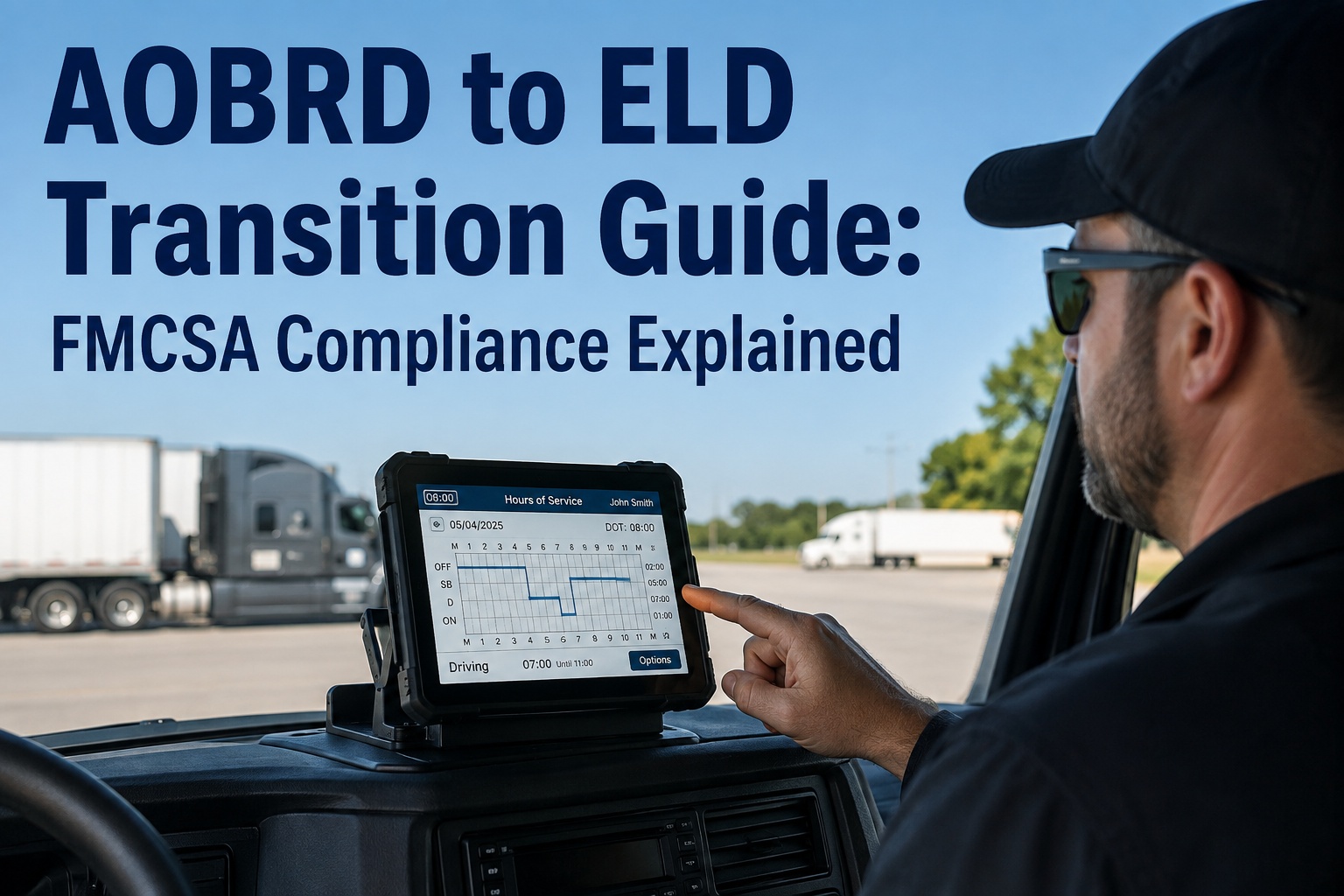
The AOBRD-to-ELD transition officially closed on December 16, 2019 — but the migration story is still very much alive in 2026. Fleets acquiring older operations, carriers pulling grandfathered trucks out of storage, and safety managers inheriting legacy compliance stacks are all discovering the hard way that an AOBRD in service today is not a valid recording device — it's a roadside out-of-service order waiting to happen. FMCSA has made it unambiguous: they are not extending the deadline, they will not grant new exemptions, and enforcement in 2026 has moved into zero-tolerance territory. The two devices look similar from the outside but differ dramatically in what data they capture, how they resist tampering, and what they show a DOT officer at roadside. This guide walks through the AOBRD-to-ELD story — what the rule change actually did, the full side-by-side capability comparison, the 6-step migration playbook for fleets still catching up, the compliance risks of running legacy hardware, and how Truck Inspection & Maintenance ties post-migration ELD data to digital DVIRs and driver files so your compliance stack works as one system.
AOBRD to ELD Transition: FMCSA Compliance Explained
The grandfather clause ended. Here's what fleets still catching up need to know.
The Transition Timeline — How We Got Here
The AOBRD-to-ELD story unfolded across three phases over four years. Understanding this timeline matters because it explains exactly why grandfathered devices no longer exist, why FMCSA won't reopen the door, and why fleets discovering AOBRDs in acquired equipment face immediate compliance failure:
Awareness & Transition Begins
ELD rule takes effect. Carriers already running AOBRDs can continue using them under a grandfather clause. New installations after this date must be FMCSA-registered ELDs — no more new AOBRDs allowed.
Full Enforcement Begins
Roadside enforcement upgraded to placing violating drivers out-of-service. AOBRD grandfathering still valid, but paper-log carriers now facing citations and CSA points on carrier record.
Grandfather Clause Ends
Hard deadline. All AOBRDs must be replaced with FMCSA-registered ELDs. FMCSA Associate Administrator for Enforcement confirmed no extension. Any AOBRD found in a truck after this date is a violation.
Zero-Tolerance Enforcement
AOBRDs are legally identical to no logging device at all. Immediate OOS orders on discovery. In 2026, FMCSA is actively cleaning its registered ELD list too — using a "compliant" device that's since been revoked triggers the same enforcement.
AOBRD vs ELD — The Complete Capability Comparison
The two devices look similar from a driver's seat but differ profoundly in what they record, how they resist tampering, and what a DOT officer sees at roadside. The FMCSA's technical specifications tell the full story — here's the side-by-side that matters for compliance decisions:
What Actually Changed — The 4 Big Data Upgrades
Zoom out from the spec table and four fundamental data capabilities separate an ELD from its AOBRD predecessor. These are the reasons FMCSA moved the industry forward — and the reasons old AOBRD data cannot simply be migrated forward into an ELD system:
GPS Location Data
ELDs capture location every 60 minutes during driving and at every duty-status change. AOBRDs weren't required to record location at all — a fundamental audit gap.
Tamper Resistance
ELD driving time is locked once recorded — edits require driver review and are logged with reason codes. AOBRDs allowed silent edits that weakened evidentiary value.
Standardized Data Transfer
ELDs must support four transfer methods — web, email, USB 2.0, Bluetooth. AOBRDs varied wildly; roadside officers often couldn't retrieve records efficiently.
Self-Diagnostics
ELDs run 6 mandatory diagnostics for power, sync, missing data, timing, positioning, and data transfer. Any malfunction is flagged automatically. AOBRDs had no such requirements.
The 6-Step Migration Playbook
Any fleet still discovering AOBRDs — through acquisition, storage retrieval, or inherited operations — needs a fast, structured migration. Here's the playbook proven fleets used during the 2018–2019 transition, updated for 2026 conditions where speed matters even more:
Audit Your Current Hardware
Inventory every truck. Identify which units have AOBRDs vs ELDs. Check every ELD device against the current FMCSA registered list at eld.fmcsa.dot.gov/List — even legitimate ELDs can be revoked. Document findings with device model, install date, and vehicle VIN.
Select a Compliant ELD Provider
Evaluate providers on FMCSA registration status, feature depth, integration options, driver UX, and support quality. Avoid the cheapest options — provider stability matters when revocations happen. Prefer providers with API access for downstream integration.
Schedule Installation & Test
Coordinate install windows to minimize downtime — typically 1–2 hours per truck. Verify ECM connection, GPS accuracy, data transfer to all four methods (web, email, USB, Bluetooth), and driver login functionality before returning the truck to service.
Train Every Driver & Dispatcher
Drivers must learn: login, duty-status changes, DVIR interaction, malfunction protocol, data transfer at roadside inspection. Dispatchers must learn: unassigned driving resolution, edit workflows with reason codes, HOS violation alerts. Document training completion.
Migrate Historic Records
Preserve final AOBRD RODS for the 6-month retention window under 49 CFR 395.8. Export to PDF or archive format that stays accessible for audits. AOBRD records don't merge into ELD databases — treat them as a separate archival period.
Validate Post-Install Compliance
Run a mock roadside inspection on the first 5 trucks. Time the data transfer. Verify HOS calculations match manual review. Confirm malfunction alerts trigger correctly. Fix any workflow gap before rolling to the full fleet.
Your ELD handles HOS. What handles the rest of compliance?
Post-migration, your ELD enforces driving hours — but DVIRs, defect routing, driver qualification files, training completion logs, and the audit trail that ties everything together still need a digital home. Truck Inspection & Maintenance runs alongside your new ELD with GPS-tagged, timestamped records for every non-HOS compliance requirement. Sign up free for up to 3 vehicles.
Risks of Running Legacy Hardware Today
Any AOBRD found in operation today creates a compounding risk stack. It's not just one violation — it triggers a chain of enforcement consequences that carriers routinely underestimate. Here's what actually happens when a DOT officer discovers an AOBRD at roadside in 2026:
Immediate Out-of-Service Order
Truck removed from service on the spot. Driver held until compliant device is installed. Revenue lost, tow/storage costs, delivery penalties.
CSA Points on Safety Record
Violations logged against carrier's CSA BASIC scores. Elevated intervention thresholds. Increased inspection likelihood for future runs.
Per-Violation Fines
Each occurrence is a separate violation. Fleet-wide AOBRD use compounds fast — dozens of trucks means dozens of fines during a single audit cycle.
Compliance Review Trigger
Pattern of ELD non-compliance triggers a full FMCSA compliance review. Sustained findings can lead to unsatisfactory rating and possible authority revocation.
Premium & Coverage Impact
Elevated CSA scores translate directly to higher premiums. Some insurers may decline renewal for carriers with sustained ELD non-compliance patterns.
Post-Crash Discovery Risk
If a crash occurs while running an AOBRD, plaintiff attorneys use it as evidence of systemic safety failure. Punitive-damage exposure increases significantly.
The Post-Migration Compliance Checklist
Migration doesn't end at install. This is the ongoing checklist every fleet needs baked into monthly operations — because ELD compliance is a continuous state, not a one-time achievement:
Frequently Asked Questions
Can I still legally use an AOBRD in 2026?
No. The AOBRD grandfather clause ended on December 16, 2019, and FMCSA has been explicit that no extension will be granted. Any AOBRD found in service today is treated as equivalent to no logging device at all — triggering immediate out-of-service orders at roadside inspections. If you acquire a truck with an AOBRD, replace it before operating the vehicle.
What are the main differences between AOBRDs and ELDs?
ELDs capture more data (GPS location, engine parameters, unassigned driving time), resist tampering (locked driving time, edit logs with reason codes), require FMCSA registration, must support four standardized data-transfer methods, and run six mandatory self-diagnostics. AOBRDs were self-certified, allowed silent edits, weren't required to record location, and had no standardized transfer requirements.
What happens to my AOBRD records after migrating?
Preserve them as archival records for the full 6-month retention window under 49 CFR 395.8 (and longer for supporting documents that fall into that period). Export to PDF or another accessible archival format. AOBRD records don't merge into ELD databases — treat them as a separate historical period, retrievable independently for audits or litigation.
How long does an AOBRD-to-ELD migration take?
Small fleets (under 25 vehicles): 2–4 weeks including vendor selection, install, and training. Mid-size fleets (25–150): 4–8 weeks with staggered installs to preserve operations. Larger fleets: plan for 8–12 weeks with phased regional rollouts. Physical install is typically 1–2 hours per truck; the real time sink is driver and dispatcher training. Talk to our team about pairing ELD deployment with digital DVIR rollout.
Are there exemptions to the ELD mandate?
Yes — four categories: vehicles with engines manufactured before model year 2000, short-haul drivers within a 150 air-mile radius returning within 14 hours, driveaway-towaway operations, and drivers keeping RODS no more than 8 days in any 30-day period. Even these operations must still comply with HOS rules — the exemption is from ELD hardware, not from the underlying regulations.
How does Truck Inspection & Maintenance fit with my new ELD?
Truck Inspection & Maintenance is the compliance layer that lives alongside your ELD. Your ELD handles HOS; TIM handles digital DVIRs, defect-to-work-order routing, driver qualification files, training completion logs, and audit-ready record retention — all GPS-tagged and timestamped. Post-migration is the perfect moment to consolidate: one login, one audit trail, one system. Sign up free for up to 3 vehicles.
ELD covers HOS. Truck Inspection & Maintenance covers everything else.
Post-migration, your ELD enforces driving hours — but DVIRs, defect routing, driver qualification files, and the full audit trail still need a digital home that's actually built to survive an FMCSA compliance review. Truck Inspection & Maintenance runs alongside any FMCSA-registered ELD, free for up to 3 vehicles with no hardware and no contracts. Set it up in 10 minutes and stop stitching compliance together from spreadsheets and paper.