DVIR apps for delivery vans and box trucks operate in a distinct space within commercial fleet software — one shaped by last-mile delivery economics that differ fundamentally from over-the-road trucking. Delivery drivers face 100-150 stops per shift, work under tight route schedules with customer satisfaction metrics measured in minutes, operate mostly Class 2-4 vehicles (10,001-26,000 lbs GVWR) that may or may not require CDL depending on weight and interstate status, and turn over at 30-50% annually in many segments — significantly higher than long-haul carriers. This combination produces specific software requirements: inspection workflows must complete in under 5 minutes (drivers cannot afford 20-30 minute paper pre-trips), interfaces must be intuitive enough for high-turnover non-CDL workforce, defect reporting must integrate with the shop workflow that keeps high-utilization vehicles on the road, and the entire system must scale to support major operators including Amazon Delivery Service Partners (DSPs), FedEx Ground contractors, USPS contract carriers, regional carriers like OnTrac, LSO, and Lasership, and the growing fleet of grocery and food delivery operations.
The 2026 regulatory environment has shifted what was once optional for delivery operations into a compliance baseline. The eDVIR Final Rule (effective March 23, 2026) explicitly authorizes electronic DVIRs under §396.11 — applying to any commercial motor vehicle operating in interstate commerce above 10,001 lbs GVWR. Delivery vans and box trucks above this threshold engaged in interstate commerce fall fully under FMCSA regulations including DVIR, DQF (Part 391 for CDL operations), maintenance records (§396.3), and annual inspections (§396.17). Intrastate operations are governed by state DOT regulations that increasingly mirror federal requirements. Beyond regulatory compliance, major operators including Amazon DSP requirements, FedEx Ground contractor standards, and USPS contract requirements specify DVIR compliance as contract conditions — making the platform decision operationally and economically consequential. Carriers without proper DVIR workflow lose contracts they would otherwise win, face insurance pricing pressure from CSA score damage, and accumulate audit exposure that surfaces during compliance reviews.
This guide is the complete DVIR app buyer's framework for delivery vans and box trucks in 2026: the 8 must-have features tailored to last-mile delivery, the 4-tier pricing landscape, the 3 most common selection mistakes, and the e-commerce delivery ROI framework. Start your free trial of our truck inspection and maintenance software to evaluate the platform against your specific delivery operation — live in 10 minutes, free for up to 3 trucks.
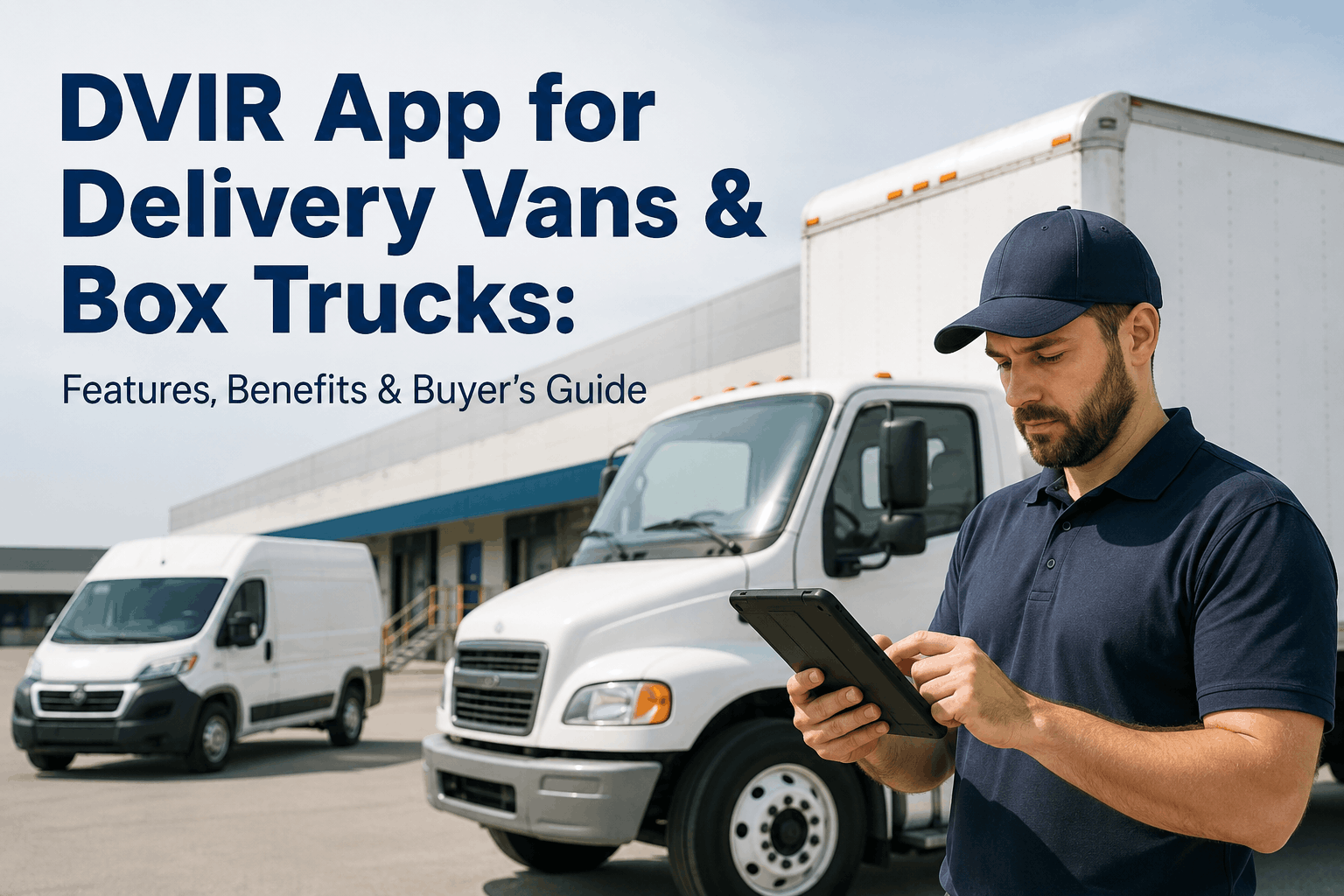
DVIR App for Delivery Vans & Box Trucks: Features, Benefits & Buyer's Guide
Why Delivery Van / Box Truck DVIR Is Different
Last-mile delivery operations face conditions that over-the-road trucking never produces. Understanding these differences explains why generic DVIR apps fail when applied to high-velocity delivery fleets.
Time-Pressured Inspection Window
Non-CDL Workforce Reality
High Turnover Workforce
Major Contractor Requirements
Cargo Security Inspection
High-Velocity Vehicle Cycling
The 8 Must-Have DVIR App Features
These 8 features distinguish delivery-focused DVIR apps from generic fleet platforms. Missing any one creates operational friction or compliance exposure. Contact our sales team to evaluate platform fit against these requirements.
01 Sub-5-Minute Inspection Workflow
02 Mobile-First Design
03 Photo Defect Capture
04 §396.13 Chain of Custody
05 High-Adoption UX Design
06 Cargo Security Workflow
07 Major Contractor Integration
08 Compliance-Ready Records
The 4 Pricing Tiers — From Entry to Enterprise
DVIR app pricing for delivery operations aligns with feature depth and integration scope. Match the tier to fleet size and operational complexity rather than overpaying or underpaying.
| Tier | Price /Vehicle /Mo | Best For | Key Capabilities |
|---|---|---|---|
| Entry | $10-20 | 1-10 vehicles | Basic mobile DVIR, photo defects, simple PM, compliance records |
| Standard | $20-35 | 10-50 vehicles | All entry + PM scheduling, analytics, fault tracking, multi-route support |
| Pro | $35-55 | 50-200 vehicles | All standard + telematics integration, contractor portal integration, advanced analytics |
| Enterprise | $55-90+ | 200+ vehicles | API access, custom integrations, white-label, dedicated support, advanced compliance |
| Free Tier | $0 (≤3 trucks) | Small operators | Basic features for small operations; useful for trial/validation |
Delivery DVIR app pricing runs lower than over-the-road compliance platforms because delivery vehicles operate under fewer regulatory categories (no HOS/ELD for many operations, no DQF for non-CDL vehicles, simpler maintenance requirements). The pricing reflects scope — entry tier sufficient for most small operators, standard tier covers most mid-size delivery fleets, pro tier serves major contractors with portal integration requirements. The mistake to avoid: trying to use over-the-road compliance platforms ($25-65/truck/month equivalent tier) when simpler delivery-focused apps cost less and fit better. Match scope to operation.
The 3 Most Common Selection Mistakes
Three patterns produce predictable downstream problems when delivery fleets select DVIR apps. Watch for these when evaluating platforms.
Choosing Over-the-Road Platforms
No Major Contractor Integration
Underestimating Driver UX Importance
The Delivery Operations ROI Framework
DVIR app ROI in delivery operations comes from five mechanisms that compound across the fleet. The cumulative effect typically returns 4-8× annual platform cost within the first year.
Avoided Compliance Penalties
Contract Retention with Major Operators
Reduced Breakdown Costs
Insurance Premium Reduction
Faster Driver Onboarding
Frequently Asked Questions
Do delivery vans need DVIRs if they don't require CDL?
It depends on weight, interstate operation, and other factors. Federal FMCSA regulations under §396.11 require DVIRs for commercial motor vehicles operating in interstate commerce above 10,001 lbs gross vehicle weight rating. Many delivery vans fall below this threshold (cargo vans like Mercedes Sprinter 2500, Ford Transit 250, Ram ProMaster 2500 are typically 9,000-10,000 lbs GVWR), making them exempt from federal DVIR requirements. Box trucks above 10,001 lbs GVWR fall fully under federal DVIR regulations including the eDVIR Final Rule (March 23, 2026). However, several factors push DVIR adoption beyond regulatory minimum: state DOT regulations often require DVIR at lower weight thresholds (some states 8,500 or 10,000 lbs); major contractors including Amazon DSPs, FedEx Ground, and USPS specify DVIR compliance as contract conditions regardless of regulatory requirement; insurance carriers reduce premiums for fleets with documented inspection programs; and operational benefits (breakdown prevention, maintenance discipline) justify DVIR adoption even when not legally required. Most successful delivery operations implement DVIR on all vehicles regardless of regulatory threshold. Start your free trial for delivery-focused DVIR workflow.
How fast should a DVIR app inspection be?
Sub-5-minute inspection is the practical target for delivery operations. The math: drivers running 100-150 stops per shift cannot afford 20-30 minute paper-equivalent inspections that destroy route schedules. Apps requiring extended inspection times produce predictable failure modes — drivers rush through workflow, skip steps, or simply don't complete inspections, defeating the purpose of structured DVIR. Sub-5-minute workflow is achievable through several design choices: guided walkaround with smart defaults (most components pass most days, defaults to pass with one-tap exception flagging); tap-to-pass UI eliminating typing for normal items; photo capture only for defects rather than every component; voice notes for descriptions instead of typing; offline operation eliminating connectivity delays; and progressive completion saving driver progress automatically. Apps that achieve sub-5-minute workflow consistently see 94% driver adoption rates; apps requiring 10+ minutes see adoption rates drop to 40-60% with predictable compliance gaps. Validate inspection speed during free trial with real drivers before committing fleet-wide. Contact our sales team for delivery-specific workflow.
What's special about Amazon DSP DVIR requirements?
Amazon Delivery Service Partners operate under specific safety and compliance program requirements that go beyond standard FMCSA regulations. The Amazon DSP program includes vehicle safety standards exceeding regulatory minimums, driver behavior monitoring through telematics, structured PM intervals shorter than typical OEM recommendations, performance scoring across multiple safety dimensions, and audit-ready documentation for Amazon review periodically. DVIR app requirements typically include: integration with Amazon DSP portal or compatible data export format; safety metric tracking aligned with Amazon scoring categories; vehicle assignment and driver assignment tracking; defect-to-repair workflow with documented response times; comprehensive cargo security inspection (DSPs handle high-value packages). Apps designed for Amazon DSP operations have these capabilities built in; generic DVIR platforms require manual workarounds that create gaps in DSP performance metrics. The cost of non-compliance: DSPs failing performance metrics lose route allocation, may face contract termination, and lose access to one of the largest delivery contracts available. Single DSP contract loss commonly costs $1M-$5M+ annually. Match platform capability to Amazon's actual requirements rather than assuming generic DVIR is sufficient.
How much should DVIR app cost for delivery operations?
Delivery DVIR app pricing runs lower than over-the-road compliance platforms because delivery operations involve fewer regulatory categories. Entry tier ($10-20/vehicle/month) covers basic mobile DVIR, photo defects, simple PM, and compliance records — appropriate for small operators (1-10 vehicles). Standard tier ($20-35/vehicle/month) adds PM scheduling, analytics, fault tracking, and multi-route support — the practical baseline for serious delivery operations (10-50 vehicles). Pro tier ($35-55/vehicle/month) adds telematics integration, major contractor portal integration (Amazon DSP, FedEx Ground, USPS), and advanced analytics — appropriate for mid-size operations (50-200 vehicles). Enterprise tier ($55-90+/vehicle/month) provides API access, custom integrations, white-label capability, and dedicated support — for large operations (200+ vehicles). Most platforms offer free tiers for 1-3 vehicles to validate before scaling. The pricing premium for major contractor integration ($10-25/vehicle/month above standard) is justified by contract retention value — single retained Amazon DSP, FedEx Ground, or USPS contract typically pays for years of platform across the entire fleet.
How do delivery fleets handle high driver turnover with DVIR apps?
High driver turnover (30-50% annually in many segments) makes DVIR app UX critical — apps requiring meaningful training time fail because trained drivers leave before competence pays back. Strategies that work: choose platforms with strong driver UX validated with actual delivery drivers (not just demo accounts); provide concise training materials in driver's primary language; embed help links in the app rather than requiring separate documentation; design for non-expert users with visual icons and tap-to-pass workflow; allow new drivers to be fully productive within 15-30 minutes of first use; and capture driver feedback to identify confusing UX areas. Platforms that achieve sub-15-minute competence for new drivers maintain compliance value even with high turnover; platforms requiring 60-90 minutes of training see compliance gaps accumulate as turnover continues. The economics: 50 driver fleet with 40% annual turnover means 20 new drivers per year. At 60-minute training per driver, that's 20 hours of training time annually; at 15-minute training, it's 5 hours. Saved 15 hours × $25-30/hour equals $375-$450 saved per year per fleet through better UX — small per-event but compounds with platform cost considerations. Sign up free to validate driver UX with your actual workforce.
How quickly can a DVIR app be deployed across a delivery fleet?
Modern cloud-based DVIR apps for delivery operations deploy in 10 minutes to 2 weeks depending on integration scope. Quick deployment (under 1 day): platform setup, driver mobile app installation, basic inspection templates, simple PM scheduling. Most delivery operations start here. Standard deployment (1-2 weeks): customized inspection templates for specific vehicle types (cargo vans vs box trucks), photo defect workflow configuration, major contractor portal integration (Amazon DSP, FedEx Ground, USPS), driver training rollout. Full deployment (2-4 weeks): telematics integration with existing provider, API integration with TMS or accounting systems, advanced reporting setup, white-label customer portals if applicable. Most fleets can run a real pilot on 3-10 vehicles within 10 minutes of starting a free trial, validating driver UX and operational workflow against actual delivery operations before committing fleet-wide. Driver adoption typically reaches 94% within 30 days of rollout when UX is strong. The fast deployment is meaningful: legacy enterprise platforms commonly require 3-6 months to deploy, during which the business case erodes and major contractor compliance requirements remain unmet. Talk to our sales team for deployment planning.