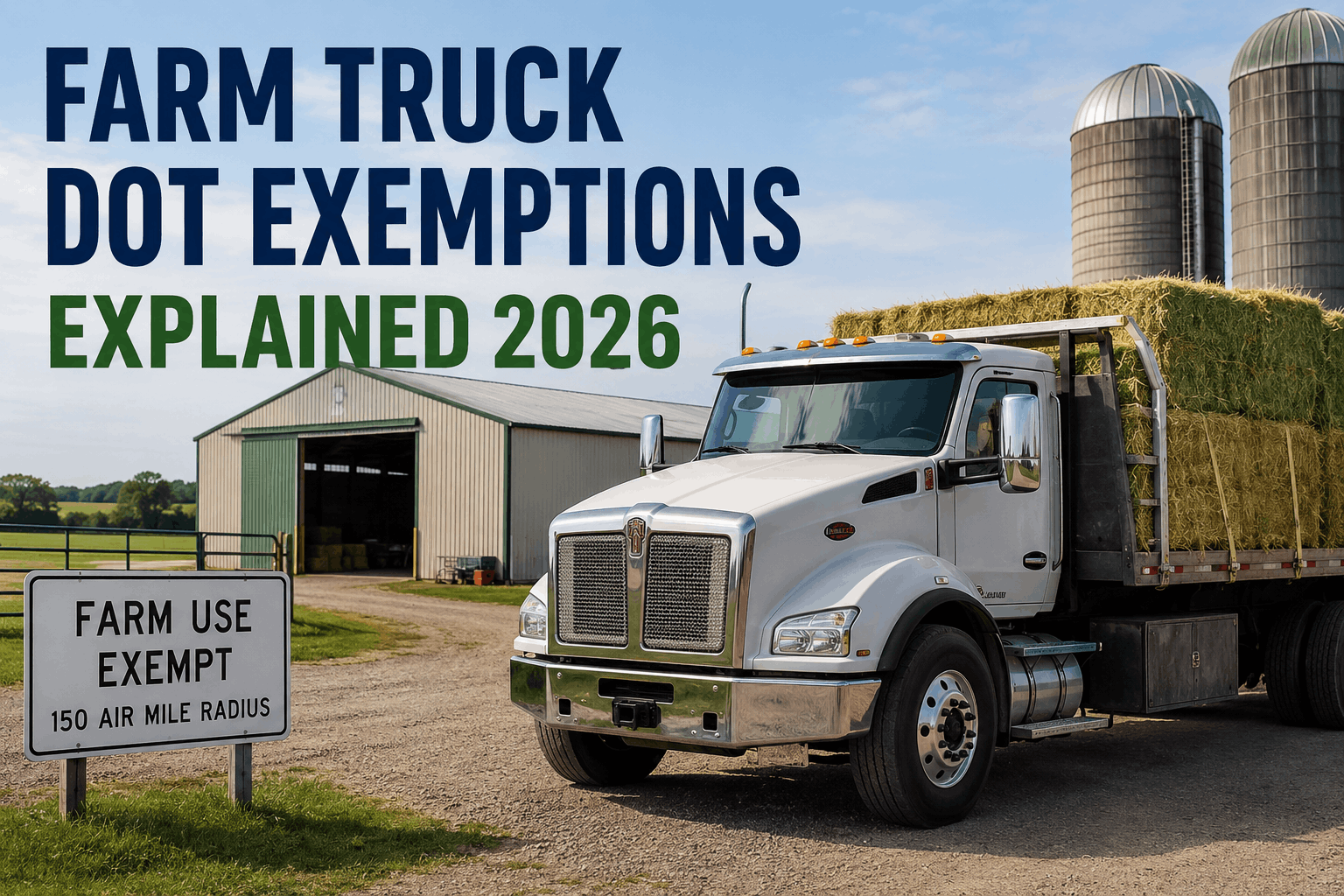
Farm truck DOT exemptions exist in a regulatory gray zone that catches many agricultural operators off guard — exemptions are real and substantial, but their boundaries are precise and the penalties for misunderstanding them are severe. The core framework is straightforward in principle: agricultural operations face genuine workflow realities (planting and harvest windows, livestock welfare time pressures, perishable commodity timing) that don't align with standard FMCSA rules designed for over-the-road trucking. Congress and FMCSA responded with three distinct exemption categories that allow farm operations meaningful flexibility while protecting public safety. But the details matter: a covered farm vehicle (CFV) exemption under 49 CFR §390.39 has different requirements than the 150 air-mile agricultural exemption under §395.1(k), which has different requirements than ELD-specific exemptions for ag commodity drivers. Confusing them — or claiming exemptions that don't actually apply — produces violations that can include $19,277-$23,048 OOS operation penalties, $7,000+ driver qualification file violations, and CSA score damage that affects insurance pricing and contract eligibility for years.
The 2026 enforcement environment intensifies this complexity. The CSA scoring overhaul weights out-of-service violations at 2× severity and uses a 24-month violation window, meaning misapplied exemptions compound across years rather than falling off quickly. The eDVIR Final Rule (effective March 23, 2026) authorizes electronic DVIRs for non-exempt operations — meaning many farm operations that historically operated on paper now need digital workflow for any portion of operations falling outside exemption coverage. Paper medical certificates were eliminated January 10, 2026 with all CDL driver medical examiner records flowing through electronic FMCSA systems — affecting CFV operations using CDL drivers and creating documentation requirements that didn't exist before. State-level variations add another layer: planting and harvesting periods are state-defined under §395.1(k), CDL waivers for farm operations vary by state, and intrastate-only operations face state DOT regulations that may differ from federal requirements. This guide walks through what's exempt, what isn't, and how to know the difference.
This guide is the complete farm truck DOT exemptions framework for 2026: the 4 major exemption categories, Covered Farm Vehicle qualification requirements, when DOT compliance still applies despite exemptions, the 2026 regulatory updates, and the digital workflow that handles compliance for any non-exempt portion of operations. Start your free trial of our truck inspection and maintenance software to deploy compliance workflow for non-exempt farm operations — live in 10 minutes, free for up to 3 trucks.
Farm Truck DOT Exemptions Explained 2026
The 4 Major Farm Truck DOT Exemptions
Four exemption categories cover the bulk of legitimate farm truck DOT relief. Each has specific qualification requirements that must be understood and met precisely. Contact our sales team for help evaluating which exemptions apply to your operation.
Covered Farm Vehicle (CFV)
§390.39 · BROADEST EXEMPTION150 Air-Mile Agricultural HOS Exemption
§395.1(k) · HOS ONLYELD-Specific Agricultural Exemptions
§395.8 · ELD ONLYState-Level Farm CDL Exemptions
STATE-SPECIFIC · CDL ONLYCovered Farm Vehicle (CFV) Qualification Requirements
The CFV exemption is the broadest farm truck relief available — but qualification requirements are precise. Misunderstanding any one of these requirements voids the exemption and produces full FMCSA compliance obligations.
| Requirement | Light/Medium CFV (≤26,001 lbs) | Heavy CFV (>26,001 lbs) |
|---|---|---|
| Geographic scope | Anywhere in United States | State of registration + 150 air-miles from farm |
| Driver requirements | Farm owner, family member, or employee | Same — owner, family, or employee |
| Transport purpose | Agricultural commodities, supplies, livestock, or machinery | Same agricultural transport purpose |
| For-hire allowed? | NO — not eligible for CFV exemption | NO — not eligible for CFV exemption |
| CFV designation required | YES — must display designation | YES — must display designation |
| Hazardous materials | Limited — specific HM exemptions apply | Same HM restrictions apply |
| Exempt from Part 382 (drug/alcohol) | YES | YES |
| Exempt from Part 383 (CDL) | YES | YES |
| Exempt from Part 391 subpart E (medical) | YES | YES |
| Exempt from Part 395 (HOS) | YES | YES |
| Exempt from Part 396 (DVIR/inspection) | YES | YES |
The fundamental CFV principle: it's the broadest exemption available but requires every qualification element to be met. Driver qualification (must be farm-related), transport purpose (must be agricultural), for-hire status (must NOT be for hire), and CFV designation (must be displayed) are all separate requirements that must be individually satisfied. Operations that meet four of five requirements don't get a partial exemption — they don't qualify at all. The CFV designation requirement is commonly missed: many otherwise-qualifying operations operate without proper CFV identification on the vehicle and discover the gap during roadside inspections.
When Farm Truck DOT Compliance Still Applies
Many farm operations partially qualify for exemptions but still have DOT compliance obligations for specific situations. Understanding these scenarios prevents the "I thought I was exempt" violations that produce most enforcement actions against ag operations.
For-Hire Operations
Heavy CFV Beyond 150 Air Miles
Hazardous Materials Transport
Outside Planting/Harvest Periods
Beyond 8 Days of Long-Distance Operation
Missing CFV Designation
2026 Updates & Clarifications
Several 2026 regulatory developments affect farm truck operations. Stay current on these changes to maintain exemption status and compliance for non-exempt portions of operations.
eDVIR Final Rule (March 23, 2026)
Paper Medical Certificates Eliminated
CSA Scoring Overhaul
FMCSA Continues CFV Clarifications
Enforcement Intensity Increasing
Frequently Asked Questions
What's the difference between CFV and the 150 air-mile agricultural exemption?
These are two distinct exemption frameworks with different scope and requirements. The Covered Farm Vehicle (CFV) exemption under 49 CFR §390.39 is broader — it provides exemption from multiple regulatory parts: 382 (drug/alcohol testing), 383 (CDL), 391 subpart E (medical certificates), 395 (HOS), and 396 (DVIR/inspection). CFV applies to vehicles operated by farm owners, family members, or employees transporting agricultural commodities, supplies, livestock, or machinery in support of the farmer's own agricultural operation — not for hire. Light/medium CFVs (≤26,001 lbs) operate anywhere in US; heavy CFVs (>26,001 lbs) limited to state of registration plus 150 air-miles. The 150 air-mile agricultural exemption under 49 CFR §395.1(k) is narrower — it applies only to HOS rules and only during state-defined planting and harvesting periods. It covers transport of agricultural commodities and farm supplies within 150 air-mile radius from commodity source, regardless of who owns the vehicle. A custom hire operation could qualify for the 150 air-mile HOS exemption (during planting/harvest) but not CFV (because it's for hire). A farmer's own pickup could qualify for CFV anywhere in US (if light/medium weight) and the 150 air-mile HOS exemption (during planting/harvest). The two can overlap but address different regulatory issues. Start your free trial for compliance workflow.
Do I need to display "Covered Farm Vehicle" on my truck?
Yes — CFV designation must be displayed on the vehicle for the exemption to apply at roadside inspection. The CFV designation requirement is commonly missed by otherwise-qualifying operations. Inspectors at roadside cannot verify CFV status from the vehicle's appearance alone — agricultural use isn't necessarily visually obvious, especially for pickup trucks and combination vehicles that look identical to non-farm operations. The designation typically takes the form of a placard, sticker, or stenciling on the vehicle clearly identifying "Covered Farm Vehicle" status. Specific format requirements vary somewhat by state and inspection agency interpretation. Best practice: contact your state Department of Transportation or motor carrier safety agency for specific format guidance, document the designation with photographs, and ensure all qualifying vehicles in your operation have proper designation. Operations otherwise meeting all CFV qualifications but missing the designation face the same penalties as completely non-exempt operations — $19,277-$23,048 OOS operation penalties, $7,000+ DQF violations if applicable. The cost of proper designation is trivial relative to the penalty exposure.
Can I haul commodities for another farmer under farm exemptions?
Generally no — neighbor hauling and similar for-hire arrangements don't qualify for CFV exemption. The fundamental CFV principle is that the exemption applies to transport in support of the farmer's own agricultural operation, not commercial hauling for compensation. Once compensation is involved — whether direct payment, custom hire arrangements, or contract hauling — the operation falls under standard FMCSA regulations regardless of whether the cargo is agricultural. Several patterns commonly trigger this issue: helping a neighbor with their harvest in exchange for payment; custom hire arrangements where a farm provides transportation services to other operations; contract hauling for commodity buyers or processors; commercial grain hauling operations that are agriculturally-oriented but operate on a for-hire basis. These operations need full FMCSA compliance: DVIR per §396.11, DQF per Part 391, drug/alcohol testing per Part 382, HOS per Part 395 (with applicable §395.1(k) seasonal exemption), and proper CDL with appropriate endorsements. The 150 air-mile agricultural HOS exemption under §395.1(k) does apply to for-hire transport — but only the HOS portion of compliance, and only during planting/harvesting periods. Other compliance requirements apply normally. Contact our sales team for compliance workflow.
Do farm exemptions cover hazardous materials transport?
Mostly no — hazardous materials transport requires full HM compliance regardless of agricultural use. Hazmat transport is governed primarily by 49 CFR Parts 171-180, which apply independently from the farm exemptions in Parts 390-399. Common agricultural HM scenarios needing full compliance: anhydrous ammonia transport in quantities above threshold, fuel hauling (diesel, gasoline, propane) in tank trucks, pesticides and herbicides above HM-classified quantities, fertilizer in HM-classified concentrations. Specific HM exemptions exist for small quantities — for example, "materials of trade" exemption for limited quantities incidental to farming operations — but these are limited in scope. Larger quantities require: CDL with HM endorsement (Class A or B as applicable), HM training, proper placarding, shipping papers, and emergency response information. The CDL requirement holds even when CFV would otherwise exempt CDL — HM transport requires CDL with HM endorsement regardless. Common compliance trap: farms transporting fuel for their own equipment in larger tanks (above material-of-trade thresholds) need HM compliance even though the fuel is for their own use. The economic and safety consequences of HM violations are severe — accidents involving improperly compliant HM transport can result in criminal charges in addition to substantial civil penalties.
What documentation do I need for farm exemption claims?
Documentation requirements vary by exemption category, but several patterns apply. For CFV operations: vehicle designation per state requirements, documentation linking driver to farm operation (employment records for non-family employees, ownership documents for farm owner, family relationship documentation for family members), transport purpose documentation showing agricultural use, and proof of non-for-hire status (no compensation records for the specific transport). For 150 air-mile agricultural HOS exemption: documentation that operation falls within state-defined planting/harvesting period, evidence of cargo type (agricultural commodity or farm supply), GPS or route documentation showing operation within 150 air-mile radius of commodity source, and driver records showing time within radius. For ELD exemptions: vehicle manufacture date documentation (for pre-2000 exemption), or driver records showing operation pattern (for 8-day-in-30-day exemption). For state CDL exemptions: state-specific documentation per state DMV requirements. Practical guidance: maintain documentation continuously rather than reconstructing during inspections; use digital systems that automatically capture GPS, time, and cargo data; train drivers on exemption documentation expectations; conduct internal audits quarterly to verify documentation completeness. The cost of poor documentation is severe — exemptions claimed without supporting documentation are commonly disallowed during enforcement, producing the full penalty for non-exempt operation. Sign up free for exemption documentation workflow.
Should farm operations use compliance software even when largely exempt?
For most modern farm operations of meaningful scale, yes — compliance software earns its cost even when most operations qualify for exemptions. Three reasons: (1) Most farms have at least some non-exempt operations. Custom hire activities, hauling for neighbors at compensation, trips beyond 150-air-mile radius for heavy CFV operations, off-season transport outside planting/harvest periods, and HM transport all fall outside exemption coverage and require full FMCSA compliance documentation. Operations with even occasional non-exempt activity need compliance workflow. (2) Exemption tracking is operationally complex. The 150-air-mile radius requires GPS verification, planting/harvest period boundaries change annually, the 8-day-in-30-day ELD threshold requires rolling-window calculation, and CFV qualification verification requires multiple data points. Manual tracking commonly produces errors that result in misapplied exemptions and violations. (3) The 2026 enforcement environment increases consequences of misunderstanding. CSA scoring overhaul weights OOS violations 2× severity with 24-month window. Insurance carriers increasingly use CSA data in pricing decisions. Major commodity buyers track carrier safety in procurement decisions. Software cost ($15-40/vehicle/month typical for compliance platforms) is trivial compared to single misapplied exemption violation ($19,277-$23,048 OOS penalty plus CSA damage). Most platforms offer free tiers for 1-3 vehicles to validate before scaling. Talk to our sales team for farm-specific compliance workflow.