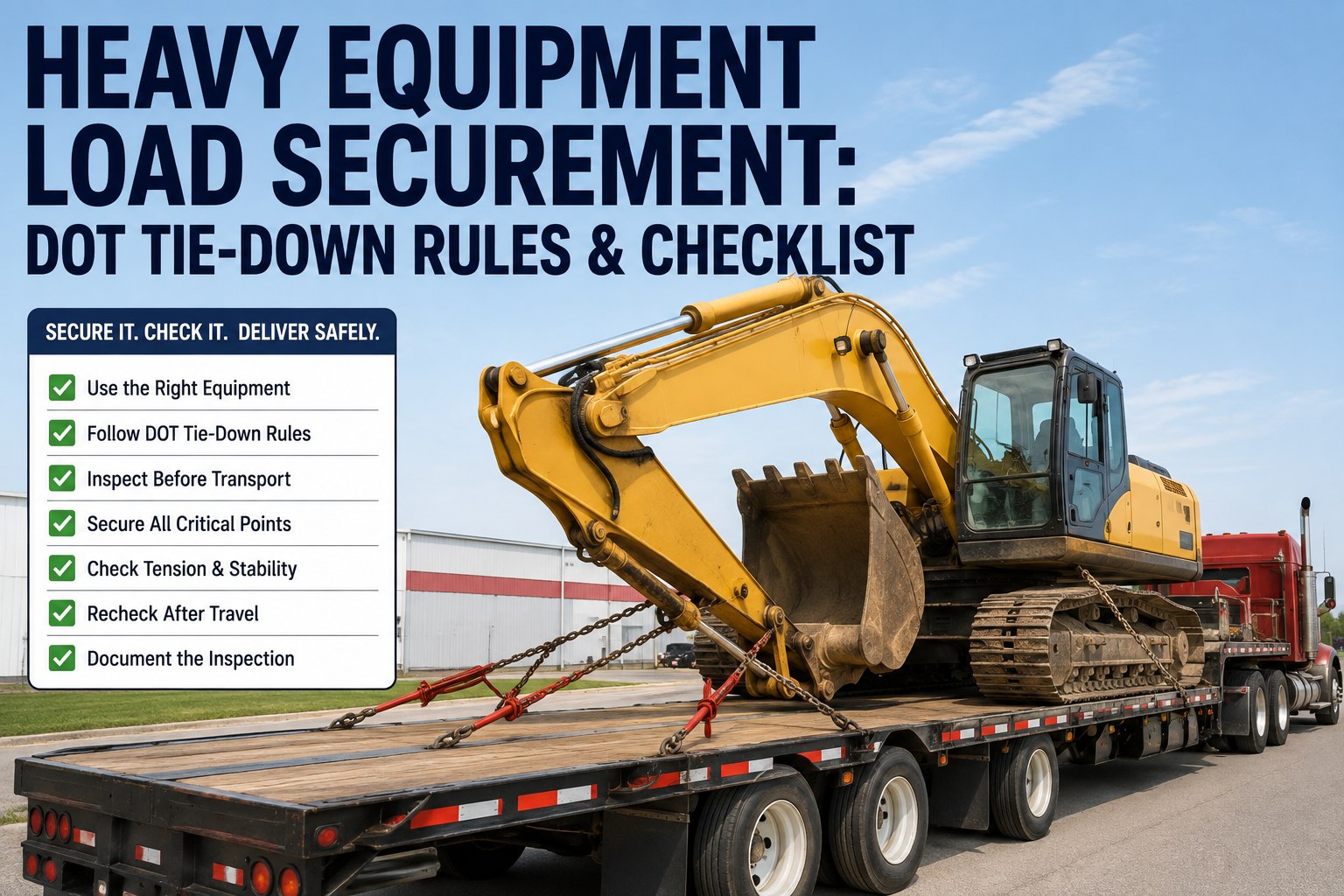
A 45,000-pound excavator on a lowboy is not just a bigger version of a lumber load. Federal Motor Carrier Safety Regulation 49 CFR §393.130 treats heavy equipment as its own category with its own rules — minimum 4 direct tie-downs regardless of what the length-and-weight table would otherwise say, minimum 5,000 lb Working Load Limit per tie-down, articulated joints locked or blocked, and every accessory (bucket, blade, ripper, boom) secured independently from the main machine. Get any of these wrong and the resulting citation isn't just a fine — it's a Level I inspection that grounds the truck and often the driver's CDL. This guide walks through the equipment-specific rules, the direct-vs-indirect WLL math that determines tie-down count, attachment-point selection on excavators / dozers / wheel loaders / articulated haulers, the loading-sequence checklist, and the reasons this commodity generates more roadside violations than any other flatbed segment. Track every load and inspection with our fleet software or reach out to our support team for a walkthrough.
Heavy Equipment Load Securement: DOT Rules & Checklist
Excavators, dozers, loaders, cranes. The commodity-specific rules that override the general flatbed math — and the loading playbook that keeps every haul audit-ready.
Why Heavy Equipment Has Its Own Rules
General flatbed securement (§393.100–.108) applies to lumber, drywall, pipe. Heavy equipment gets an additional layer of rules under §393.130 because the risk profile is different. Understanding why the rules exist makes them memorable.
Massive concentrated weight
A 40,000 lb excavator on 4 tracks concentrates all that mass at 4 contact points. Any tie-down failure and momentum crosses the trailer edge in under a second.
Articulated joints move
Booms, arms, blades, and attachments can rotate under load — even at highway speed. Unlocked joints turn a stable load into a moving one within seconds of departure.
Detachable accessories
Buckets, blades, and rippers are separate items in the eyes of FMCSA. A blade on an unsecured bucket lift is not the same as a bucket bolted to a boom — one is legal, the other isn't.
Direct tie-down math changes
Direct tie-downs count only 50% of their WLL because tension pulls on a single line. Get the math wrong on an "excavator with 4 chains" load and you're 30% short of legal without realizing it.
The §393.130 Rules — Plainly Stated
Every heavy equipment load is governed by these five specific rules. Meet all five and you're compliant. Miss any one and you're not.
Minimum 4 direct tie-downs for equipment over 10,000 lbs
Regardless of what §393.106 would say from the length-and-weight table, heavy equipment above 10,000 lbs GVW requires at least 4 direct tie-downs. Four is the floor — heavier equipment often needs more.
Each tie-down WLL at least 5,000 lbs
3/8" Grade 70 chain (6,600 WLL) and above meet this. Lower-rated chains and 2" straps typically don't. The rule sets a per-tie-down minimum independent of the 50% aggregate WLL rule.
All accessory equipment secured separately
Buckets, blades, booms, rippers, and attachments each require independent securement. A single chain "over the top" catching multiple accessories does not count.
Articulated joints locked or blocked
Boom, arm, and steering joints must be locked at manufacturer-designed lock points or blocked to prevent movement. This includes wheel-loader articulation and excavator boom-arm-bucket kinematics.
Aggregate WLL still equals 50% of gross weight
The general 50% rule from §393.106 still applies. Direct tie-downs count 50% of WLL. The math must satisfy both R1-R2 and this aggregate — whichever demands more tie-downs governs.
Direct vs Indirect: The Math That Governs Every Load
This one distinction accounts for more heavy-equipment violations than any other single rule. Get it right and everything else falls into place.
Worked Example: 45,000 lb Excavator
Here's the full compliance calculation for a common heavy-equipment load. Follow this template and swap in your numbers.
Equipment Attachment Points — By Machine Type
Not every point on a machine is a legitimate tie-down anchor. Manufacturer-designated D-rings, shackles, and tow points are — bumpers, hoses, and axles are not.
The Loading Sequence Checklist
Compliant heavy-equipment loading isn't just about chains at the end. It's a sequenced workflow — miss a step and everything downstream fails.
Digitize the loading checklist
Photo-stamped inspection at every step, tie-down count and WLL math verified per load, audit archive by driver and VIN. No more paper checklists, no more inspection surprises.
The 6 Most-Cited Heavy Equipment Violations
Data from FMCSA roadside inspections identifies the specific failures that generate the most heavy-equipment cargo securement citations. Focus prevention here.
Frequently Asked Questions
FMCSA §393.130 requires a minimum of 4 direct tie-downs for equipment over 10,000 lbs, with each tie-down having a Working Load Limit of at least 5,000 lbs. The aggregate WLL rule still applies — the count often needs to be higher than 4 to meet the 50% requirement, especially with direct tie-downs counting at only half their rated WLL.
A direct tie-down (chain from equipment straight down to trailer) puts all tension on a single line, without distributing force across two attachment points. FMCSA accounts for this reduced restraint by crediting only 50% of the WLL toward aggregate compliance. An indirect tie-down (chain over the top and back to trailer) counts at 100% because tension acts on both anchor points.
Yes. Under §393.130, all accessory equipment must be secured independently from the main machine. A chain over the excavator that also holds down the bucket does not count as securement for the bucket — a separate tie-down is required. Buckets, blades, rippers, and booms each need their own attachment.
Any chain rated at least 5,000 lb WLL satisfies the per-tie-down minimum. In practice, 3/8" Grade 70 chain (6,600 WLL) is the industry standard for heavy equipment. For very heavy machines, 1/2" Grade 70 chain (11,300 WLL) reduces the count needed to meet aggregate requirements.
Yes — whenever a chain or strap passes over any sharp edge that could cut, abrade, or reduce the WLL of the tie-down. Track edges, blade corners, and boom pin housings are common contact points requiring protection. Missing edge protection is a citable violation and can trigger an out-of-service order.
No. Parking brakes are engaged as part of securement, but wheel or track chocks (physical blocks front and rear) are required as blocking devices independent of the brake system. A brake system that leaks or releases in transit without physical blocking is a securement failure.
Turn every heavy-equipment load into audit-ready compliance
Digital §393.130 checklist. Automatic tie-down count and aggregate WLL calculation. Photo evidence at every step. Attachment-point verification per machine type. Compliance archive by VIN, driver, and load. Everything a Level I inspector could ask for — one workflow.